Zhang Hanfei, Li Yuhao, Li Lin
Department of Nuclear Medicine, West China Hospital, Sichuan University, No. 37, Guo Xue Xiang, Chengdu, 610041, China.
BMC Cancer. 2025 Feb 28;25(1):368. doi: 10.1186/s12885-025-13598-y.
Studies have linked gut microbiome and differentiated thyroid cancer (DTC). However, their causal relationships and potential mediating factors have not been well defined. Our study investigated the causal relationships between the gut microbiome, papillary thyroid cancer (PTC) and follicular thyroid cancer (FTC), as well as the mediating effect of potential blood metabolites, using genetic approaches.
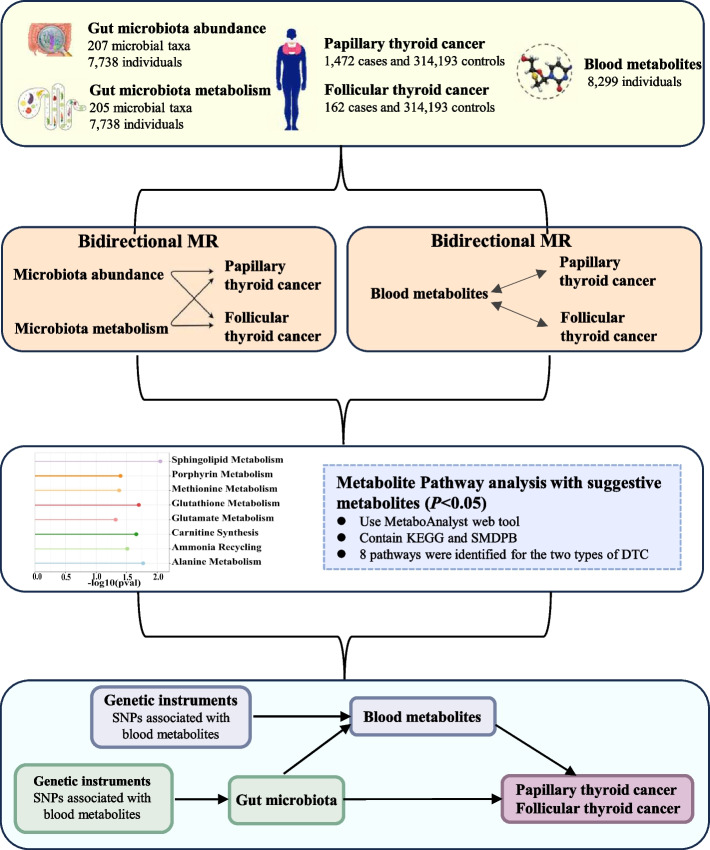
Leveraging the summary statistics of gut microbial taxa, blood metabolites, PTC and FTC from the largest genome-wide association studies (GWAS) to date, we applied the bidirectional and mediation Mendelian randomization (MR) design. The multivariable MR approach based on Bayesian model averaging (MR-BMA) was used to prioritize the most likely causal taxa. Furthermore, metabolic pathway analysis was performed via the web-based Metaconflict 4.0.
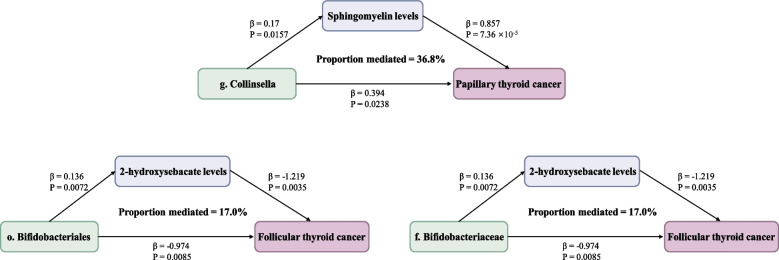
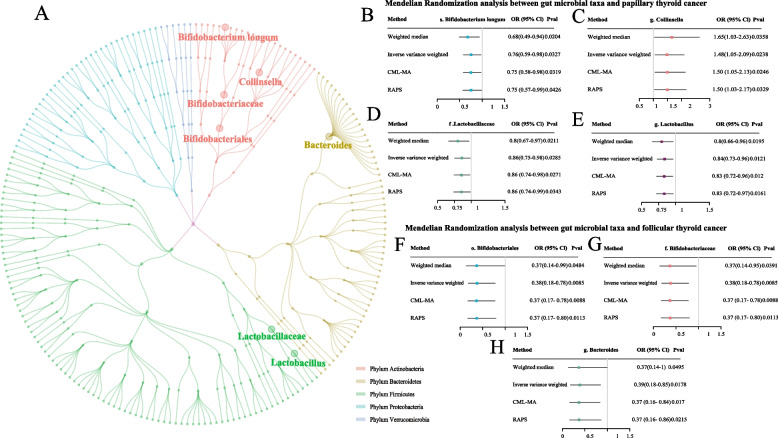
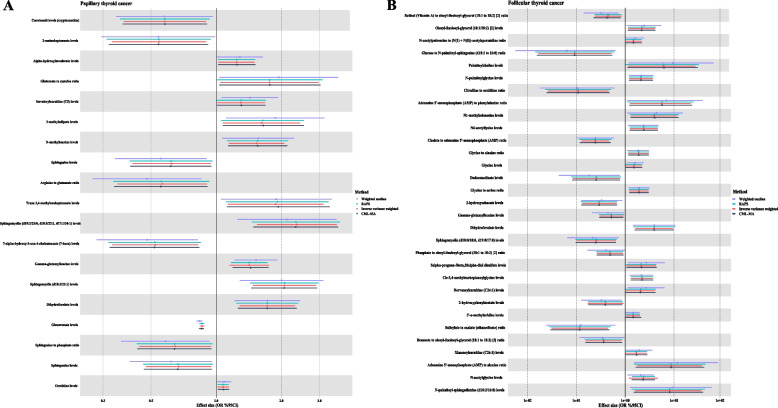
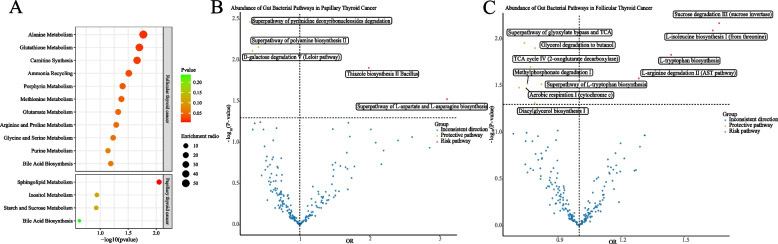
After sensitivity analyses, we identified 4 taxa, 19 blood metabolites, and 5 gut bacterial pathways were causally associated with PTC. Similarly, 3 taxa, 31 blood metabolites, and 3 gut bacterial pathways were found to be causally associated with FTC, with 2 blood metabolites exhibiting bidirectional causal relationships. Metabolic pathway analysis revealed 8 significant pathways in PTC and FTC. MR-BMA analysis pinpointed species Bifidobacterium longum as the primary causal taxon for PTC and genus Bacteroides for FTC. The mediation MR analysis showed that sphingomyelin (d18:2/23:0, d18:1/23:1, d17:1/24:1) and 2-hydroxysebacate mediated the causal effects of specific gut microbiota on PTC and FTC, respectively.
The study suggested a causal relationship between several gut microbial taxa and DTC, and that specific blood metabolites might mediate this relationship.
研究已将肠道微生物群与分化型甲状腺癌(DTC)联系起来。然而,它们之间的因果关系和潜在中介因素尚未明确界定。我们的研究使用遗传学方法调查了肠道微生物群、乳头状甲状腺癌(PTC)和滤泡状甲状腺癌(FTC)之间的因果关系,以及潜在血液代谢物的中介作用。
利用迄今为止最大规模的全基因组关联研究(GWAS)中肠道微生物分类群、血液代谢物、PTC和FTC的汇总统计数据,我们应用了双向和中介孟德尔随机化(MR)设计。基于贝叶斯模型平均的多变量MR方法(MR-BMA)用于确定最可能的因果分类群。此外,通过基于网络的Metaconflict 4.0进行代谢途径分析。
经过敏感性分析,我们确定了4个分类群、19种血液代谢物和5条肠道细菌途径与PTC存在因果关系。同样,发现3个分类群、31种血液代谢物和3条肠道细菌途径与FTC存在因果关系,其中2种血液代谢物表现出双向因果关系。代谢途径分析揭示了PTC和FTC中的8条重要途径。MR-BMA分析确定长双歧杆菌为PTC的主要因果分类群,拟杆菌属为FTC的主要因果分类群。中介MR分析表明,鞘磷脂(d18:2/23:0、d18:1/23:1、d17:1/24:1)和2-羟基壬二酸分别介导了特定肠道微生物群对PTC和FTC的因果效应。
该研究表明几种肠道微生物分类群与DTC之间存在因果关系,并且特定的血液代谢物可能介导这种关系。