Dobler Léa, Richard Océane, Clerici Emmanuelle, Stern Emilie, Lejoyeux Michel, d'Ortho Marie-Pia, Maruani Julia, Geoffroy Pierre A
Département de psychiatrie et d'addictologie, AP-HP, GHU Paris Nord, DMU Neurosciences, Hôpital Bichat - Claude Bernard, Paris, France.
Centre ChronoS, GHU Paris - Psychiatry & Neurosciences, Paris, France.
Brain Behav. 2025 Mar;15(3):e70383. doi: 10.1002/brb3.70383.
Premenstrual syndrome (PMS) affects nearly half of women worldwide and is associated with sleep disturbances, though the specific relationship between PMS and nightmares remains underexplored. Clinical observations suggest a potential link, leading this study to investigate whether women with PMS experience more frequent or intense nightmares compared to those without PMS.
We conducted a prospective case series of seven women experiencing nightmares, all of whom participated in weekly imagery rehearsal therapy (IRT) over 1-month. Each participant completed the daily record of severity of problems (DRSP) to assess PMS symptoms and kept daily dream diaries throughout one menstrual cycle, tracking nightmare frequency, intensity, and emotional valence. The nightmare severity index (NSI) was administered at the beginning and end of the study. Descriptive analysis was used for the dream metrics, and the Wilcoxon signed-rank test was employed to assess changes in NSI scores.
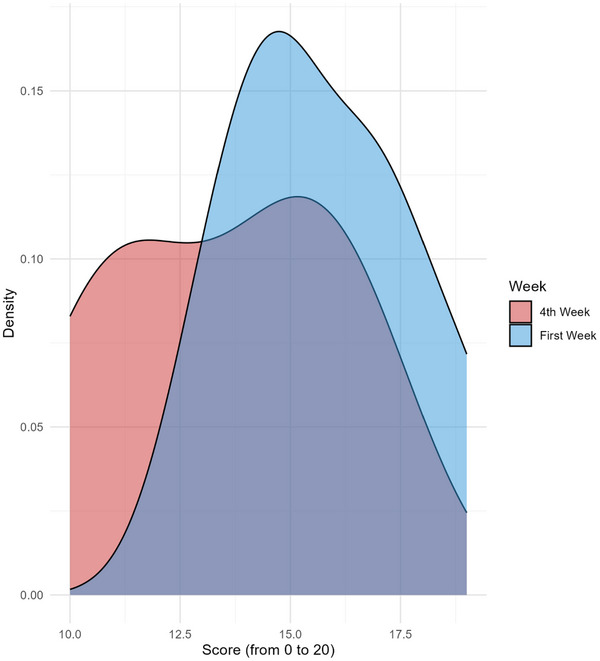
Women with PMS exhibited an increase in nightmare frequency during the premenstrual phase, but no formal statistical comparisons were made between PMS and non-PMS groups regarding dream frequency or intensity. A significant reduction in NSI scores (p = 0.03) was observed across the entire sample, though this effect was not significant in the PMS subgroup.
This case series is the first, to our knowledge, to provide detailed longitudinal data indicating that nightmare frequency may fluctuate across the menstrual cycle and could be more pronounced in women with PMS. While IRT effectively reduced nightmare severity overall, its specific impact on nightmares in women with PMS requires further research in larger studies.
经前综合征(PMS)影响着全球近一半的女性,且与睡眠障碍有关,不过PMS与噩梦之间的具体关系仍未得到充分研究。临床观察表明存在潜在联系,促使本研究调查与无PMS的女性相比,患有PMS的女性是否经历更频繁或更强烈的噩梦。
我们对7名经历噩梦的女性进行了一项前瞻性病例系列研究,所有参与者在1个月内每周接受意象排练疗法(IRT)。每位参与者完成问题严重程度每日记录(DRSP)以评估PMS症状,并在整个月经周期内每天记录梦境日记,跟踪噩梦频率、强度和情绪效价。在研究开始和结束时进行噩梦严重程度指数(NSI)评估。对梦境指标进行描述性分析,并采用Wilcoxon符号秩检验评估NSI分数的变化。
患有PMS的女性在经前期噩梦频率增加,但在梦境频率或强度方面,未对PMS组和非PMS组进行正式的统计比较。在整个样本中观察到NSI分数显著降低(p = 0.03),不过在PMS亚组中这种效果不显著。
据我们所知,这个病例系列首次提供了详细的纵向数据,表明噩梦频率可能在月经周期中波动,并且在患有PMS的女性中可能更明显。虽然IRT总体上有效降低了噩梦严重程度,但其对患有PMS的女性噩梦的具体影响需要在更大规模的研究中进一步探讨。