Nayak Aditya R, Kolluru Srinivas, Kumar Aloke, Bhadury Punyasloke
Department of Ocean and Mechanical Engineering, Florida Atlantic University, Boca Raton, FL 33431, USA.
Harbor Branch Oceanographic Institute, Florida Atlantic University, Fort Pierce, FL 34946, USA.
iScience. 2025 Jan 28;28(2):111916. doi: 10.1016/j.isci.2025.111916. eCollection 2025 Feb 21.
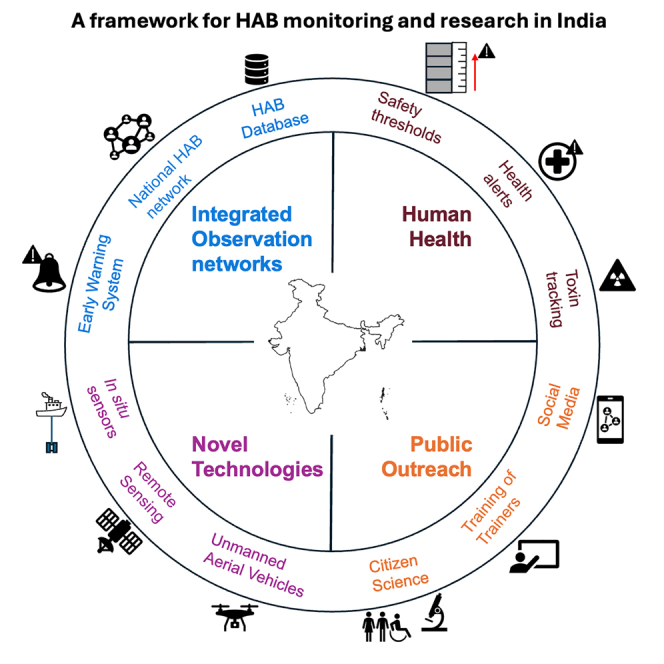
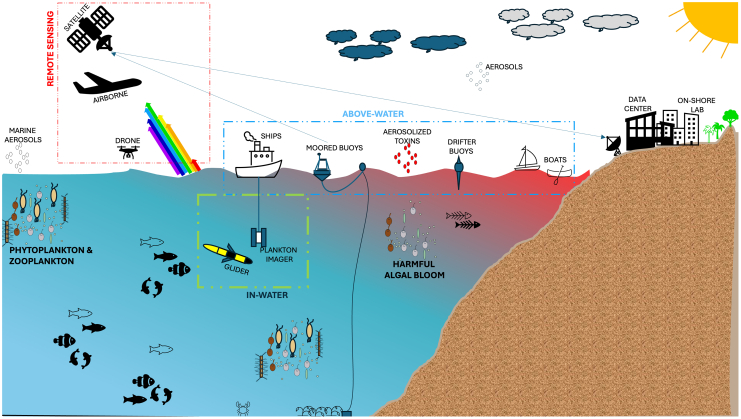
Harmful algal bloom (HAB) events substantially impact human and aquatic ecosystem health and the global blue economy; hence, a concerted effort is required to advance our understanding of HAB ecology to better inform monitoring and mitigation measures. Here, we highlight the current state of HAB research and monitoring in India, where ∼17% of the human population resides in the vicinity of its long coastline and is dependent on the sustainable blue economy. Through the lens of established programs from countries across the globe, we identify existing gaps and highlight four broad areas for focusing future efforts: (1) the development/employment of novel technologies for HAB research and monitoring; (2) the need for integrated observation networks and a coordinated effort across different central/state agencies and research institutes; (3) clinical studies on human health effects; and (4) public outreach and citizen science initiatives to increase awareness on this topic, including policy level interventions.
有害藻华(HAB)事件对人类和水生生态系统健康以及全球蓝色经济产生重大影响;因此,需要共同努力来增进我们对有害藻华生态学的理解,以便更好地为监测和缓解措施提供信息。在此,我们重点介绍印度有害藻华研究和监测的现状,印度约17%的人口居住在其漫长的海岸线附近,依赖可持续的蓝色经济。通过全球各国既定项目的视角,我们找出了现有差距,并强调了未来努力应聚焦的四个广泛领域:(1)开发/应用用于有害藻华研究和监测的新技术;(2)需要综合观测网络以及不同中央/邦机构和研究机构之间的协调努力;(3)关于对人类健康影响的临床研究;(4)开展公众宣传和公民科学倡议,以提高对该主题的认识,包括政策层面的干预措施。