
克隆体中的生长适应性与稳定性:遗传与环境的作用
Growth adaptability and stability in clones: the role of genetics and environment.
作者信息
Xiao Yao, Wang Zhengde, Wang Junhui, Yun Huiling, Ling Juanjuan, Zhai Wenji, Zhao Kun, Yu Xiaochi, Ma Wenjun
机构信息
State Key Laboratory of Tree Genetics and Breeding, Key Laboratory of Forest Tree Breeding, State Forestry and Grassland Administration, Catalpa Bungei National Innovation Alliance, Research Institute of Forestry, Chinese Academy of Forestry, Beijing 100091, China.
Xiaolongshan Research Institute of Forestry, Tianshui 741032, China.
出版信息
For Res (Fayettev). 2025 Jan 22;5:e002. doi: 10.48130/forres-0025-0003. eCollection 2025.
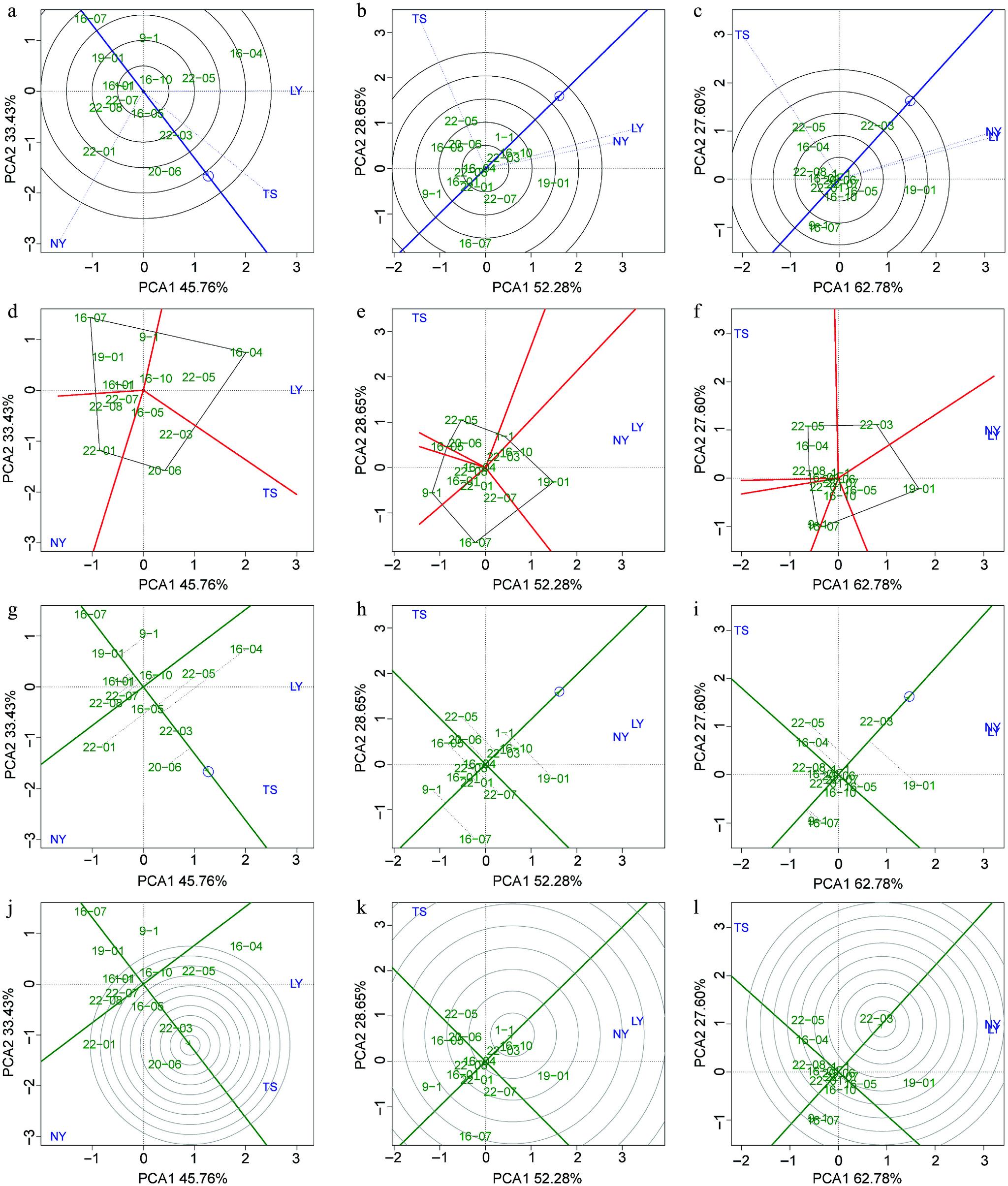
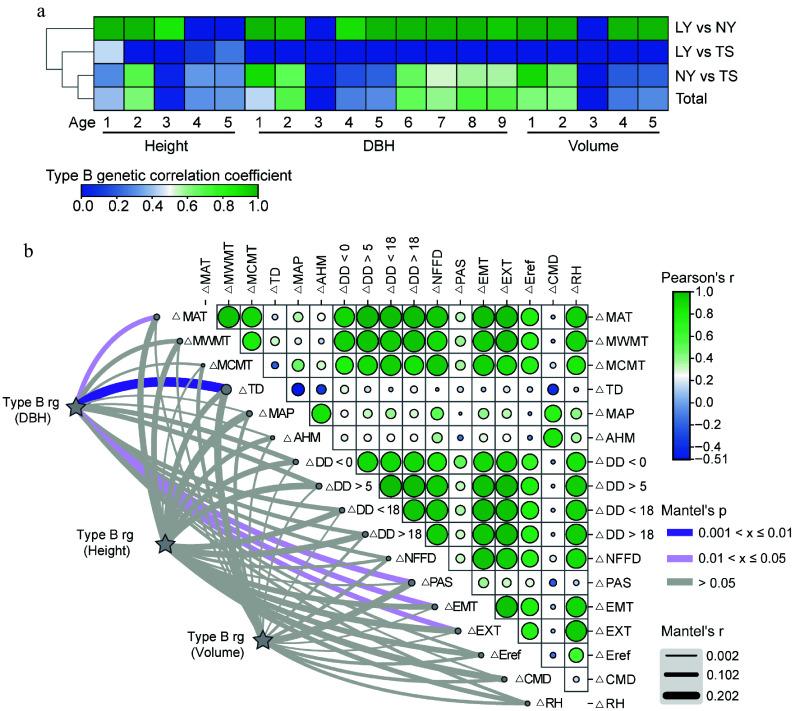
Understanding genotype, environment, and genotype-by-environment (G × E) interactions is vital for effective forest breeding. The , valued for its rapid growth and high-quality wood, exhibits uncertain genetic variation in growth across diverse ecological conditions. To clarify this, we measured the growth traits of clones over several years at multiple sites to evaluate the effects of genetics and environment on growth. The results indicate that growth traits exhibit significant genetic differences and high repeatability, and the significant G × E interaction highlights the importance of site-specific tree selection. Correlation and regression analysis indicated that MCMT was positively correlated with DBH, whereas DD < 18 was negatively correlated with DBH. TD and CMD showed positive correlations with height and volume. Multivariate regression trees (MRT) analysis showed that clones thrived under specific conditions: TD > 26.65 °C with MCMT > 0.1 °C and CMD > 520.5. Mantel analysis results indicated that TD is the main factor driving the G × E of DBH. To identify clones well-suited for targeted cultivation and stability in various regions, we estimated BLUP values for clone growth and applied BLUP-GGE to assess the yield and stability of 5-year height, 9-year DBH, and 5-year volume. Clone 1-1 was selected for its high and stable DBH, with a 6.22% genetic gain. Clone 22-03 was selected for its high and stable volume, with a 12.11% gain. These elite clones are anticipated to boost plantation productivity and are likely to be cultivated and promoted across multiple regions.
了解基因型、环境以及基因型与环境的相互作用(G×E)对于有效的林木育种至关重要。因其生长迅速且木材质量高而受到重视,但在不同生态条件下其生长的遗传变异存在不确定性。为了阐明这一点,我们在多个地点对无性系的生长性状进行了数年测量,以评估遗传和环境对生长的影响。结果表明,生长性状存在显著的遗传差异和高重复性,显著的G×E相互作用凸显了特定地点树木选择的重要性。相关性和回归分析表明,MCMT与胸径呈正相关,而DD<18与胸径呈负相关。树高和材积与TD和CMD呈正相关。多元回归树(MRT)分析表明,无性系在特定条件下生长良好:TD>26.65°C,MCMT>0.1°C且CMD>520.5。Mantel分析结果表明,TD是驱动胸径G×E的主要因素。为了确定适合在不同地区进行定向培育和具有稳定性的无性系,我们估计了无性系生长的最佳线性无偏预测(BLUP)值,并应用BLUP-GGE评估了5年生树高、9年生胸径和5年生材积的产量和稳定性。无性系1-1因其胸径高且稳定而被选中,遗传增益为6.22%。无性系22-03因其材积高且稳定而被选中,增益为12.11%。这些优良无性系有望提高人工林生产力,并可能在多个地区进行培育和推广。


 Zotero 插件