Myran Daniel T, Xiao Jennifer, Fabiano Nicholas, Pugliese Michael, Kaster Tyler S, Rosenblat Joshua D, Husain M Ishrat, Fiedorowicz Jess G, Wong Stanley, Tanuseputro Peter, Solmi Marco
Department of Family Medicine (Myran), University of Ottawa; Ottawa Hospital Research Institute (Myran, Xiao, Fiedorowicz); ICES uOttawa, Ottawa Hospital Research Institute (Myran, Pugliese); Bruyère Research Institute (Myran); School of Epidemiology and Public Health, Faculty of Medicine (Myran, Fiedorowicz, Solmi), University of Ottawa, Ottawa, Ont.; Department of Psychiatry, Faculty of Medicine (Kaster, Rosenblat, Husain, Wong), University of Toronto; Temerty Centre for Therapeutic Brain Intervention (Kaster, Husain), Centre for Addiction and Mental Health, Toronto, Ont.; ICES Western, London, Ont.; Department of Psychiatry (Fabiano, Fiedorowicz, Solmi), University of Ottawa; Department of Mental Health (Fiedorowicz, Solmi), The Ottawa Hospital, Ottawa, Ont.; Department of Family Medicine and Primary Care (Tanuseputro), University of Hong Kong, Hong Kong; Department of Child and Adolescent Psychiatry (Solmi), Charité Universitätsmedizin, Berlin, Germany.
CMAJ. 2025 Mar 2;197(8):E204-E213. doi: 10.1503/cmaj.241191.
Although clinical trials involving psychedelic-assisted psychotherapy have not observed short-term increases in the risk of death, limited data exist on mortality associated with hallucinogen use outside of controlled trial settings. We sought to determine whether people with an emergency department visit or hospital admission involving hallucinogen use were at increased risk of all-cause death compared with the general population and with people with acute care presentations involving other substances.
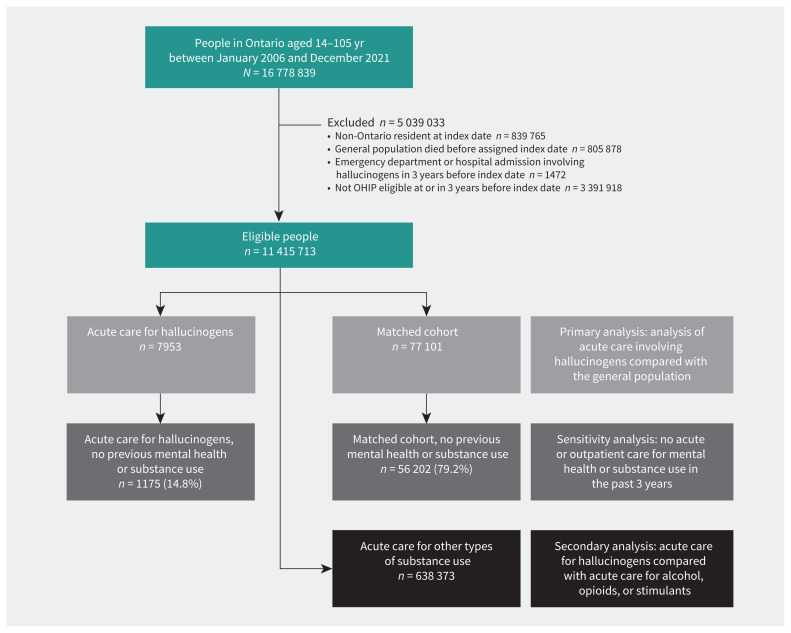
We conducted a retrospective cohort study using linked health administrative data on all people aged 15 years and older living in Ontario, Canada, from 2006 to 2022. We compared overall and cause-specific mortality between members of the general population and people with incident acute care (an emergency department visit or hospital admission) involving hallucinogens and other substances.
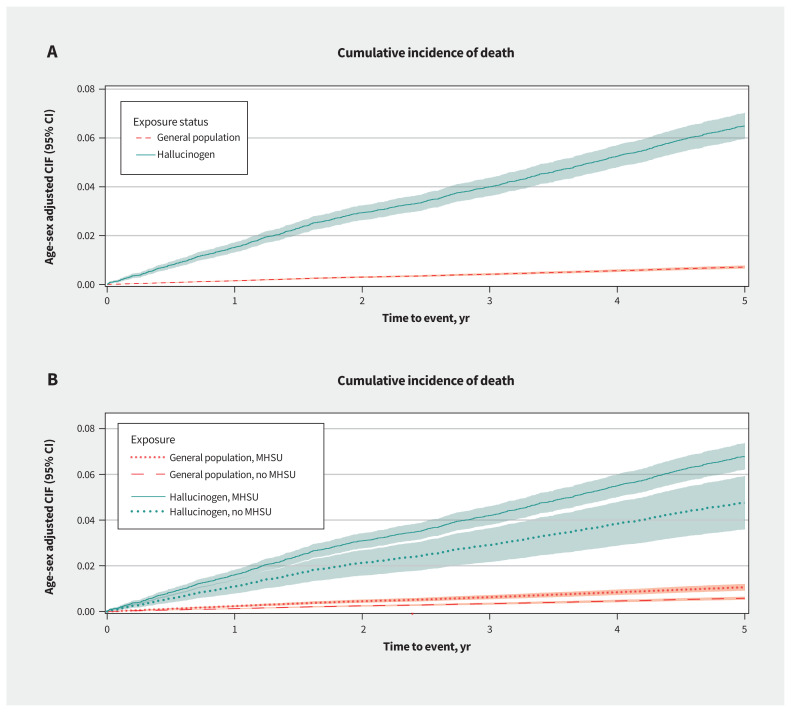
We included 11 415 713 people; 7953 (0.07%) had incident acute care involving hallucinogens. In a matched analysis with 77 101 people with a median follow-up of 7 (interquartile range 3-11) years, acute care involving hallucinogens was associated with a 2.6-fold (hazard ratio [HR] 2.57, 95% confidence interval [CI] 2.09-3.15) increased all-cause mortality within 5 years ( = 482, absolute risk 6.1%) relative to the general population ( = 460, absolute risk 0.6%). Analyses excluding people with comorbid mental or substance use disorders showed similar elevations in mortality risk for acute care involving hallucinogens relative to the general population (HR 3.25, 95% CI 2.27-4.63). People with acute care involving hallucinogens were at a significantly elevated risk of death by unintentional drug poisoning (HR 2.03, 95% CI 1.02-4.05), suicide (HR 5.23, 95% CI 1.38-19.74), respiratory disease (HR 2.46, 95% CI 1.18-5.11), and cancer (HR 2.88, 95% CI 1.61-5.14) relative to the general population.
Requiring hospital-based care for hallucinogen use was associated with increases in risk of death relative to the general population, particularly from suicide. These findings should be considered in clinical and policy decision-making, given the increasing use of hallucinogens and associated problematic use.
尽管涉及迷幻剂辅助心理治疗的临床试验未观察到短期死亡风险增加,但关于在对照试验环境之外使用致幻剂相关的死亡率数据有限。我们试图确定与普通人群以及涉及其他物质的急性护理患者相比,因使用致幻剂而到急诊科就诊或住院的患者全因死亡风险是否增加。
我们利用2006年至2022年加拿大安大略省所有15岁及以上居民的关联健康管理数据进行了一项回顾性队列研究。我们比较了普通人群成员与因使用致幻剂和其他物质而发生急性护理(急诊科就诊或住院)的患者之间的总体死亡率和特定病因死亡率。
我们纳入了11415713人;7953人(0.07%)因使用致幻剂而发生急性护理。在对77101人进行的匹配分析中,中位随访时间为7年(四分位间距3 - 11年),与普通人群相比(n = 460,绝对风险0.6%),因使用致幻剂而进行的急性护理与5年内全因死亡率增加2.6倍(风险比[HR] 2.57,95%置信区间[CI] 2.09 - 3.15)相关(n = 482,绝对风险6.1%)。排除患有共病精神或物质使用障碍的患者的分析显示,与普通人群相比,因使用致幻剂而进行的急性护理的死亡风险也有类似升高(HR 3.25,95% CI 2.27 - 4.63)。与普通人群相比,因使用致幻剂而进行急性护理的患者因意外药物中毒(HR 2.03,95% CI 1.02 - 4.05)、自杀(HR 5.23,95% CI 1.38 - 19.74)、呼吸系统疾病(HR 2.46,95% CI 1.18 - 5.11)和癌症(HR 2.88,95% CI 1.61 - 5.14)导致的死亡风险显著升高。
与普通人群相比,因使用致幻剂而需要住院治疗与死亡风险增加相关,尤其是自杀风险。鉴于致幻剂使用的增加以及相关的问题使用情况,这些发现应在临床和政策决策中予以考虑。