Qin Pingyang, Niu Yuzhen, Duan Jizheng, Lin Ping
College of Chemical Engineering and Environment, Weifang University of Science and Technology, Weifang, 262700, China.
Institute of Modern Physics, Chinese Academy of Science, Lanzhou, 730000, China.
BMC Pharmacol Toxicol. 2025 Mar 3;26(1):49. doi: 10.1186/s40360-025-00851-0.
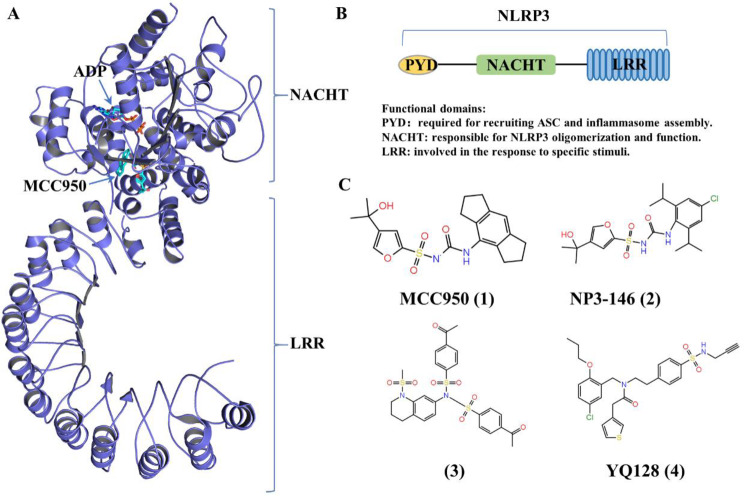
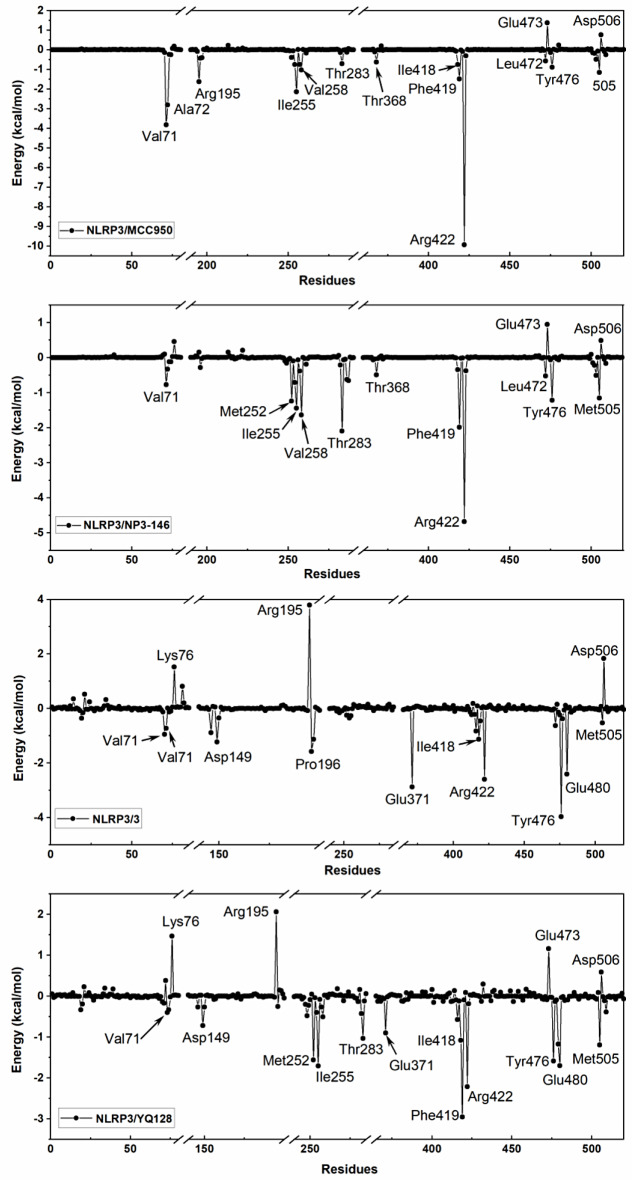
NLRP3 (Nucleotide-binding oligomerization domain, LRR and pyrin domain-containing protein 3) is a pivotal regulator of inflammation, with strong implications in gout, neurodegenerative diseases, and various inflammatory conditions. Consequently, the exploration of NLRP3 inhibitors is of great significance for the treatment of diseases. MCC950, NP3-146, compound (3), and YQ128 are four highly bioactive NLRP3 inhibitors that show great potential; however, their mechanism of action is currently limited to targeting the ATP binding region (NACHT site) of the NLRP3 protein. To gain deeper insights into the defining features of NLRP3 inhibitors and to develop more potent inhibitors, it is imperative to elucidate the interaction mechanism between NLRP3 and these inhibitors. In this study, we employ a comprehensive computational approach to investigate the binding mechanism between NLRP3 and representative inhibitors. Utilizing the molecular mechanics/generalized Born surface area (MM/GBSA) method, we calculate the binding free energy and pinpoint the key residues involved in the binding of the four inhibitors to NLRP3. The decomposition of binding free energy by the MM/GBSA method reveals that the residues Val71, Arg195, Ile255, Phe419, Arg422, and Met505, situated around the binding pocket, play a crucial role in conferring the high bioactivity of NLRP3 inhibitors. Furthermore, pharmacophore analysis of the four NLRP3 complexes indicates that the primary interaction between the inhibitors and NLRP3 was mainly hydrophobic interaction. Our study provides a profound understanding of the interaction mechanism between NLRP3 and its inhibitors, identifies the key residues involved, and provides theoretical guidance for the design of more efficient NLRP3 inhibitors.
NLRP3(含核苷酸结合寡聚化结构域、富含亮氨酸重复序列和吡啉结构域蛋白3)是炎症的关键调节因子,在痛风、神经退行性疾病及各种炎症性疾病中具有重要意义。因此,探索NLRP3抑制剂对疾病治疗具有重要意义。MCC950、NP3 - 146、化合物(3)和YQ128是四种具有高生物活性的NLRP3抑制剂,显示出巨大潜力;然而,它们的作用机制目前仅限于靶向NLRP3蛋白的ATP结合区域(NACHT位点)。为了更深入了解NLRP3抑制剂的关键特征并开发更有效的抑制剂,阐明NLRP3与这些抑制剂之间的相互作用机制至关重要。在本研究中,我们采用综合计算方法研究NLRP3与代表性抑制剂之间的结合机制。利用分子力学/广义玻恩表面积(MM/GBSA)方法,我们计算结合自由能并确定四种抑制剂与NLRP3结合所涉及的关键残基。通过MM/GBSA方法对结合自由能的分解表明,位于结合口袋周围的残基Val71、Arg195、Ile255、Phe419、Arg422和Met505在赋予NLRP3抑制剂高生物活性方面起关键作用。此外,对四种NLRP3复合物的药效团分析表明,抑制剂与NLRP3之间的主要相互作用主要是疏水相互作用。我们的研究为NLRP3与其抑制剂之间的相互作用机制提供了深入理解,确定了所涉及的关键残基,并为设计更有效的NLRP3抑制剂提供了理论指导。