Ivanova Mirena, Laage Kragh Martin, Szarvas Judit, Tosun Elif Seyda, Holmud Natacha Friis, Gmeiner Alexander, Amar Corinne, Guldimann Claudia, Huynh TuAnh N, Karpíšková Renáta, Rota Carmen, Gomez Diego, Aboagye Eurydice, Etter Andrea, Centorame Patrizia, Torresi Marina, De Angelis Maria Elisabetta, Pomilio Francesco, Okholm Anders Hauge, Xiao Yinghua, Kleta Sylvia, Lüth Stefanie, Pietzka Ariane, Kovacevic Jovana, Pagotto Franco, Rychli Kathrin, Zdovc Irena, Papić Bojan, Heir Even, Langsrud Solveig, Møretrø Trond, Brown Phillip, Kathariou Sophia, Stephan Roger, Tasara Taurai, Dalgaard Paw, Njage Patrick Murigu Kamau, Fagerlund Annette, Aarestrup Frank, Truelstrup Hansen Lisbeth, Leekitcharoenphon Pimlapas
Research Group for Genomic Epidemiology, National Food Institute, Technical University of Denmark, Kgs Lyngby, Denmark.
Research Group for Food Microbiology and Hygiene, National Food Institute, Technical University of Denmark, Kgs Lyngby, Denmark.
Appl Environ Microbiol. 2025 Apr 23;91(4):e0182924. doi: 10.1128/aem.01829-24. Epub 2025 Mar 4.
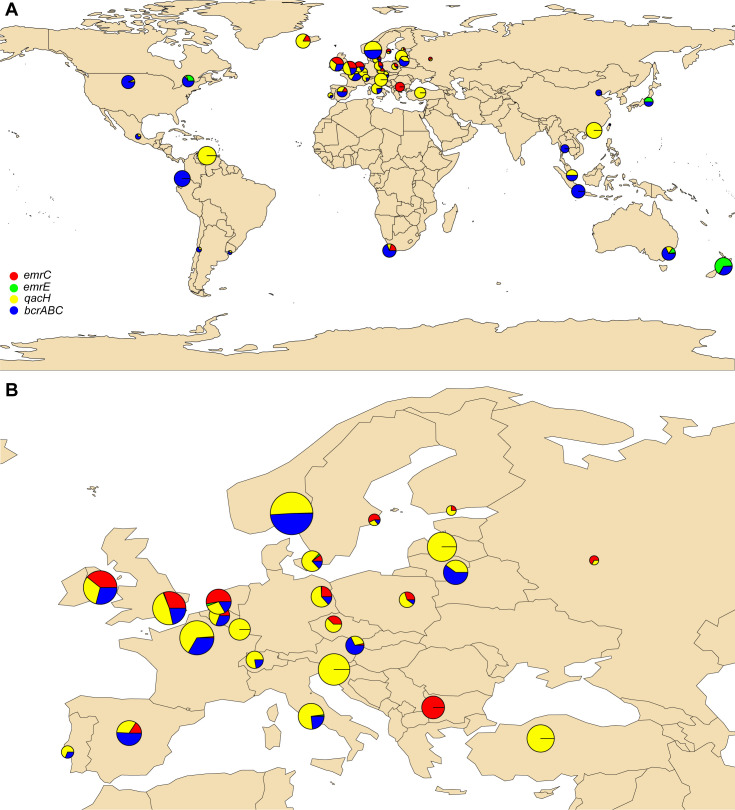
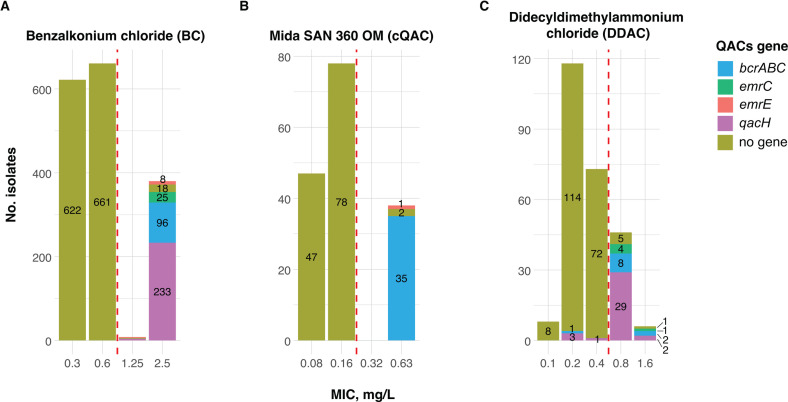
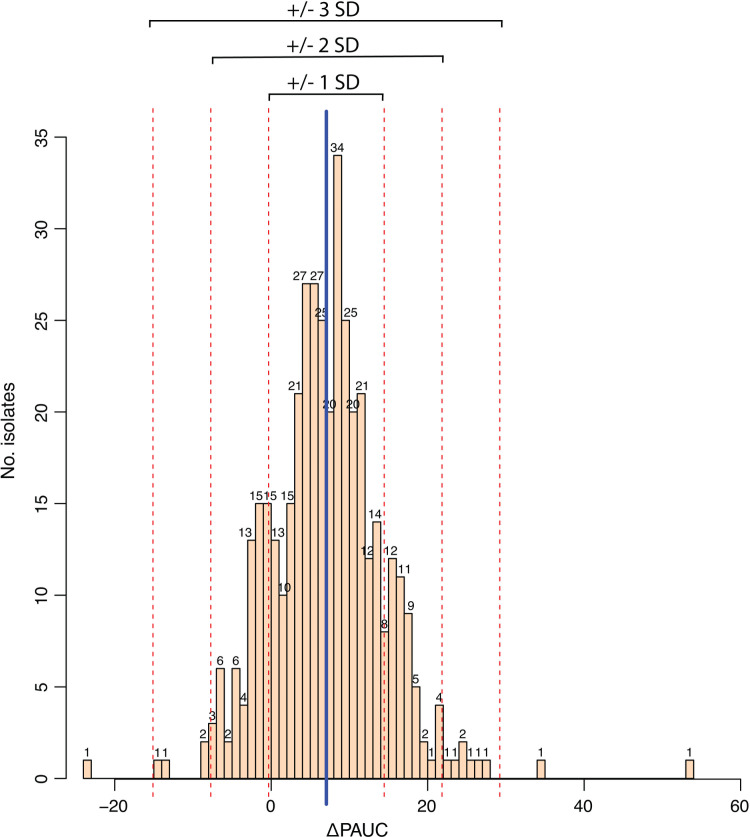
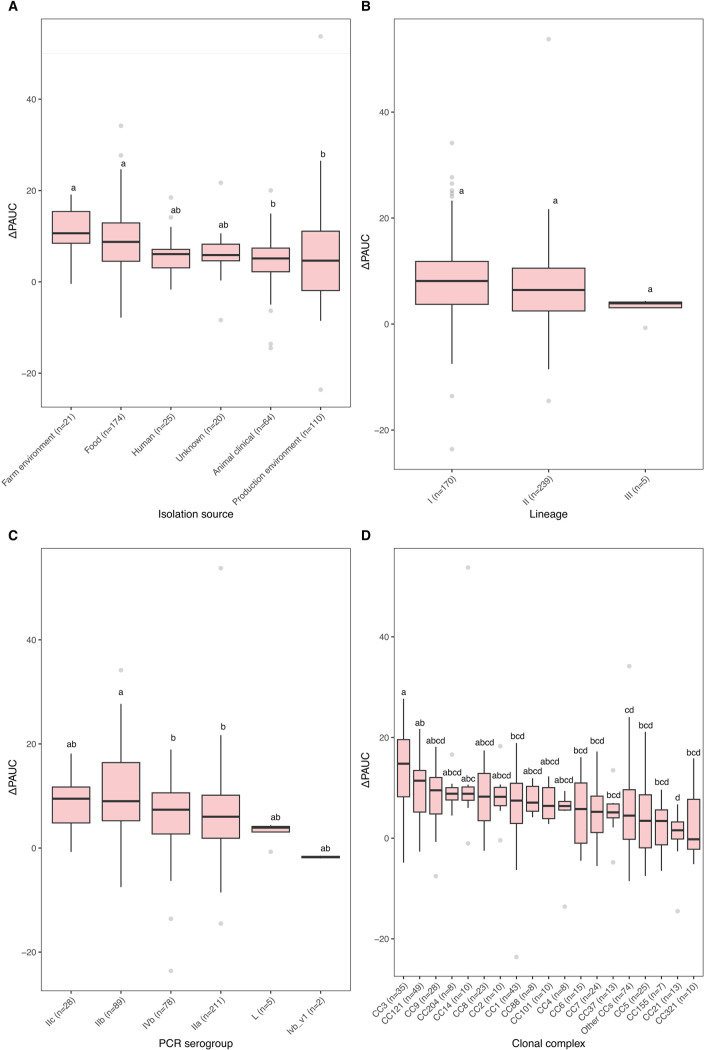
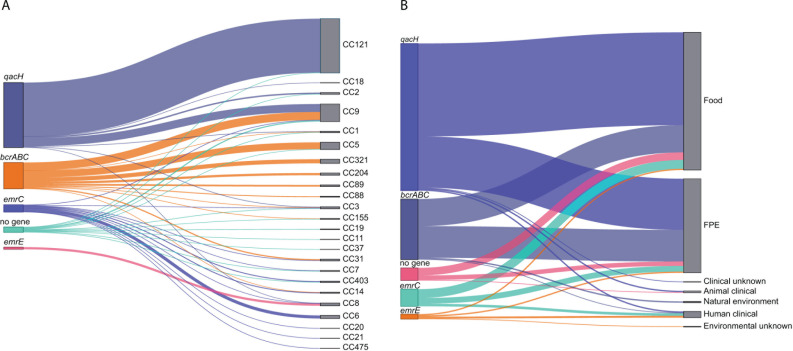
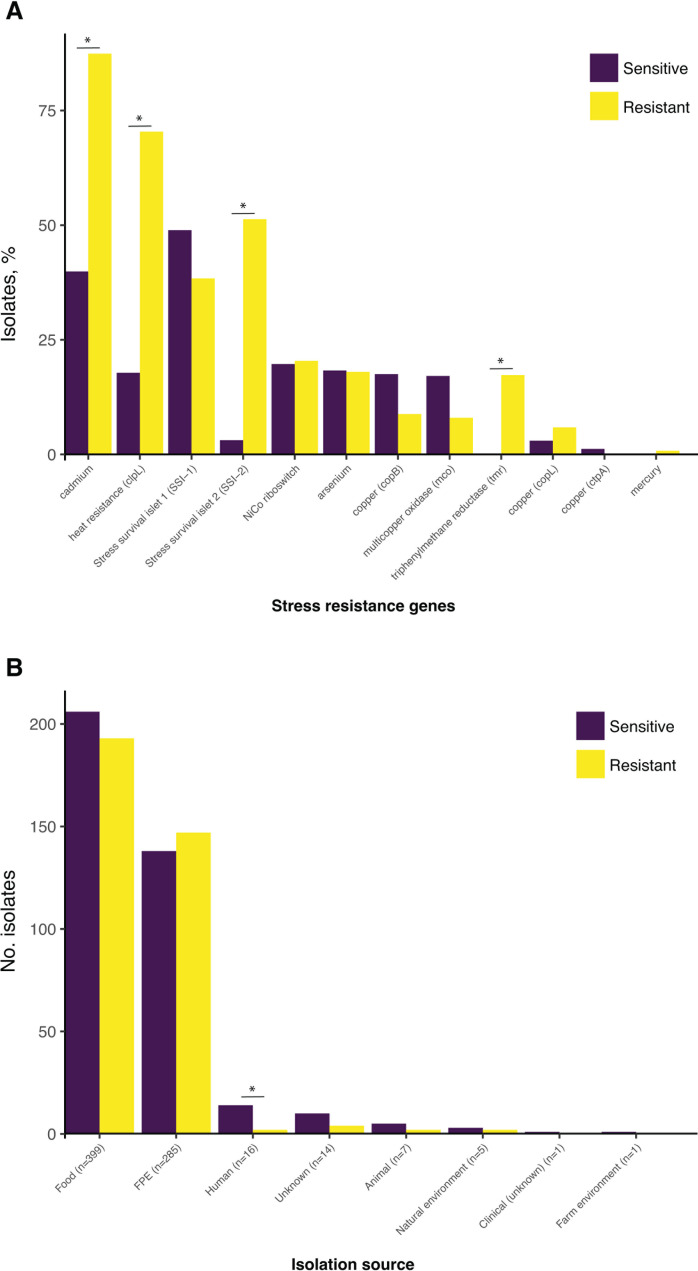
presents a significant concern for the food industry due to its ability to persist in the food processing environment. One of the factors contributing to its persistence is decreased sensitivity to disinfectants. Our objective was to assess the diversity of sensitivity to food industry disinfectants by testing the response of 1,671 . isolates to quaternary ammonium compounds (QACs) and 414 isolates to peracetic acid (PAA) using broth microdilution and growth curve analysis assays, respectively, and to categorize the isolates into sensitive and tolerant. A high phenotype-genotype concordance (95%) regarding tolerance to QACs was obtained by screening the genomes for the presence of QAC tolerance-associated genes , , and . Based on this high concordance, we assessed the QAC genes' dissemination among publicly available genomes ( = 39,196). Overall, QAC genes were found in 23% and 28% of the collection in this study and in the global data set, respectively. and were the most prevalent genes, with being the most detected QAC gene in the USA, while dominated in Europe. No significant differences ( > 0.05) in the PAA tolerance were detected among isolates belonging to different lineages, serogroups, clonal complexes, or isolation sources, highlighting limited variation in the sensitivity to this disinfectant. The present work represents the largest testing of sensitivity to important food industry disinfectants at the phenotypic and genomic level, revealing diversity in the tolerance to QACs while all isolates showed similar sensitivity to PAA.
Contamination of within food processing environments is of great concern to the food industry due to challenges in eradicating the isolates once they become established and persistent in the environment. Genetic markers associated with increased tolerance to certain disinfectants have been identified, which alongside other biotic and abiotic factors can favor the persistence of in the food production environment. By employing a comprehensive large-scale phenotypic testing and genomic analysis, this study significantly enhances the understanding of the tolerance to quaternary ammonium compounds (QACs) and the genetic determinants associated with the increased tolerance. We provide a global overview of the QAC genes prevalence among public sequences and their distribution among clonal complexes, isolation sources, and geographical locations. Additionally, our comprehensive screening of the peracetic acid (PAA) sensitivity shows that this disinfectant can be used in the food industry as the lack of variation in sensitivity indicates reliable effect and no apparent possibility for the emergence of tolerance.
由于其能够在食品加工环境中持续存在,这对食品行业来说是一个重大问题。导致其持续存在的因素之一是对消毒剂的敏感性降低。我们的目标是通过分别使用肉汤微量稀释法和生长曲线分析试验,检测1671株菌株对季铵化合物(QACs)的反应以及414株菌株对过氧乙酸(PAA)的反应,来评估对食品行业消毒剂敏感性的多样性,并将这些菌株分类为敏感型和耐受型。通过筛选基因组中是否存在与QAC耐受相关的基因、、和,获得了关于对QACs耐受性的高表型 - 基因型一致性(95%)。基于这种高一致性,我们评估了QAC基因在公开可用的基因组(= 39196)中的传播情况。总体而言,在本研究的菌株集合中以及全球数据集中,分别有23%和28%的菌株发现了QAC基因。和是最普遍的基因,在美国是检测到最多的QAC基因,而在欧洲占主导地位。在属于不同谱系、血清群、克隆复合体或分离来源的菌株中,未检测到对PAA耐受性的显著差异(> 0.05),这突出表明对这种消毒剂的敏感性变化有限。目前的工作代表了在表型和基因组水平上对重要食品行业消毒剂敏感性的最大规模测试,揭示了对QACs耐受性的多样性,而所有菌株对PAA表现出相似的敏感性。
食品加工环境中的污染是食品行业极为关注的问题,因为一旦这些菌株在环境中定植并持续存在,根除它们具有挑战性。已经鉴定出与对某些消毒剂耐受性增加相关的遗传标记,这些标记与其他生物和非生物因素一起,可能有利于在食品生产环境中的持续存在。通过采用全面的大规模表型测试和基因组分析,本研究显著增强了对季铵化合物(QACs)耐受性以及与耐受性增加相关的遗传决定因素的理解。我们提供了QAC基因在公共序列中的流行情况及其在克隆复合体、分离来源和地理位置中的分布的全球概述。此外,我们对过氧乙酸(PAA)敏感性的全面筛选表明,这种消毒剂可用于食品行业,因为敏感性缺乏变化表明其效果可靠且没有明显的耐受性出现可能性。