Shiode Yuto, Kodama Takahiro, Sato Yu, Takahashi Ryo, Matsumae Takayuki, Shirai Kumiko, Doi Akira, Tahata Yuki, Hikita Hayato, Tatsumi Tomohide, Fukai Moto, Taketomi Akinobu, Ruchirawat Mathuros, Wang Xin Wei, Takehara Tetsuo
Department of Gastroenterology and Hepatology, Osaka University, Graduate School of Medicine, 2-2 Yamadaoka Suita, Osaka, 565-0871, Japan.
Laboratory of Human Carcinogenesis, Center for Cancer Research, National Cancer Institute, Bethesda, MD, USA.
Biomark Res. 2025 Mar 4;13(1):37. doi: 10.1186/s40364-025-00752-8.
Hepatocellular carcinoma (HCC) can be classified into several subtypes based on molecular traits, aiding in prognostic stratification. The subtype with a poor prognosis is often associated with stem/progenitor features. This study focused on identifying circulating biomarkers for aggressive HCC.
We searched for secretory proteins whose expression was positively associated with the stem/progenitor markers KRT19, EPCAM, and PROM1 in 2 independent HCC cohorts. Serum folate receptor 1 (FOLR1) levels were measured in 238 chronic liver disease and 247 HCC patients, evaluating their diagnostic and prognostic capabilities.
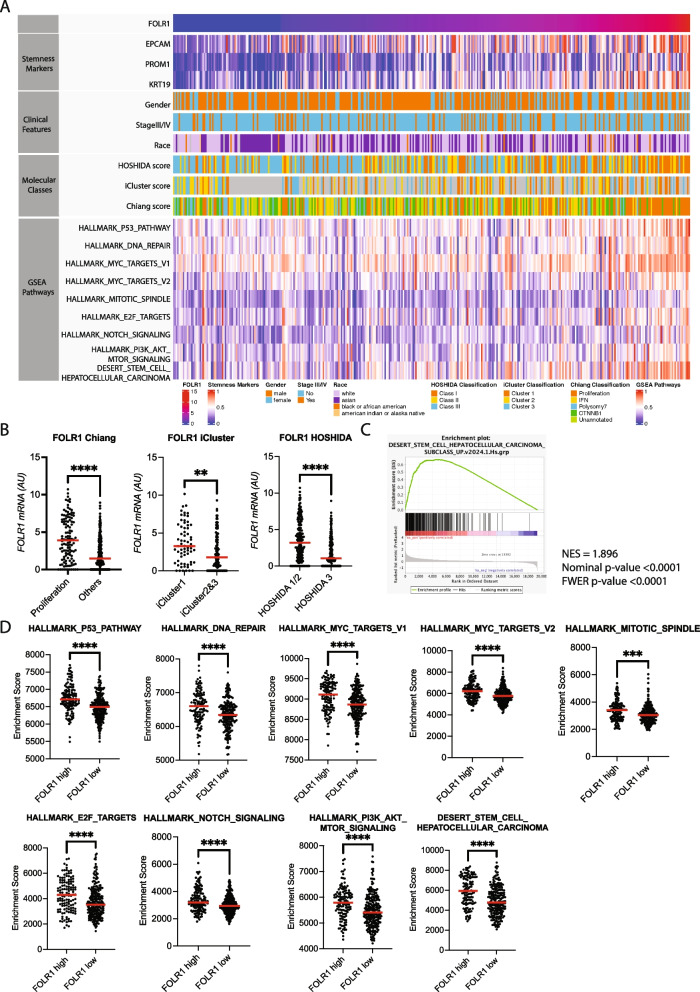
FOLR1 was identified as a secretory protein that was positively correlated with all 3 stem/progenitor markers and a poor prognosis in both the discovery and validation cohorts. Higher FOLR1 expression was detected in tumor than nontumor tissues and was associated with aggressive subtypes, and activation of p53, DNA repair, Myc, E2F, and PI3K/AKT/mTOR pathways. Serum FOLR1 levels correlated with tumoral FOLR1 expression in HCC patients and were significantly elevated compared with those in patients with chronic hepatitis or nonliver disease. Serum FOLR1 levels demonstrated diagnostic performance for HCC comparable to that of alpha-fetoprotein (AFP), and their combination increased the diagnostic accuracy. Elevated serum FOLR1 levels were associated with poor prognosis in HCC patients, regardless of treatment, especially in patients with early-stage disease. The multivariate analysis revealed that the serum FOLR1 level and the Gender, Age, AFP-L3, AFP, and Des-gamma-carboxy prothrombin (GALAD) score were independent predictors of a poor prognosis with their combination further stratifying prognosis.
FOLR1 is a stemness-associated biomarker for HCC, with serum levels serving as a diagnostic marker for HCC and a prognostic indicator for early-stage disease.
肝细胞癌(HCC)可根据分子特征分为几种亚型,有助于进行预后分层。预后不良的亚型通常与干细胞/祖细胞特征相关。本研究聚焦于识别侵袭性HCC的循环生物标志物。
我们在2个独立的HCC队列中搜索其表达与干细胞/祖细胞标志物角蛋白19(KRT19)、上皮细胞黏附分子(EPCAM)和prominin 1(PROM1)呈正相关的分泌蛋白。在238例慢性肝病患者和247例HCC患者中检测血清叶酸受体1(FOLR1)水平,评估其诊断和预后能力。
FOLR1被鉴定为一种分泌蛋白,在发现队列和验证队列中均与所有3种干细胞/祖细胞标志物呈正相关且预后不良。肿瘤组织中FOLR1表达高于非肿瘤组织,且与侵袭性亚型以及p53、DNA修复、Myc、E2F和PI3K/AKT/mTOR通路的激活相关。HCC患者血清FOLR1水平与肿瘤组织中FOLR1表达相关,与慢性肝炎或非肝病患者相比显著升高。血清FOLR1水平对HCC的诊断性能与甲胎蛋白(AFP)相当,两者联合可提高诊断准确性。血清FOLR1水平升高与HCC患者预后不良相关,无论治疗情况如何,尤其是早期疾病患者。多变量分析显示,血清FOLR1水平以及性别、年龄、AFP-L3、AFP和去γ-羧基凝血酶原(GALAD)评分是预后不良的独立预测因素,它们联合使用可进一步分层预后。
FOLR1是HCC的一种干性相关生物标志物,血清水平可作为HCC的诊断标志物和早期疾病的预后指标。