Childs Alexa, Aidoo-Micah Gloryanne, Maini Mala K, Meyer Tim
Department of Medical Oncology, Royal Free Hospital, London, UK.
Division of Infection and Immunity, Institute of Immunity and Transplantation, University College London, London, UK.
JHEP Rep. 2024 Jun 9;6(10):101130. doi: 10.1016/j.jhepr.2024.101130. eCollection 2024 Oct.
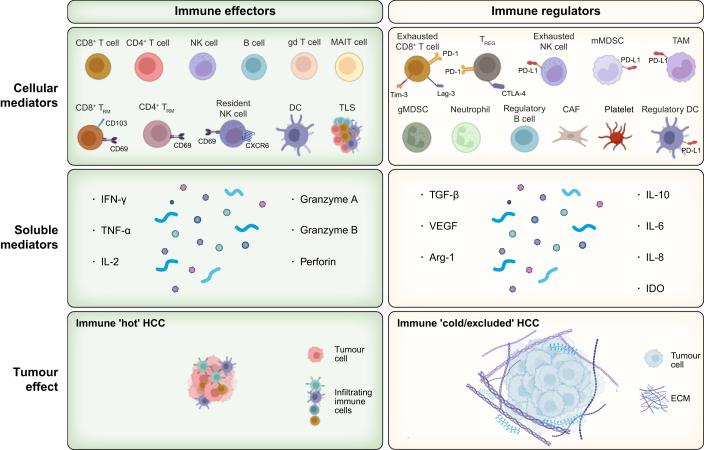
Hepatocellular carcinoma (HCC) is a major global healthcare challenge, with >1 million patients predicted to be affected annually by 2025. In contrast to other cancers, both incidence and mortality rates continue to rise, and HCC is now the third leading cause of cancer-related death worldwide. Immune checkpoint inhibitors (ICIs) have transformed the treatment landscape for advanced HCC, with trials demonstrating a superior overall survival benefit compared to sorafenib in the first-line setting. Combination therapy with either atezolizumab (anti-PD-L1) and bevacizumab (anti-VEGF) or durvalumab (anti-PD-L1) and tremelimumab (anti-CTLA-4) is now recognised as standard of care for advanced HCC. More recently, two phase III studies of ICI-based combination therapy in the early and intermediate disease settings have successfully met their primary end points of improved recurrence- and progression-free survival, respectively. Despite these advances, and in contrast to other tumour types, there remain no validated predictive biomarkers of response to ICIs in HCC. Ongoing research efforts are focused on further characterising the tumour microenvironment in order to select patients most likely to benefit from ICI and identify novel therapeutic targets. Herein, we review the current understanding of the immune landscape in which HCC develops and the evidence for ICI-based therapeutic strategies in HCC. Additionally, we describe the state of biomarker development and novel immunotherapy approaches in HCC which have progressed beyond the pre-clinical stage and into early-phase trials.
肝细胞癌(HCC)是一项重大的全球医疗挑战,预计到2025年每年将有超过100万患者受到影响。与其他癌症不同,HCC的发病率和死亡率持续上升,目前已成为全球癌症相关死亡的第三大主要原因。免疫检查点抑制剂(ICIs)改变了晚期HCC的治疗格局,多项试验表明,在一线治疗中,与索拉非尼相比,ICIs具有更好的总生存获益。阿替利珠单抗(抗PD-L1)联合贝伐单抗(抗VEGF)或度伐利尤单抗(抗PD-L1)联合曲美木单抗(抗CTLA-4)的联合治疗现已被公认为晚期HCC的标准治疗方案。最近,两项基于ICIs的联合治疗在早期和中期疾病中的III期研究分别成功达到了改善无复发生存期和无进展生存期的主要终点。尽管取得了这些进展,但与其他肿瘤类型不同,HCC中仍没有经过验证的ICIs反应预测生物标志物。正在进行的研究工作集中在进一步表征肿瘤微环境,以便选择最有可能从ICIs中获益的患者,并确定新的治疗靶点。在此,我们综述了目前对HCC发生的免疫格局的认识以及基于ICIs的HCC治疗策略的证据。此外,我们还描述了HCC中生物标志物开发的现状以及已从临床前阶段进入早期试验的新型免疫治疗方法。