Cohen Abigael, Reijman Max, Kraan Gerald A, Baart Sara J, Verhaar Jan A N, Colaris Joost W
Department of Orthopaedics and Sport Medicine, Erasmus MC University Medical Center, PO box 2040, 3000 CA, Rotterdam, The Netherlands.
Department of Orthopaedic Surgery, Reinier Haga Orthopaedic Center, Zoetermeer, The Netherlands.
J Orthop Traumatol. 2025 Mar 5;26(1):14. doi: 10.1186/s10195-025-00822-5.
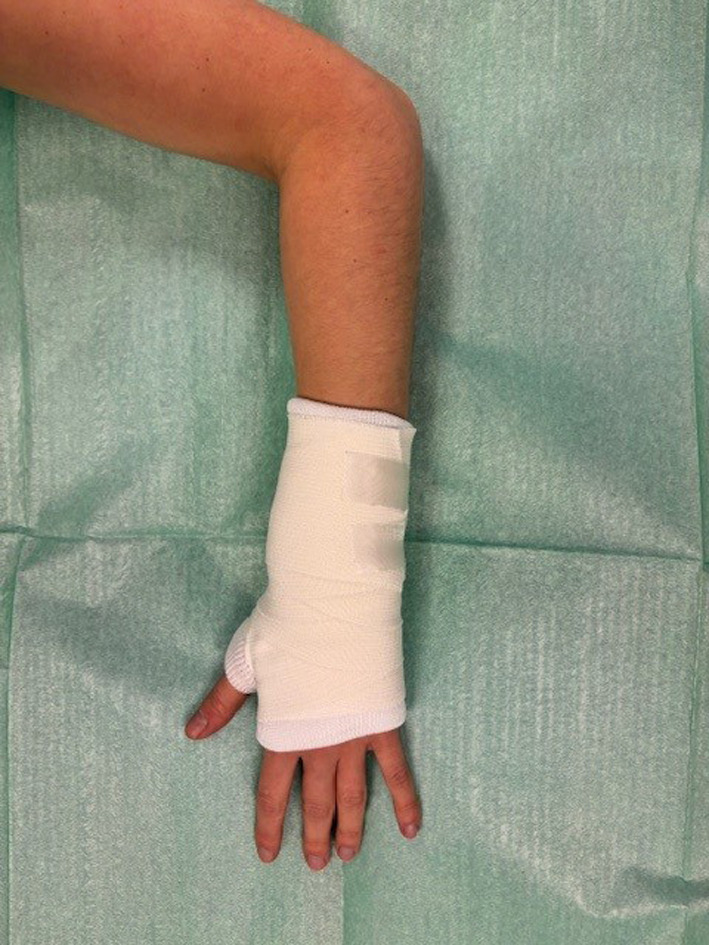
In suspected scaphoid fractures with normal initial radiographs, the usual care is casting, but only 10% of patients have scaphoid fractures. To reduce overtreatment, we evaluated whether bandaging, instead of casting, resulted in noninferior functional outcomes.
We included adults with suspected scaphoid fractures and normal initial radiographs at the emergency department in our multicenter randomized controlled trial. Patients were randomized to 3-day bandaging or 2-week casting. Questionnaires, physical examination, and radiographs were performed at 2 weeks and 1 year. Additional questionnaires were sent after inclusion, 6 weeks, and 3 months. Our primary outcome was the adjusted estimated difference between groups of the Quick Disabilities of the Arm, Shoulder, and Hand (QDASH) score at 3 months (natural logarithm of the margin of noninferiority = 2.0). Secondary outcomes included the QDASH score, Patient-Rated Hand/Wrist Evaluation Score, visual analog scale pain, wrist range of motion, patient satisfaction, and complications during follow-up.
Of the 180 patients (91 bandaging and 89 casting), 16 had scaphoid fractures and there were no scaphoid nonunions. Functional outcome in the bandaging group was noninferior at 3 months compared with the casting group [adjusted estimated difference QDASH score 0.30 (95% CI 0.02-0.62)]. All other patient-reported function and pain scores were not significantly different between groups. Range of motion at 2 weeks was better in the bandaging group, and they were more satisfied with the treatment than the casting group.
Casting for suspected scaphoid fractures but normal initial radiographs can be avoided because bandaging seems to be an alternative treatment option when patients are reevaluated after 2 weeks. Level of evidence Level II. Trial registration Trial registered at the Trialregister on 2018-02-28 on www.trialregister.nl , NTR7164.
在初次X线片正常的疑似舟骨骨折患者中,常规治疗方法是石膏固定,但仅有10%的患者患有舟骨骨折。为减少过度治疗,我们评估了采用包扎而非石膏固定是否能获得非劣效的功能结局。
在我们的多中心随机对照试验中,纳入了在急诊科就诊的初次X线片正常的疑似舟骨骨折的成年人。患者被随机分为3天包扎组或2周石膏固定组。在2周和1年时进行问卷调查、体格检查及X线检查。纳入后、6周和3个月时还会发送额外的问卷。我们的主要结局是3个月时两组间手臂、肩部和手部快速残疾评定量表(QDASH)评分的校正估计差值(非劣效性界值的自然对数 = 2.0)。次要结局包括QDASH评分、患者自评手/腕部评估评分、视觉模拟疼痛量表评分、腕关节活动范围、患者满意度以及随访期间的并发症。
180例患者(91例包扎组和89例石膏固定组)中,16例患有舟骨骨折,且无舟骨不愈合情况。与石膏固定组相比,包扎组在3个月时的功能结局非劣效[校正估计差值QDASH评分0.30(95%可信区间0.02 - 0.62)]。所有其他患者报告的功能和疼痛评分在两组间无显著差异。包扎组在2周时的活动范围更好,且他们对治疗的满意度高于石膏固定组。
对于初次X线片正常的疑似舟骨骨折患者,可以避免石膏固定,因为在2周后对患者进行重新评估时,包扎似乎是一种替代治疗选择。证据级别:二级。试验注册:该试验于2018年2月28日在www.trialregister.nl的Trialregister上注册,注册号为NTR7164。