Galli Francesco, Perret-Gentil Saskia, Champetier Antoine, Lüchinger Rita, Harisberger Myriam, Kuntzer Thibault, Rieder Stefan, Nathues Christina, Vidondo Beatriz, Lentz Hartmut, Belik Vitaly, Dürr Salome
Veterinary Public Health Institute, University of Bern, 3097, Liebefeld, Switzerland.
Graduate School for Cellular and Biomedical Sciences, University of Bern, 3012, Bern, Switzerland.
Sci Rep. 2025 Mar 6;15(1):7842. doi: 10.1038/s41598-025-92011-x.
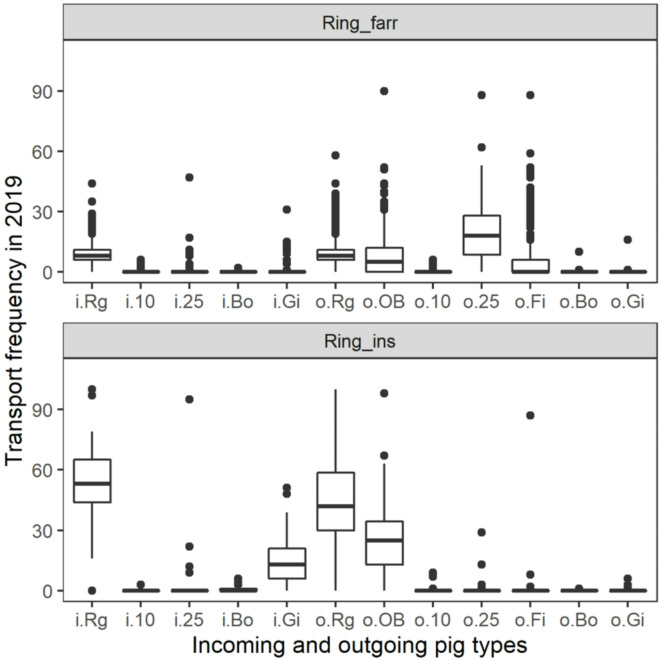
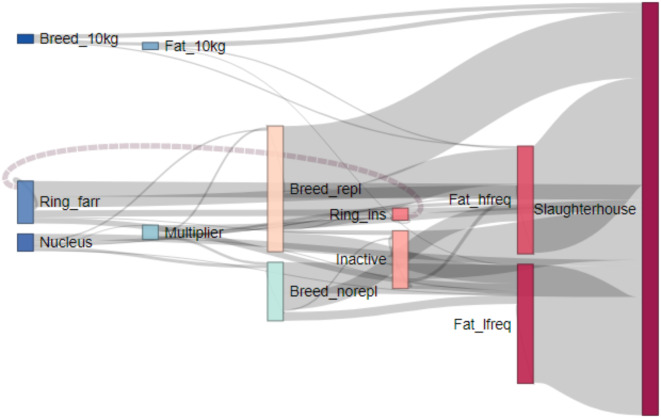
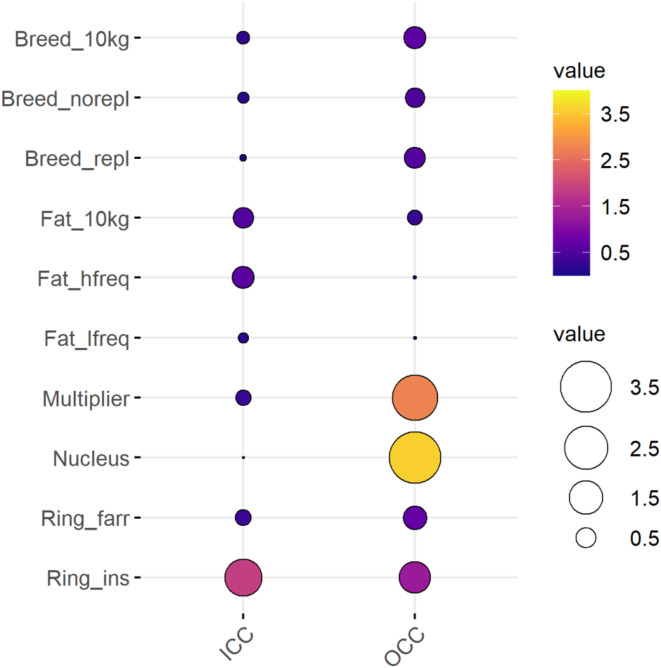
Livestock production systems are complex and evolve over time, affecting their adaptability to economic, political, and disease-related changes. In Europe, disease resilience is crucial due to threats like the African swine fever virus, which jeopardizes pork production stability. The European Union identifies farm production type as a key risk factor for disease spread, making it important to track changes in farm production types to assess disease risk. However, detailed production type data is often lacking in national databases. For Swiss pig farms, we used prediction and clustering algorithms to classify 9'687 - 11'247 trading farms between 2014 and 2019 by one of eleven production types. We then analyzed the pig trade network and stratified farm centrality measures (ICC and OCC) by production type. We found that 145 farms belonging to three production types have substantially higher ICC and OCC than other farms, suggesting that they could be the target of disease surveillance programs. Our predictions until 2025 show an increase both in overall pig trade network connectivity and in proportion of production types with high ICC and OCC, indicating that the structural changes in the Swiss pig production system may increase infectious disease exposure over time.
畜牧生产系统复杂且随时间演变,影响其对经济、政治及与疾病相关变化的适应能力。在欧洲,由于非洲猪瘟病毒等威胁危及猪肉生产稳定性,疾病恢复力至关重要。欧盟将农场生产类型确定为疾病传播的关键风险因素,因此追踪农场生产类型的变化以评估疾病风险很重要。然而,国家数据库中往往缺乏详细的生产类型数据。对于瑞士猪场,我们使用预测和聚类算法,在2014年至2019年间将9687至11247个贸易猪场按11种生产类型之一进行分类。然后,我们分析了生猪贸易网络,并按生产类型对农场中心性指标(入度中心性和出度中心性)进行分层。我们发现,属于三种生产类型的145个农场的入度中心性和出度中心性显著高于其他农场,这表明它们可能是疾病监测计划的目标。我们对2025年之前的预测显示,生猪贸易网络的整体连通性以及具有高入度中心性和出度中心性的生产类型比例均会增加,这表明瑞士生猪生产系统的结构变化可能会随着时间的推移增加传染病暴露风险。