
通过水动力肢体静脉注射的多聚体纳米胶束介导的Pgc-1α4 mRNA递送增强杜氏肌营养不良小鼠的抗损伤能力。
Polyplex Nanomicelle-Mediated Pgc-1α4 mRNA Delivery Via Hydrodynamic Limb Vein Injection Enhances Damage Resistance in Duchenne Muscular Dystrophy Mice.
作者信息
Du Xuan, Nakanishi Hideyuki, Yamada Takashi, Sin Yooksil, Minegishi Katsura, Motohashi Norio, Aoki Yoshitsugu, Itaka Keiji
机构信息
Department of Biofunction Research, Laboratory for Biomaterials and Bioengineering, Institute of Integrated Research, Institute of Science Tokyo, Tokyo, 101-0062, Japan.
Clinical Biotechnology Team, Center for Infectious Disease Education and Research (CiDER), Osaka University, Osaka, 565-0871, Japan.
出版信息
Adv Sci (Weinh). 2025 Apr;12(16):e2409065. doi: 10.1002/advs.202409065. Epub 2025 Mar 6.
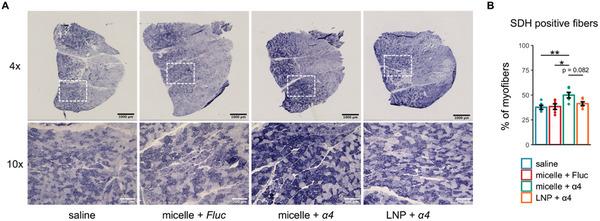
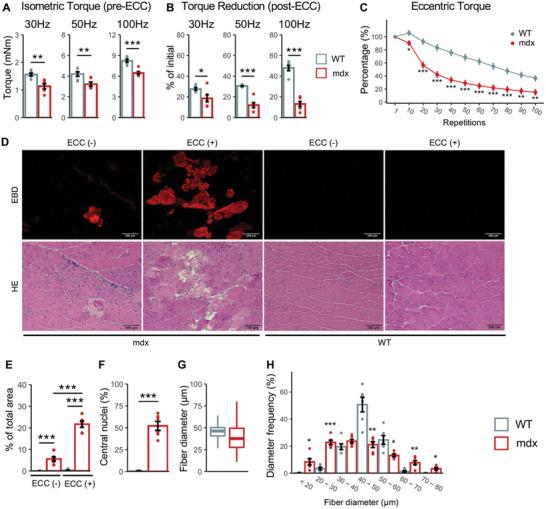
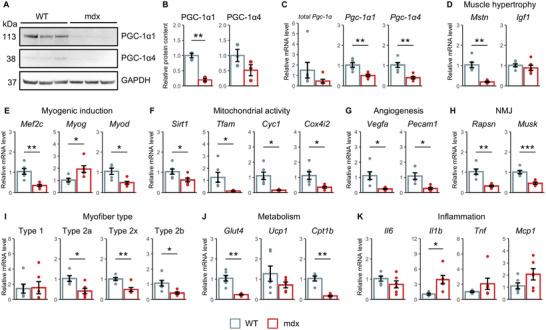
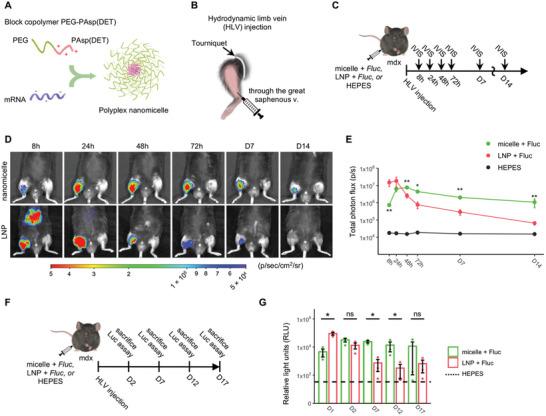
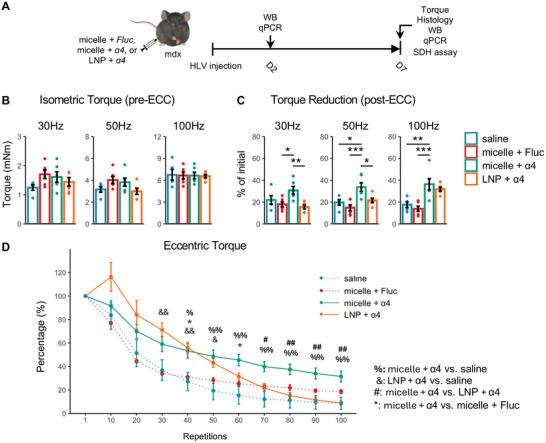
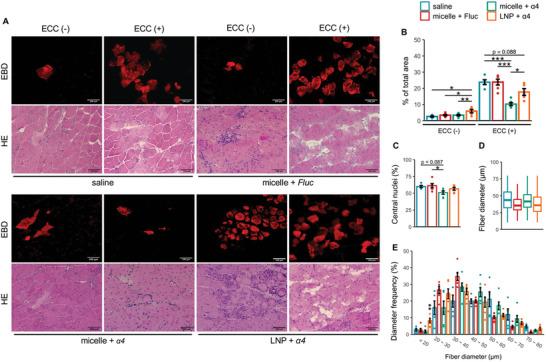
Duchenne muscular dystrophy (DMD) is caused by mutations in the DMD gene, leading to the absence of dystrophin and progressive muscle degeneration. Current therapeutic strategies, such as exon-skipping and gene therapy, face limitations including truncated dystrophin production and safety concerns. To address these issues, a novel mRNA-based therapy is explored using polyplex nanomicelles to deliver mRNA encoding peroxisome proliferator-activated receptor gamma coactivator 1 alpha isoform 4 (PGC-1α4) via hydrodynamic limb vein (HLV) administration. Using an in vivo muscle torque measurement technique, it is observed that nanomicelle-delivered Pgc-1α4 mRNA significantly improved muscle damage resistance and mitochondrial activity in mdx mice. Specifically, HLV administration of Pgc-1α4 mRNA in dystrophic muscles significantly relieved the torque reduction and myofiber injury induced by eccentric contraction (ECC), boosted metabolic gene expression, and enhanced muscle oxidative capacity. In comparison, lipid nanoparticles (LNPs), a widely used mRNA delivery system, does not achieve similar protective effects, likely due to their intrinsic immunogenicity. This foundational proof-of-concept study highlights the potential of mRNA-based therapeutics for the treatment of neuromuscular diseases such as DMD and demonstrates the capability of polyplex nanomicelles as a safe and efficient mRNA delivery system for therapeutic applications.
杜兴氏肌肉营养不良症(DMD)由DMD基因突变引起,导致肌营养不良蛋白缺失和进行性肌肉退化。目前的治疗策略,如外显子跳跃和基因治疗,面临着包括产生截短的肌营养不良蛋白以及安全问题等局限性。为了解决这些问题,人们探索了一种基于mRNA的新型疗法,即使用多聚体纳米胶束通过水动力肢体静脉(HLV)给药来递送编码过氧化物酶体增殖物激活受体γ共激活因子1α异构体4(PGC-1α4)的mRNA。使用体内肌肉扭矩测量技术,观察到纳米胶束递送的Pgc-1α4 mRNA显著提高了mdx小鼠的肌肉抗损伤能力和线粒体活性。具体而言,在营养不良的肌肉中通过HLV给药Pgc-1α4 mRNA可显著缓解由离心收缩(ECC)诱导的扭矩降低和肌纤维损伤,促进代谢基因表达,并增强肌肉氧化能力。相比之下,脂质纳米颗粒(LNPs)作为一种广泛使用的mRNA递送系统,由于其固有的免疫原性,无法实现类似的保护作用。这项基础概念验证研究突出了基于mRNA的疗法在治疗诸如DMD等神经肌肉疾病方面的潜力,并证明了多聚体纳米胶束作为一种安全有效的mRNA递送系统用于治疗应用的能力。

 Zotero 插件