Ganos Christos, Ferguson Michael A, Gray Kurt, Lees Andrew J, Bhatia Kailash P, Haggard Patrick
Movement Disorder Clinic, Edmond J. Safra Program in Parkinson's Disease, Division of Neurology University of Toronto, Toronto Western Hospital, Toronto, Canada M5T 2S8.
Department of Neurology, Charité - Universitätsmedizin Berlin, Corporate Member of Freie Universität Berlin and Humboldt-Universität zu Berlin, 10117 Berlin, Germany.
Brain Commun. 2025 Jan 13;7(2):fcae471. doi: 10.1093/braincomms/fcae471. eCollection 2025.
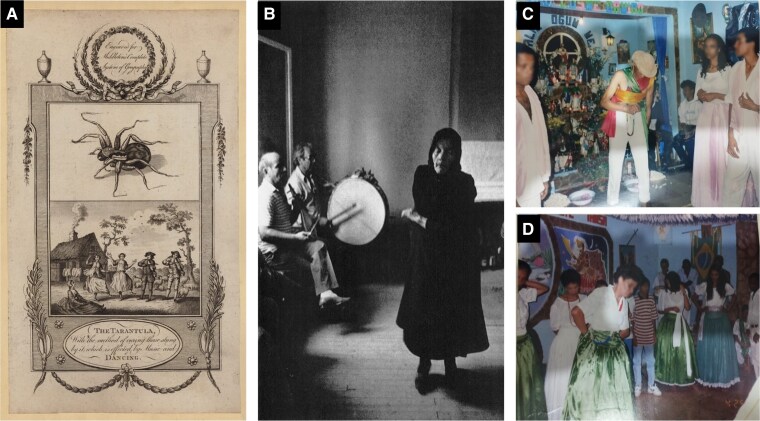
Religion is a widespread feature of human life. Religions typically include both distinctive varieties of experience and also a set of foundational beliefs. An additional, but often overlooked, part of many religions is their expression through specific actions, which we here designate religious motor behaviours. Here we describe these religious motor behaviours and offer a taxonomy based on the conceptual schemes of movement neuroscience and neurology. Thus, religious rituals include both behaviours characterized by decreased motor output (e.g. ritualistic silence) and behaviours characterized by increased motor output (e.g. ritual dances). Neurology often also distinguishes between movements that are as voluntary or involuntary. We show that this same distinction can also apply to religious experiences, since these may be characterized either by a heightened sense of personal control or a sense of being controlled by an external, divine source. We then use these conceptual structures of movement neuroscience to investigate examples from a wide range of religious contexts. We thereby categorize religious motor behaviours into different classes, focusing on specific examples: repetitive ritual actions; motor behaviours where the experience of volition is altered, such as automatisms; and possession-like states. We suggest that a scientific approach to these behaviours should include their predominant phenomenological presentation, the accompanying subjective experience of volition and the underlying neurocognitive mechanisms. This investigation shows rich parallels between religious motor behaviours and motor behaviours observed in neurological disorders, including those that present with functional neurological symptoms. Our approach does not and should not pathologize religious motor behaviours, but rather draws attention to a rich set of non-clinical motor phenomena that highlights important social, cultural and psychological elements of human movement control. Movement neuroscience and religious activity have unexplored overlaps and can usefully learn from each other.
宗教是人类生活中普遍存在的一个特征。宗教通常既包括独特的体验形式,也包括一系列基本信仰。许多宗教中另外一个常被忽视的部分是它们通过特定行为的表达,我们在此将其称为宗教运动行为。在这里,我们描述这些宗教运动行为,并基于运动神经科学和神经学的概念框架提供一种分类法。因此,宗教仪式既包括以运动输出减少为特征的行为(如仪式性沉默),也包括以运动输出增加为特征的行为(如仪式舞蹈)。神经学通常还区分自愿或非自愿的运动。我们表明,同样的区分也适用于宗教体验,因为这些体验可能以个人控制感增强或被外部神圣力量控制的感觉为特征。然后,我们利用这些运动神经科学的概念结构来研究来自广泛宗教背景的例子。我们据此将宗教运动行为分为不同类别,重点关注具体例子:重复性仪式动作;意志体验发生改变的运动行为,如自动症;以及附体样状态。我们建议,对这些行为的科学研究方法应包括其主要的现象学表现、伴随的意志主观体验以及潜在的神经认知机制。这项研究表明,宗教运动行为与在神经疾病中观察到的运动行为之间存在丰富的相似之处,包括那些表现为功能性神经症状的行为。我们的方法不会也不应将宗教运动行为病态化,而是提请人们注意一组丰富的非临床运动现象,这些现象突出了人类运动控制中重要的社会、文化和心理因素。运动神经科学和宗教活动存在尚未探索的重叠之处,并且可以相互借鉴。