Vanholder Raymond, Bé Alicia, De Barbieri Ilaria, Gallego Daniel, Fontana Monica, Faure Marine, Luyckx Valerie, Oostrom Tom, Scheres Eveline, van Vredendaal Ole, Lameire Norbert
Nephrology Section, Department of Internal Medicine and Pediatrics, Ghent University Hospital, Ghent, Belgium; EKHA President.
Associate, European Kidney Health Alliance, Brussels, Belgium, Dentons Global Advisors (DGA) Group, Health Practice, Brussels, Belgium.
Clin Kidney J. 2025 Jan 9;18(3):sfaf005. doi: 10.1093/ckj/sfaf005. eCollection 2025 Mar.
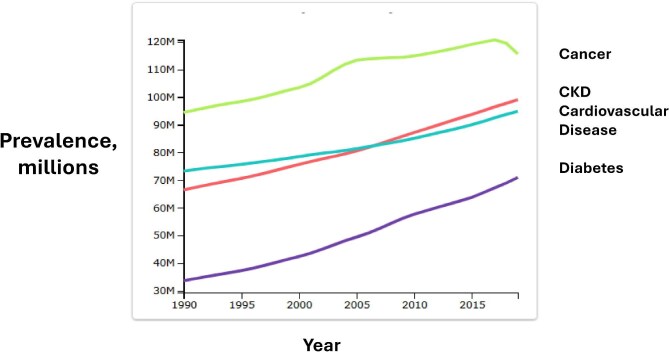
Chronic kidney disease (CKD) is one of the most prevalent and fatal chronic diseases. However, the political attention CKD receives is not proportional to its significant human, economic and ecological burden. One major reason is the lack of awareness among the general population and policymakers. As a result, investment in the therapeutic approaches to CKD have largely remained inadequate, while existing therapies did not change for decades. To respond to the lack of awareness of CKD, several European and international kidney care societies, supported by national and regional organizations, founded the European Kidney Health Alliance (EKHA) in 2007. This Alliance is a Brussels-based advocacy organization representing people with kidney diseases and the kidney care community at the European Union level, and from there, also at the country level. EKHA's aim is to ensure that every candidate for kidney care, irrespective of stage of kidney disease, receives optimal and timely treatment, which is affordable at a societal and individual level. This publication reviews the European political landscape, EKHA's history, points of focus and tools for harnessing available data into advocacy on CKD. Areas discussed include prevention and screening of CKD, its health-economic and environmental impact, and the need to facilitate kidney transplantation and home dialysis. We also examine EKHA's specific approaches to enhance kidney care, its affordability and its sustainability. The EKHA model aims at forestalling the burden of CKD and its underestimated economic and ecologic impact.
慢性肾脏病(CKD)是最常见且致命的慢性病之一。然而,CKD所获得的政治关注与其巨大的人力、经济和生态负担并不相称。一个主要原因是普通民众和政策制定者缺乏认识。因此,对CKD治疗方法的投资在很大程度上仍然不足,而现有的治疗方法几十年来都没有改变。为应对对CKD缺乏认识的问题,在国家和地区组织的支持下,几个欧洲和国际肾脏护理协会于2007年成立了欧洲肾脏健康联盟(EKHA)。该联盟是一个总部位于布鲁塞尔的倡导组织,在欧盟层面代表肾病患者和肾脏护理群体,并且从那里也在国家层面代表他们。EKHA的目标是确保每一位肾脏护理候选人,无论其肾病处于何种阶段,都能获得最佳且及时的治疗,这种治疗在社会和个人层面都是负担得起的。本出版物回顾了欧洲的政治格局、EKHA的历史、重点关注领域以及将现有数据用于CKD倡导的工具。讨论的领域包括CKD的预防和筛查、其健康经济和环境影响,以及促进肾脏移植和家庭透析的必要性。我们还研究了EKHA加强肾脏护理、其可负担性及其可持续性的具体方法。EKHA模式旨在预防CKD的负担及其被低估的经济和生态影响。