Gilliam Ashley, Sadler Natalie C, Li Xiaolu, Garcia Marci, Johnson Zachary, Veličković Marija, Kim Young-Mo, Feng Song, Qian Wei-Jun, Cheung Margaret S, Bohutskyi Pavlo
Biological Sciences Division, Earth and Biological Sciences Directorate, Pacific Northwest National Laboratory, Richland, WA, USA.
Department of Biological Systems Engineering, Washington State University, Pullman, WA, USA.
Microb Cell Fact. 2025 Mar 8;24(1):56. doi: 10.1186/s12934-025-02665-5.
The industrial feasibility of photosynthetic bioproduction using cyanobacterial platforms remains challenging due to insufficient yields, particularly due to competition between product formation and cellular carbon demands across different temporal phases of growth. This study investigates how circadian clock regulation impacts carbon partitioning between storage, growth, and product synthesis in Synechococcus elongatus PCC 7942, and provides insights that suggest potential strategies for enhanced bioproduction.
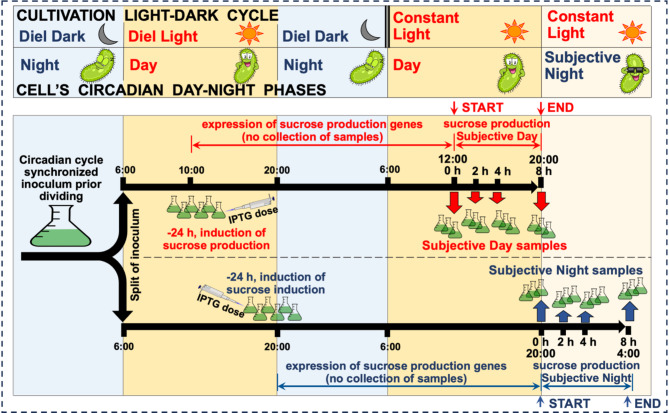
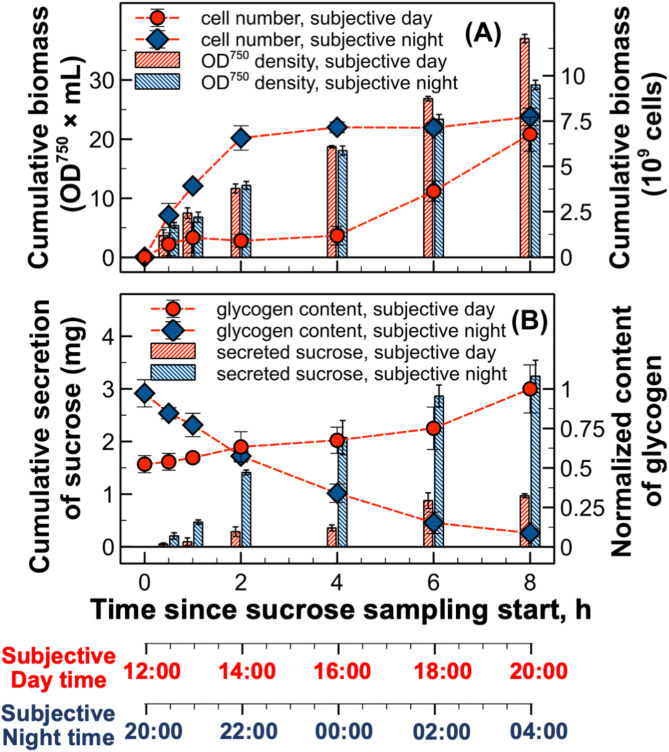
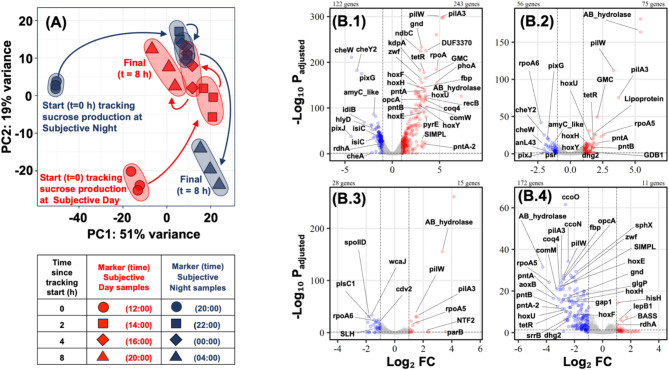
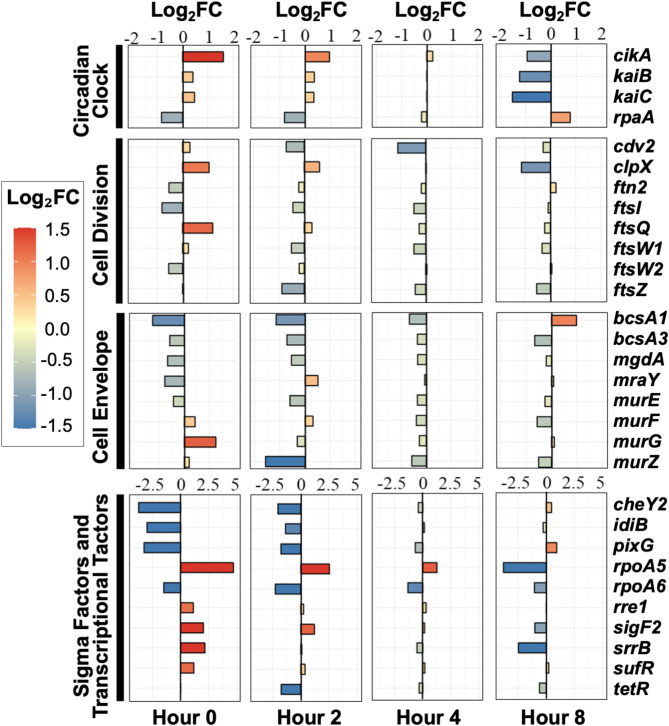
After entrainment to light-dark cycles, PCC 7942 cultures transitioned to constant light revealed distinct temporal patterns in sucrose production, exhibiting three-fold higher productivity during subjective night compared to subjective day despite moderate down-regulation of genes from the photosynthetic apparatus. This enhanced productivity coincided with reduced glycogen accumulation and halted cell division at subjective night time, suggesting temporal separation of competing processes. Transcriptome analysis revealed coordinated circadian clock-driven adjustment of the cell cycle and rewiring of energy and carbon metabolism, with over 300 genes showing differential expression across four time points. The subjective night was characterized by altered expression of cell division-related genes and reduced expression of genes involved in glycogen synthesis, while showing upregulation of glycogen degradation pathways, alternative electron flow components, the pentose phosphate pathway, and oxidative decarboxylation of pyruvate. These molecular changes created favorable conditions for product formation through enhanced availability of major sucrose precursors (glucose-1-phosphate and fructose-6-phosphate) and maintained redox balance through multiple mechanisms.
Our analysis of circadian regulatory rewiring of carbon metabolism and redox balancing suggests two potential approaches that could be developed for improving cyanobacterial bioproduction: leveraging natural circadian rhythms for optimizing cultivation conditions and timing of pathway induction, and engineering strains that mimic circadian-driven metabolic shifts through controlled carbon flux redistribution and redox rebalancing. While these strategies remain to be tested, they could theoretically improve the efficiency of photosynthetic bioproduction by enabling better temporal separation between cell growth, carbon storage accumulation, and product synthesis phases.
由于产量不足,利用蓝藻平台进行光合生物生产的工业可行性仍然具有挑战性,特别是由于在不同生长阶段产品形成与细胞碳需求之间存在竞争。本研究调查了生物钟调控如何影响聚球藻PCC 7942中储存、生长和产品合成之间的碳分配,并提供了一些见解,这些见解为提高生物生产的潜在策略提供了建议。
在适应明暗循环后,转入持续光照的PCC 7942培养物在蔗糖生产中表现出明显的时间模式,尽管光合装置的基因适度下调,但在主观夜间的生产力比主观白天高两倍。这种提高的生产力与糖原积累减少和主观夜间细胞分裂停止相吻合,表明竞争过程在时间上是分离的。转录组分析揭示了生物钟驱动的细胞周期协调调节以及能量和碳代谢的重新布线,超过300个基因在四个时间点表现出差异表达。主观夜间的特征是细胞分裂相关基因的表达改变以及糖原合成相关基因的表达降低,同时糖原降解途径、替代电子流成分、戊糖磷酸途径和丙酮酸氧化脱羧上调。这些分子变化通过增加主要蔗糖前体(葡萄糖-1-磷酸和果糖-6-磷酸)的可用性为产品形成创造了有利条件,并通过多种机制维持了氧化还原平衡。
我们对碳代谢的生物钟调节重新布线和氧化还原平衡的分析表明,可以开发两种潜在方法来提高蓝藻生物生产:利用自然生物钟节律优化培养条件和途径诱导的时间,以及通过控制碳通量重新分布和氧化还原重新平衡来模拟生物钟驱动的代谢转变的工程菌株。虽然这些策略仍有待测试,但理论上它们可以通过在细胞生长、碳储存积累和产品合成阶段之间实现更好的时间分离来提高光合生物生产的效率。