• 文献检索
  • 文档翻译
  • 深度研究
  • 学术资讯
  • Suppr Zotero 插件Zotero 插件
  • 邀请有礼
  • 套餐&价格
  • 历史记录
应用&插件
Suppr Zotero 插件Zotero 插件浏览器插件Mac 客户端Windows 客户端微信小程序
定价
高级版会员购买积分包购买API积分包
服务
文献检索文档翻译深度研究API 文档MCP 服务
关于我们
关于 Suppr公司介绍联系我们用户协议隐私条款
关注我们

Suppr 超能文献

核心技术专利:CN118964589B侵权必究
粤ICP备2023148730 号-1Suppr @ 2026

文献检索

告别复杂PubMed语法,用中文像聊天一样搜索,搜遍4000万医学文献。AI智能推荐,让科研检索更轻松。

立即免费搜索

文件翻译

保留排版,准确专业,支持PDF/Word/PPT等文件格式,支持 12+语言互译。

免费翻译文档

深度研究

AI帮你快速写综述,25分钟生成高质量综述,智能提取关键信息,辅助科研写作。

立即免费体验

使用机器学习算法进行颗粒物浓度预测:一种虚拟监测站的方法

PM concentration prediction using machine learning algorithms: an approach to virtual monitoring stations.

作者信息

Makhdoomi Ahmad, Sarkhosh Maryam, Ziaei Somayyeh

机构信息

Department of Environmental Health Engineering, School of Health, Mashhad University of Medical Sciences, Mashhad, Iran.

出版信息

Sci Rep. 2025 Mar 8;15(1):8076. doi: 10.1038/s41598-025-92019-3.

DOI:10.1038/s41598-025-92019-3
PMID:40057563
原文链接:https://pmc.ncbi.nlm.nih.gov/articles/PMC11890590/
Abstract

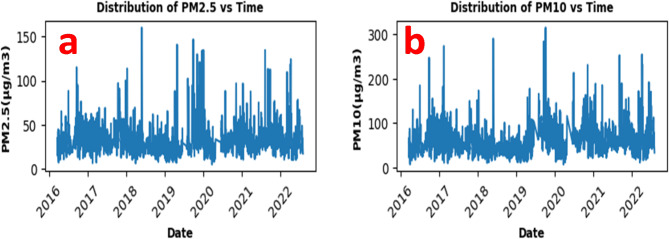
One of the most important pollutants is PM, which is particularly important to monitor pollutant levels to keep the pollutant concentration under control. In this research, an attempt has been made to predict the concentrations of PM using four Machine Learning (ML) models. The ML methods include Light Gradient Boosting Machine (LGBM), Extreme Gradient Boosting Regressor (XGBR), Random Forest (RF) and Gradient Boosting Regressor (GBR). The mean and maximum concentration of PM were recorded 32.84 µg/m and 160.25 µg/m, respectively, indicating the occurrence of occasional episodes of high pollution levels from 2016 to 2022. The PM2.5 concentrations dropped below 30 µg/m in 2018 due to reduced human activities during COVID-19 lockdowns but PM levels were significantly increased because of the ongoing operation of heavy industries post-COVID-19 lockdowns during 2021. The ML models performed very well in predicting the concentrations of PM with around 95% of their predictions falling within the factor of the observed concentration. The results presented that among the four ML algorithms, GBR confirmed good model performance compared to the other models, with the lowest MSE (5.33) and RMSE (2.31), as well as high accuracy measures. This suggests that GBR is the best model for reducing large errors, making it more robust in capturing variations in PM2.5 levels. In conclusion, the study proposed a method to obtain high-accuracy PM prediction results using ML which are useful for air quality monitoring on a global scale and improving acute exposure assessment in epidemiological research.

摘要

最重要的污染物之一是颗粒物(PM),监测污染物水平以控制污染物浓度尤为重要。在本研究中,已尝试使用四种机器学习(ML)模型预测PM的浓度。这些ML方法包括轻梯度提升机(LGBM)、极端梯度提升回归器(XGBR)、随机森林(RF)和梯度提升回归器(GBR)。PM的平均浓度和最大浓度分别记录为32.84微克/立方米和160.25微克/立方米,这表明2016年至2022年期间偶尔会出现高污染水平事件。由于在新冠疫情封锁期间人类活动减少,2018年PM2.5浓度降至30微克/立方米以下,但在2021年新冠疫情封锁后,由于重工业的持续运营,PM水平显著上升。这些ML模型在预测PM浓度方面表现非常出色,约95%的预测值落在观测浓度的系数范围内。结果表明,在这四种ML算法中,与其他模型相比,GBR具有良好的模型性能,均方误差(MSE)最低(5.33),均方根误差(RMSE)最低(2.31),且具有较高的准确度指标。这表明GBR是减少大误差的最佳模型,使其在捕捉PM2.5水平变化方面更稳健。总之,该研究提出了一种使用ML获得高精度PM预测结果的方法,这对于全球范围内的空气质量监测以及改善流行病学研究中的急性暴露评估非常有用。

https://cdn.ncbi.nlm.nih.gov/pmc/blobs/e908/11890590/757cacbc4d54/41598_2025_92019_Fig6_HTML.jpg
https://cdn.ncbi.nlm.nih.gov/pmc/blobs/e908/11890590/b2fe9d0fd86d/41598_2025_92019_Fig1_HTML.jpg
https://cdn.ncbi.nlm.nih.gov/pmc/blobs/e908/11890590/5fd0e723a632/41598_2025_92019_Fig2_HTML.jpg
https://cdn.ncbi.nlm.nih.gov/pmc/blobs/e908/11890590/57469f52e120/41598_2025_92019_Fig3_HTML.jpg
https://cdn.ncbi.nlm.nih.gov/pmc/blobs/e908/11890590/92cab836112f/41598_2025_92019_Fig4_HTML.jpg
https://cdn.ncbi.nlm.nih.gov/pmc/blobs/e908/11890590/4f4bd54908dc/41598_2025_92019_Fig5_HTML.jpg
https://cdn.ncbi.nlm.nih.gov/pmc/blobs/e908/11890590/757cacbc4d54/41598_2025_92019_Fig6_HTML.jpg
https://cdn.ncbi.nlm.nih.gov/pmc/blobs/e908/11890590/b2fe9d0fd86d/41598_2025_92019_Fig1_HTML.jpg
https://cdn.ncbi.nlm.nih.gov/pmc/blobs/e908/11890590/5fd0e723a632/41598_2025_92019_Fig2_HTML.jpg
https://cdn.ncbi.nlm.nih.gov/pmc/blobs/e908/11890590/57469f52e120/41598_2025_92019_Fig3_HTML.jpg
https://cdn.ncbi.nlm.nih.gov/pmc/blobs/e908/11890590/92cab836112f/41598_2025_92019_Fig4_HTML.jpg
https://cdn.ncbi.nlm.nih.gov/pmc/blobs/e908/11890590/4f4bd54908dc/41598_2025_92019_Fig5_HTML.jpg
https://cdn.ncbi.nlm.nih.gov/pmc/blobs/e908/11890590/757cacbc4d54/41598_2025_92019_Fig6_HTML.jpg

相似文献

1
PM concentration prediction using machine learning algorithms: an approach to virtual monitoring stations.使用机器学习算法进行颗粒物浓度预测:一种虚拟监测站的方法
Sci Rep. 2025 Mar 8;15(1):8076. doi: 10.1038/s41598-025-92019-3.
2
A land use regression model using machine learning and locally developed low cost particulate matter sensors in Uganda.乌干达使用机器学习和本地开发的低成本颗粒物传感器的土地利用回归模型。
Environ Res. 2021 Aug;199:111352. doi: 10.1016/j.envres.2021.111352. Epub 2021 May 24.
3
Machine learning-based quantification and separation of emissions and meteorological effects on PM in Greater Bangkok.基于机器学习的大曼谷地区排放物与气象因素对细颗粒物影响的量化与分离
Sci Rep. 2025 Apr 28;15(1):14775. doi: 10.1038/s41598-025-99094-6.
4
Improving PM prediction in New Delhi using a hybrid extreme learning machine coupled with snake optimization algorithm.利用混合极限学习机和蛇型优化算法提高新德里的 PM 预测精度。
Sci Rep. 2023 Nov 29;13(1):21057. doi: 10.1038/s41598-023-47492-z.
5
Elevating hourly PM forecasting in Istanbul, Türkiye: Leveraging ERA5 reanalysis and genetic algorithms in a comparative machine learning model analysis.提升土耳其伊斯坦布尔的每小时 PM 预测:在比较机器学习模型分析中利用 ERA5 再分析和遗传算法。
Chemosphere. 2024 Sep;364:143096. doi: 10.1016/j.chemosphere.2024.143096. Epub 2024 Aug 13.
6
Unmasking the sky: high-resolution PM prediction in Texas using machine learning techniques.揭开天空的面具:利用机器学习技术在德克萨斯州进行高分辨率 PM 预测。
J Expo Sci Environ Epidemiol. 2024 Sep;34(5):814-820. doi: 10.1038/s41370-024-00659-w. Epub 2024 Apr 1.
7
Evaluation of machine learning techniques with multiple remote sensing datasets in estimating monthly concentrations of ground-level PM.利用多种遥感数据集评估机器学习技术估算地面 PM 月浓度
Environ Pollut. 2018 Nov;242(Pt B):1417-1426. doi: 10.1016/j.envpol.2018.08.029. Epub 2018 Aug 11.
8
Seasonal prediction of daily PM concentrations with interpretable machine learning: a case study of Beijing, China.基于可解释机器学习的日 PM 浓度季节性预测:以中国北京为例。
Environ Sci Pollut Res Int. 2022 Jun;29(30):45821-45836. doi: 10.1007/s11356-022-18913-9. Epub 2022 Feb 12.
9
Predicting ambient PM concentrations in Ulaanbaatar, Mongolia with machine learning approaches.利用机器学习方法预测蒙古乌兰巴托的环境 PM 浓度。
J Expo Sci Environ Epidemiol. 2021 Jul;31(4):699-708. doi: 10.1038/s41370-020-0257-8. Epub 2020 Aug 3.
10
Deep Ensemble Machine Learning Framework for the Estimation of Concentrations.深度集成机器学习框架用于估算浓度。
Environ Health Perspect. 2022 Mar;130(3):37004. doi: 10.1289/EHP9752. Epub 2022 Mar 7.

引用本文的文献

1
Machine learning-based quantification and separation of emissions and meteorological effects on PM in Greater Bangkok.基于机器学习的大曼谷地区排放物与气象因素对细颗粒物影响的量化与分离
Sci Rep. 2025 Apr 28;15(1):14775. doi: 10.1038/s41598-025-99094-6.

本文引用的文献

1
Assessing VOC emissions from different gas stations: impacts, variations, and modeling fluctuations of air pollutants.评估不同加油站的挥发性有机化合物排放:空气污染物的影响、变化及建模波动
Sci Rep. 2024 Jul 18;14(1):16617. doi: 10.1038/s41598-024-67542-4.
2
The Air Quality Index (AQI) in historical and analytical perspective a tutorial review.空气质量指数(AQI)的历史与分析视角:一篇教程综述
Talanta. 2024 Jan 15;267:125260. doi: 10.1016/j.talanta.2023.125260. Epub 2023 Oct 5.
3
Unique regulatory roles of ncRNAs changed by PM in human diseases.
颗粒物改变的非编码RNA在人类疾病中的独特调控作用。
Ecotoxicol Environ Saf. 2023 Apr 15;255:114812. doi: 10.1016/j.ecoenv.2023.114812. Epub 2023 Mar 22.
4
A hybrid deep learning model for regional O and NO concentrations prediction based on spatiotemporal dependencies in air quality monitoring network.基于空气质量监测网络时空相关性的区域 O 和 NO 浓度预测的混合深度学习模型。
Environ Pollut. 2023 Mar 1;320:121075. doi: 10.1016/j.envpol.2023.121075. Epub 2023 Jan 11.
5
Public engagement with air quality data: using health behaviour change theory to support exposure-minimising behaviours.公众参与空气质量数据:利用健康行为改变理论支持减少暴露的行为。
J Expo Sci Environ Epidemiol. 2023 May;33(3):321-331. doi: 10.1038/s41370-022-00449-2. Epub 2022 Jun 28.
6
Understanding the role of atmospheric circulations and dispersion of air pollution associated with extreme smog events over South Asian megacity.理解大气环流与与南亚特大城市极端雾霾事件相关的空气污染扩散的作用。
Environ Monit Assess. 2022 Jan 11;194(2):82. doi: 10.1007/s10661-021-09674-y.
7
Effects of lockdown due to COVID-19 outbreak on air quality and anthropogenic heat in an industrial belt of India.新冠疫情封锁对印度某工业带空气质量和人为热的影响。
J Clean Prod. 2021 May 15;297:126674. doi: 10.1016/j.jclepro.2021.126674. Epub 2021 Mar 17.
8
The coefficient of determination R-squared is more informative than SMAPE, MAE, MAPE, MSE and RMSE in regression analysis evaluation.在回归分析评估中,决定系数R平方比对称平均绝对百分比误差(SMAPE)、平均绝对误差(MAE)、平均绝对百分比误差(MAPE)、均方误差(MSE)和均方根误差(RMSE)更具信息量。
PeerJ Comput Sci. 2021 Jul 5;7:e623. doi: 10.7717/peerj-cs.623. eCollection 2021.
9
Occurrence and source apportionment of polycyclic aromatic hydrocarbons (PAHs) in dust of an emerging industrial city in Iran: implications for human health.伊朗新兴工业城市粉尘中多环芳烃(PAHs)的产生和来源分配:对人类健康的影响。
Environ Sci Pollut Res Int. 2021 Nov;28(44):63359-63376. doi: 10.1007/s11356-021-14839-w. Epub 2021 Jul 6.
10
Estimating hourly PM concentrations in Beijing with satellite aerosol optical depth and a random forest approach.利用卫星气溶胶光学深度和随机森林方法估算北京的逐时 PM 浓度。
Sci Total Environ. 2021 Mar 25;762:144502. doi: 10.1016/j.scitotenv.2020.144502. Epub 2020 Dec 14.