Lu Yuan, Huang Jianchun, Yan Jian, Wei Qingfang, He Meirong, Yuan Chunlan, Long Yu
Obstetrics Department, Nanning Second People's Hospital, Nanning, Guangxi, 530000, China.
Department of Obstetrics and Gynecology, The First Affiliated Hospital of Guangxi Medical University, Nanning, Guangxi, 530000, China.
BMC Pregnancy Childbirth. 2025 Mar 8;25(1):257. doi: 10.1186/s12884-025-07367-9.
To comprehensively evaluate the risk factors for recurrent gestational diabetes mellitus (GDM) in women with a history of GDM during re-pregnancy.
Articles about risk factors for recurrent GDM were searched in China National Knowledge Infrastructure, Wanfang Data, VIP Database for Chinese Technical Periodicals, PubMed, EMBASE, the Cochrane Library, and Web of Science from the date of establishment to January 2023. Meta-analysis of risk factors for recurrent GDM was performed using STATA/SE 15.1 software.
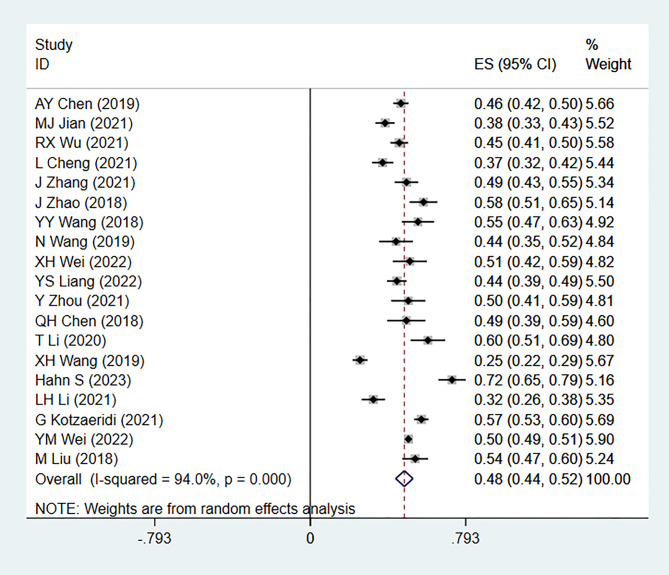
A total of 19 studies were included in the meta-analysis, comprising 15 case-control studies and 4 cohort studies, involving 11,385 patients. Among them, 2,462 patients experienced recurrent GDM, while 2,909 did not. The analysis of case-control studies revealed a GDM recurrence rate of 48%. Meta-analysis identified several significant risk factors for GDM recurrence: advanced maternal age at subsequent pregnancy [ES = 3.02, 95% CI (1.24,2.79), P = 0.003], increased BMI prior to the subsequent pregnancy [ES = 2.23, 95% CI (1.04,1.72), P = 0.026], elevated 1-hour plasma glucose levels in oral glucose tolerance test (OGTT) during previous pregnancy [ES = 2.79, 95% CI (1.11,1.78), P = 0.005], increased 2-hour OGTT glucose levels in previous pregnancy [ES = 2.75, 95% CI (1.11,1.91), P = 0.006], and previous delivery of macrosomia [ES = 3.48, 95% CI (1.38,3.18), P = 0.001]. All these factors showed statistically significant differences between the recurrence and non-recurrence groups. Pregnant women with a history of GDM can reduce the risk of recurrence by adopting a reasonable pregnancy plan, such as avoiding advanced maternal age, managing body weight, controlling blood glucose levels during pregnancy, and losing weight before conception.
Advanced maternal age, elevated BMI before subsequent pregnancy, increased OGTT levels during the previous pregnancy, and the delivery of macrosomia are significant risk factors for recurrent GDM.
全面评估既往有妊娠期糖尿病(GDM)史的女性再次妊娠时发生复发性GDM的危险因素。
在中国知网、万方数据、维普中文科技期刊数据库、PubMed、EMBASE、Cochrane图书馆和Web of Science中检索自建库至2023年1月关于复发性GDM危险因素的文章。使用STATA/SE 15.1软件对复发性GDM的危险因素进行Meta分析。
Meta分析共纳入19项研究,包括15项病例对照研究和4项队列研究,涉及11385例患者。其中,2462例患者发生复发性GDM,2909例未发生。病例对照研究分析显示GDM复发率为48%。Meta分析确定了几个GDM复发的重要危险因素:再次妊娠时产妇年龄较大[效应量(ES)=3.02,95%置信区间(CI)(1.24,2.79),P = 0.003]、再次妊娠前体重指数(BMI)增加[ES = 2.23,95%CI(1.04,1.72),P = 0.026]、前次妊娠期间口服葡萄糖耐量试验(OGTT)1小时血糖水平升高[ES = 2.79,95%CI(1.11,1.78),P = 0.005]、前次妊娠OGTT 2小时血糖水平升高[ES = 2.75,95%CI(1.11,1.91),P = 0.006]以及前次分娩巨大儿[ES = 3.48,95%CI(1.38,3.18),P = 0.001]。所有这些因素在复发组和未复发组之间均显示出统计学显著差异。有GDM病史的孕妇可通过采取合理的妊娠计划降低复发风险,如避免产妇年龄较大、控制体重、孕期控制血糖水平以及孕前减重。
产妇年龄较大、再次妊娠前BMI升高、前次妊娠期间OGTT水平升高以及分娩巨大儿是复发性GDM的重要危险因素。