Costanzo Simona, de Laat Bas, Di Castelnuovo Augusto, van der Vorm Lisa, De Curtis Amalia, Cerletti Chiara, Ninivaggi Marisa, Donati Maria Benedetta, Iacoviello Licia, de Laat-Kremers Romy
Research Unit of Epidemiology and Prevention, IRCCS Neuromed, Pozzilli, Italy.
Department of Data Analysis and Artificial Intelligence, Synapse Research Institute, Maastricht, Netherlands.
Front Cardiovasc Med. 2025 Feb 21;12:1528871. doi: 10.3389/fcvm.2025.1528871. eCollection 2025.
Recent developments have made the thrombin generation (TG) test accessible to the clinical laboratory. Therefore, the clinical interpretation of TG parameters has become of increasing interest, and reference values are required. Age and sex have been shown to affect TG parameters, but no consensus has been reached on the subject. We investigated the effect of age and sex on TG parameters to determine the need for age and sex specific reference values for TG.
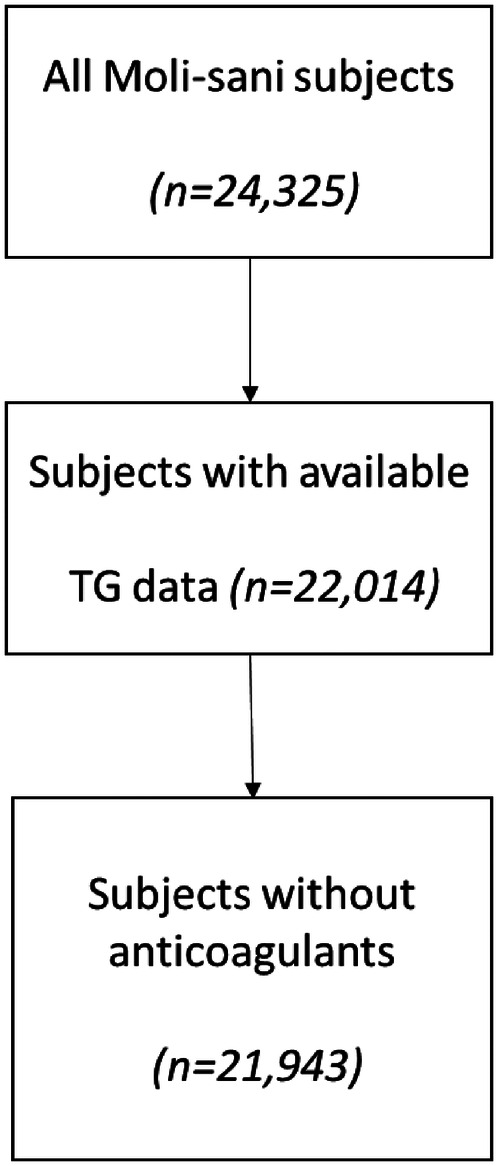
TG was measured in 22,014 individuals of the Moli-sani study, a cross-sectional cohort of the general adult Italian population. TG was measured using Calibrated Automated Thrombinography in platelet poor plasma (PPP) using PPP reagent Low and PPP reagent, in the presence and absence of thrombomodulin (TM).
Individuals were grouped into 6 age categories: 35-44 years of age ( = 5,073), 45-54 ( = 6,448), 55-64 ( = 5,516), 65-74 ( = 3,539), 75-84 ( = 1,261), and 85 years of age and older ( = 106). Men and women were distributed evenly in the age categories. Smoking was more common at younger age, whereas cardiovascular diseases, hypertension, hypercholesterolemia, and diabetes were more common at older age ( < 0.001). Lag time and velocity index increased with age, whereas the endogenous thrombin potential (ETP) and time-to-peak decreased. The inhibitory effect of TM was reduced at higher age ( < 0.001). The TG lag time was shorter in women than men at younger age (6%-7% lower in women), and the ETP was lower in women. The activated protein C (APC) pathway was desensitized in women and older individuals.
The TG profile becomes more "procoagulant" at older age, especially in women. The sensitivity of the APC pathway to TM is reduced with increasing age in men and women. Therefore, age and sex appropriate reference values for TG parameters would be of interest for the ongoing clinical implementation of the TG assay.
近期的发展使得临床实验室能够开展凝血酶生成(TG)检测。因此,TG参数的临床解读愈发受到关注,且需要参考值。年龄和性别已被证明会影响TG参数,但在这一问题上尚未达成共识。我们研究了年龄和性别对TG参数的影响,以确定是否需要针对年龄和性别的TG参考值。
在Moli-sani研究的22014名个体中测量TG,该研究是意大利成年普通人群的一项横断面队列研究。使用校准自动凝血酶生成法在无血小板血浆(PPP)中,使用低PPP试剂和PPP试剂,在有和没有血栓调节蛋白(TM)的情况下测量TG。
个体被分为6个年龄组:35 - 44岁(n = 5073)、45 - 54岁(n = 6448)、55 - 64岁(n = 5516)、65 - 74岁(n = 3539)、75 - 84岁(n = 1261)以及85岁及以上(n = 106)。男性和女性在各年龄组中分布均匀。吸烟在较年轻人群中更为常见,而心血管疾病、高血压、高胆固醇血症和糖尿病在较年长人群中更为常见(P < 0.001)。凝血启动时间和速度指数随年龄增加而增加,而内源性凝血酶潜力(ETP)和峰值时间减少。在较高年龄时,TM的抑制作用降低(P < 0.001)。在较年轻年龄时,女性的TG凝血启动时间比男性短(女性低6% - 7%),且女性的ETP较低。活化蛋白C(APC)途径在女性和年长个体中不敏感。
随着年龄增长,尤其是女性,TG谱变得更具“促凝性”。男性和女性中,APC途径对TM的敏感性随年龄增长而降低。因此,针对年龄和性别的TG参数参考值对于TG检测在临床中的持续应用将具有重要意义。