Boron Mallorie, Hauzer-Martin Tiffany, Keil Joseph, Sun Xue-Long
Department of Chemistry and Chemical and Biomedical Engineering and Center for Gene Regulation in Health and Disease (GRHD), Cleveland State University, Cleveland, Ohio, United States.
TH Open. 2022 Jul 11;6(3):e194-e212. doi: 10.1055/a-1801-2055. eCollection 2022 Jul.
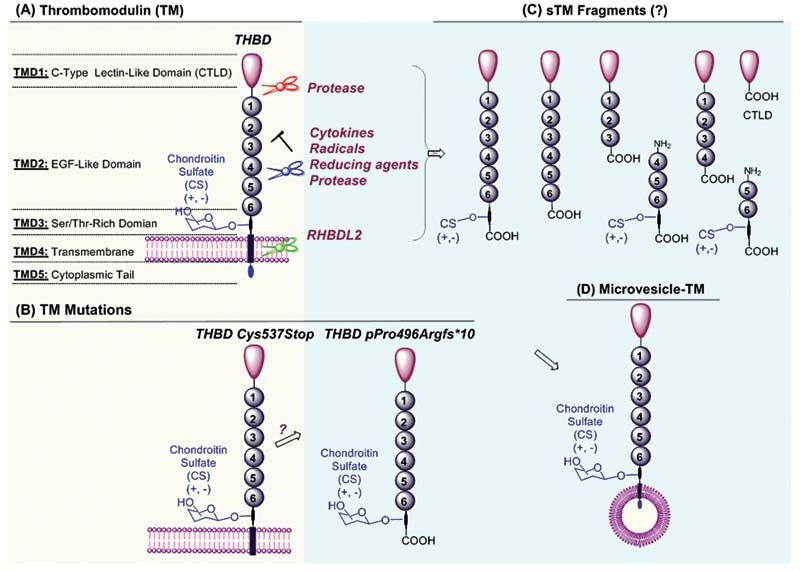
Thrombomodulin (TM) is a type-I transmembrane protein that is mainly expressed on endothelial cells and plays important roles in many biological processes. Circulating TM of different forms are also present in biofluids, such as blood and urine. Soluble TM (sTM), comprised of several domains of TM, is the major circulating TM which is generated by either enzymatic or chemical cleavage of the intact protein under different conditions. Under normal conditions, sTM is present in low concentrations (<10 ng/mL) in the blood but is elevated in several pathological conditions associated with endothelial dysfunction such as cardiovascular, inflammatory, infection, and metabolic diseases. Therefore, sTM level has been examined for monitoring disease development, such as disseminated intravascular coagulation (DIC), sepsis and multiple organ dysfunction syndrome in patients with novel coronavirus disease 2019 (COVID-19) recently. In addition, microvesicles (MVs) that contain membrane TM (MV-TM) have been found to be released from activated cells which also contribute to levels of circulating TM in certain diseases. Several release mechanisms of sTM and MV-TM have been reported, including enzymatic, chemical, and TM mutation mechanisms. Measurements of sTM and MV-TM have been developed and explored as biomarkers in many diseases. In this review, we summarize all these advances in three categories as follows: (1) release mechanisms of circulating TM, (2) methods for measuring circulating TM in biological samples, and (3) correlation of circulating TM with diseases. Altogether, it provides a whole picture of recent advances on circulating TM in health and disease.
血栓调节蛋白(TM)是一种I型跨膜蛋白,主要在内皮细胞上表达,在许多生物学过程中发挥重要作用。不同形式的循环TM也存在于生物流体中,如血液和尿液中。可溶性TM(sTM)由TM的几个结构域组成,是主要的循环TM,它是在不同条件下通过完整蛋白的酶切或化学切割产生的。在正常情况下,sTM在血液中的浓度较低(<10 ng/mL),但在与内皮功能障碍相关的几种病理状态下会升高,如心血管疾病、炎症、感染和代谢性疾病。因此,最近已经检测了sTM水平以监测疾病的发展,如2019年新型冠状病毒病(COVID-19)患者的弥散性血管内凝血(DIC)、败血症和多器官功能障碍综合征。此外,已发现含有膜TM(MV-TM)的微泡(MVs)从活化细胞中释放出来,这在某些疾病中也会导致循环TM水平升高。已经报道了sTM和MV-TM的几种释放机制,包括酶促、化学和TM突变机制。sTM和MV-TM的测量方法已被开发并探索作为许多疾病的生物标志物。在这篇综述中,我们将所有这些进展总结为以下三类:(1)循环TM的释放机制,(2)生物样品中循环TM的测量方法,以及(3)循环TM与疾病的相关性。总之,它提供了关于健康和疾病中循环TM最新进展的全貌。