Xie Anxia, Jin Ziwei, Li Changping, Li Chengxiong, Luo Gang, Zhang Xuecheng, Jian Shengyan, Li Deqin, Xie Youbang, Xie Ling, Wei Xiaoxing
Research Center for High Altitude Medicine, Qinghai University, No.251, Ningda Road, Chengbei District, Xining, 810016, People's Republic of China.
Department of Obstetrics, Qinghai Provincial People's Hospital, Xining, 810007, People's Republic of China.
Clin Exp Med. 2025 Mar 10;25(1):78. doi: 10.1007/s10238-025-01607-0.
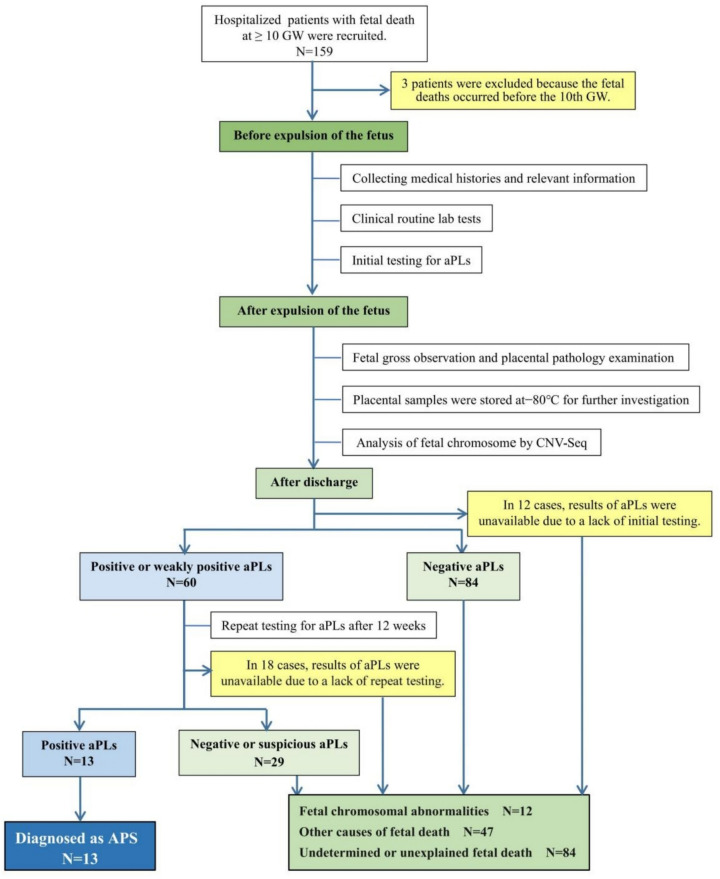
To investigate the causes of fetal death, focusing on maternal antiphospholipid syndrome diagnosis, and to follow the patients for changes in antiphospholipid antibodies, subsequent pregnancy outcomes, and thrombotic events. This is a prospective longitudinal cohort study that recruited patients who were hospitalized for fetal death at ≥ 10 weeks of gestation from three tertiary hospitals in China. Antiphospholipid syndrome was diagnosed according to the 2006 Sydney classification criteria. In total, 159 patients were recruited to the study; 3 were excluded and 144 of whom tested for aPLs. Among these, 126 (87.5%) were available for diagnostic analysis of antiphospholipid syndrome, 13 (10.3%) of which carried a diagnosis of antiphospholipid syndrome. Meanwhile, 136 of 156 patients had fetal samples for which copy number variation sequencing was completed, and 12 (8.8%) of which carried a diagnosis of fetal chromosomal abnormalities. During later follow-up, among the 13 patients with antiphospholipid syndrome, seven were persistently positive serostatus of antiphospholipid antibodies, four exhibited fluctuation, and one had negative conversion; four patients with subsequent pregnancies received guideline-based therapy and had term livebirths. None of the participants experienced thrombotic events. Maternal antiphospholipid syndrome was found to be one of the important causes of fetal death, contributing 10.3% of cases of fetal death at ≥ 10 weeks of gestation, slight ahead of fetal chromosomal abnormalities. Follow-up indicated that the serostatus of antiphospholipid antibodies may fluctuate significantly in some patients with antiphospholipid syndrome.Clinical trial registration:As this study was an observational study, we did not register it as a clinical trial.
为了调查胎儿死亡的原因,重点关注母体抗磷脂综合征的诊断,并跟踪患者抗磷脂抗体的变化、后续妊娠结局和血栓形成事件。这是一项前瞻性纵向队列研究,招募了来自中国三家三级医院、妊娠≥10周因胎儿死亡住院的患者。抗磷脂综合征根据2006年悉尼分类标准进行诊断。总共159名患者被纳入研究;3名被排除,其中144名检测了抗磷脂抗体。其中,126名(87.5%)可用于抗磷脂综合征的诊断分析,其中13名(10.3%)被诊断为抗磷脂综合征。同时,156名患者中的136名有胎儿样本并完成了拷贝数变异测序,其中12名(8.8%)被诊断为胎儿染色体异常。在后续随访中,13名抗磷脂综合征患者中,7名抗磷脂抗体血清学状态持续阳性,4名出现波动,1名转阴;4名后续妊娠的患者接受了基于指南的治疗并足月分娩活婴。没有参与者发生血栓形成事件。发现母体抗磷脂综合征是胎儿死亡的重要原因之一,在妊娠≥10周的胎儿死亡病例中占10.3%,略高于胎儿染色体异常。随访表明,抗磷脂综合征患者中部分患者的抗磷脂抗体血清学状态可能有显著波动。临床试验注册:由于本研究是一项观察性研究,我们未将其注册为临床试验。