Yuan Cui-Xia, Wu Chun, Pan Zheng-Xia, Li Yong-Gang
Department of Cardiothoracic Surgery, Children's Hospital of Chongqing Medical University, National Clinical Research Center for Child Health and Disorders, Ministry of Education Key Laboratory of Child Development and Diorders, Chongqing Key Laboratory of Structural Birth Defect and Reconstruction, Chongqing, China.
BMC Surg. 2025 Mar 10;25(1):94. doi: 10.1186/s12893-025-02827-7.
Pulmonary infection is a common clinical complication in children with congenital pulmonary airway malformation (CPAM). Surgical intervention has been proven effective in managing this condition. We aim to evaluate the impact of pulmonary infection on the outcomes of total thoracoscopic procedures in children with CPAM.
This was a single-center retrospective study. CPAM patients who underwent total thoracoscopic surgery at a tertiary care center from January 2013 to December 2023 were divided into three groups based on pulmonary infection status: non-infection (NI), hidden infection (HI), and pulmonary infection (PI). Clinical characteristics and operation-related outcomes were compared among the groups.
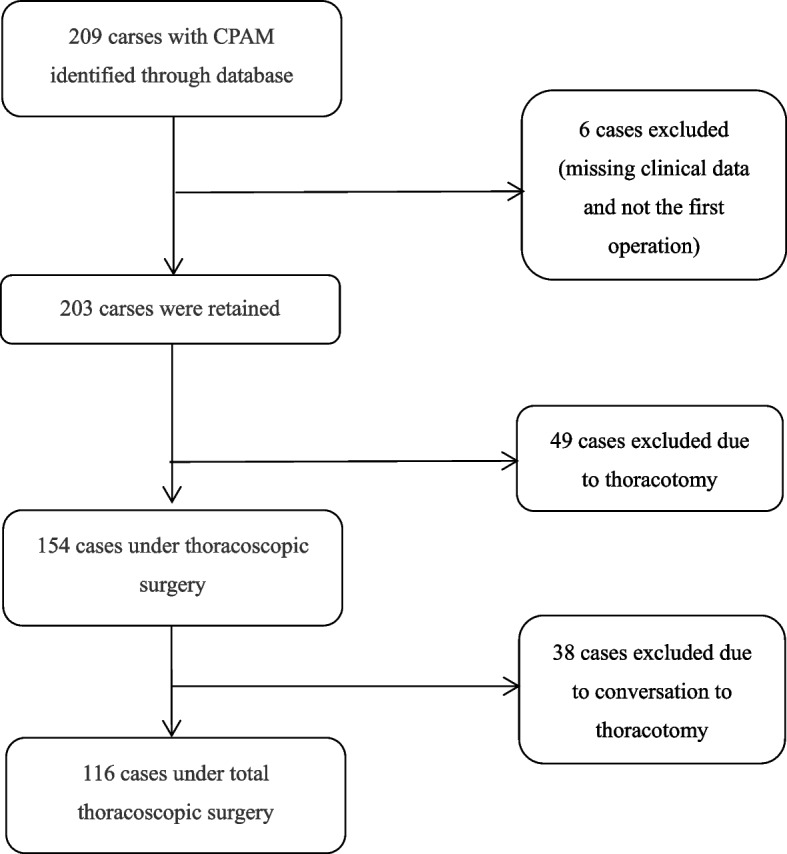
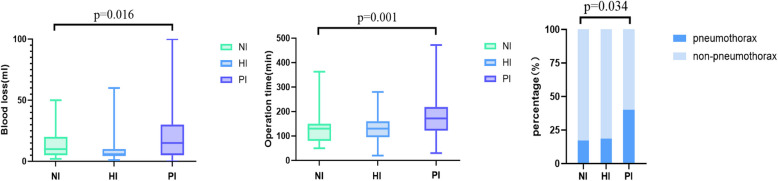
A total of 154 children with CPAM who underwent thoracoscopic surgery were categorized into three groups based on pulmonary infection: the NI group (27 cases), HI group (56 cases), and PI group (71 cases). The conversion rate to thoracotomy was 14.8%, 23.2%, and 29.2% respectively across the three groups. 116 cases were successfully completed thoracoscopically. There were no significant differences in gender distribution among the three groups (p > 0.05), but statistically significant (p < 0.05) in age and weight. Significant differences emerged in operative time and blood loss (p < 0.05), but no significant variations were found in transfusion requirements, chest tube duration, ventilator use duration, or hospital stay length (p > 0.05). In postoperative pulmonary complications, a statistically significant difference was found regarding pneumothorax incidence among all three groups (p < 0.05), whereas no significant differences (p > 0.05) emerged concerning atelectasis or pneumonia incidences across these cohorts.
Pulmonary infection is the most prevalent complication in CPAM and exhibits a high rate of hidden infections, thereby complicating surgical intervention and increasing associated risks. Early thoracoscopic intervention prior to infection manifestation can optimize surgical outcomes and reduce associated complications.
肺部感染是先天性肺气道畸形(CPAM)患儿常见的临床并发症。手术干预已被证明对治疗该疾病有效。我们旨在评估肺部感染对CPAM患儿全胸腔镜手术结局的影响。
这是一项单中心回顾性研究。2013年1月至2023年12月在三级医疗中心接受全胸腔镜手术的CPAM患者根据肺部感染状况分为三组:无感染(NI)组、隐匿性感染(HI)组和肺部感染(PI)组。比较三组的临床特征和手术相关结局。
共有154例接受胸腔镜手术的CPAM患儿根据肺部感染情况分为三组:NI组(27例)、HI组(56例)和PI组(71例)。三组中转开胸率分别为14.8%、23.2%和29.2%。116例成功完成胸腔镜手术。三组间性别分布无显著差异(p>0.05),但年龄和体重有统计学意义(p<0.05)。手术时间和失血量有显著差异(p<0.05),但输血需求、胸管留置时间、呼吸机使用时间或住院时间无显著差异(p>0.05)。在术后肺部并发症方面,三组气胸发生率有统计学意义(p<0.05),而这些队列中肺不张或肺炎发生率无显著差异(p>0.05)。
肺部感染是CPAM中最常见的并发症,隐匿性感染率高,从而使手术干预复杂化并增加相关风险。在感染表现前尽早进行胸腔镜干预可优化手术结局并减少相关并发症。