Wang Pengtang, Gao Xintong, Zheng Min, Jaroniec Mietek, Zheng Yao, Qiao Shi-Zhang
School of Chemical Engineering, The University of Adelaide, Adelaide, SA, Australia.
Department of Chemistry and Biochemistry & Advanced Materials and Liquid Crystal Institute, Kent State University, Kent, OH, USA.
Nat Commun. 2025 Mar 11;16(1):2424. doi: 10.1038/s41467-025-57798-3.
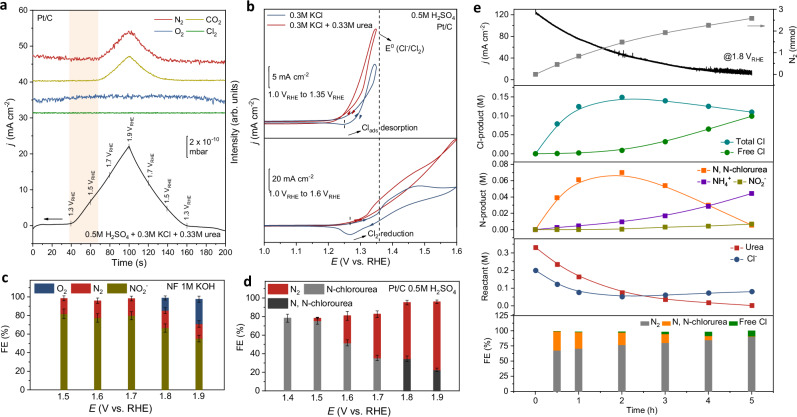
Urea electrooxidation offers a cost-effective alternative to water oxidation for energy-saving hydrogen production. However, its practical application is limited by expensive urea reactants and sluggish reaction kinetics. Here, we present an efficient urine electrolysis system for hydrogen production, using cost-free urine as feedstock. Our system leverages a discovered Cl-mediated urea oxidation mechanism on Pt catalysts, where adsorbed Cl directly couple with urea to form N-chlorourea intermediates, which are then converted into N via intermolecular N-N coupling. This rapid mediated-oxidation process notably improves the activity and stability of urine electrolysis while avoiding Cl-induced corrosion, enabling over 200 hours of operation at reduced voltages. Accordingly, a notable reduction in the electricity consumption is achieved during urine electrolysis (4.05 kWh Nm) at 300 mA cm in practical electrolyser for hydrogen production, outperforming the traditional urea (5.62 kWh Nm) and water (4.70-5.00 kWh Nm) electrolysis.
尿素电氧化为节能制氢提供了一种经济高效的水氧化替代方案。然而,其实际应用受到昂贵的尿素反应物和缓慢的反应动力学的限制。在此,我们展示了一种高效的尿液电解制氢系统,该系统使用免费的尿液作为原料。我们的系统利用了在铂催化剂上发现的氯介导的尿素氧化机制,其中吸附的氯直接与尿素偶联形成N-氯脲中间体,然后通过分子间N-N偶联将其转化为氮气。这种快速的介导氧化过程显著提高了尿液电解的活性和稳定性,同时避免了氯引起的腐蚀,能够在降低的电压下运行超过200小时。因此,在实际的制氢电解槽中,当电流密度为300 mA/cm²时,尿液电解过程中的耗电量显著降低(4.05 kWh/Nm³),优于传统的尿素(5.62 kWh/Nm³)和水(4.70 - 5.00 kWh/Nm³)电解。