Gezgin Yildirim Deniz, Orulluoglu Emine Yılmaz, Yildiz Cisem, Acari Ceyhun, Dundar Hatice Adiguzel, Akaci Okan, Akinci Nurver, Aliyev Emil, Alpman Bedriye Nuray, Altug Gucenmez Ozge, Arslanoglu Aydin Elif, Atmis Bahriye, Avar Aydin Pinar Ozge, Aydin Fatma, Baba Ozge, Baglan Esra, Bagrul Ilknur, Barut Kenan, Basaran Ozge, Bayrakci Umut Selda, Belder Nuran, Yucel Burcu Bozkaya, Buyukkaragoz Bahar, Caglayan Sengul, Cakan Mustafa, Celikel Elif, Demir Ferhat, Demir Selcan, Demir Yigit Yasemin, Demirkan Fatma Gul, Dincel Nida, Dogantan Seyda, Ekici Tekin Zahide, Genc Esra, Haslak Fatih, Isguder Rana, Kara Aslihan, Kasap Cuceoglu Muserref, Kaya Akca Ummusen, Kisaoglu Hakan, Kisla Ekinci Rabia Miray, Kızıldag Zehra, Kurt Tuba, Kucukali Batuhan, Leventoglu Emre, Nalcacioglu Hulya, Yener Gulcin Otar, Ozdel Semanur, Ozdemir Atikel Yesim, Ozdemir Cicek Sumeyra, Pektas Leblebiciler Sule, Serdaroglu Erkin, Sonmez Hafize Emine, Sunar Yayla Emine Nur, Surmeli Doven Serra, Sahin Sezgin, Sener Seher, Tanatar Ayse, Tanidir Merve, Taskin Sema Nur, Tiryaki Betul, Tuncez Serife, Turkucar Serkan, Uzun Kenan Bahriye, Yildiz Nurdan, Yilmaz Kenan, Tabel Yilmaz, Dursun Ismail, Canpolat Nur, Mir Sevgi, Peru Harun, Topaloglu Rezan, Kaya Gurgoze Metin, Balat Ayse, Bilginer Yelda, Celikel Acar Banu, Sozeri Betul, Unsal Erbil, Kasapcopur Ozgür, Bakkaloglu Sevcan A
Department of Pediatric Rheumatology, Faculty of Medicine, Gazi University, Ankara, 21000, Turkey.
Department of Pediatrics, Faculty of Medicine, Gazi University, Ankara, Turkey.
Pediatr Rheumatol Online J. 2025 Mar 11;23(1):24. doi: 10.1186/s12969-025-01080-9.
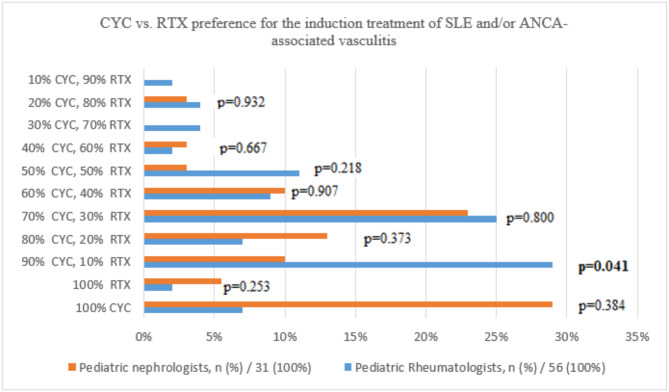
Cyclophosphamide (CYC) is an inactive alkylating agent that transforms the alkyl radicals into other molecules and is used in combination with systemic corticosteroids in the treatment of many childhood rheumatic diseases, such as systemic lupus erythematosus (SLE), and ANCA-associated vasculitis (AAV). In recent years, rituximab (RTX), a B-cell-targeting anti-CD20 monoclonal antibody, has emerged as a new alternative treatment modality over CYC for induction therapy of childhood-onset rheumatic diseases. Clinicians adopt different practices for using CYC particularly in relation to indications, posology, pre-treatment laboratory work-up, post-treatment follow-up, and screening pre- and post-treatment vaccination status. This study aimed to evaluate the principles and approaches of administering CYC therapy in pediatric rheumatology and pediatric nephrology practices and to compare the clinician preferences for CYC and RTX in induction therapy of childhood-onset rheumatic diseases.
This study includes a web-based questionnaire executed on 87 participants (56 pediatric rheumatologists (PRs) and 31 pediatric nephrologists (PNs)). Both pediatric subspecialties evaluated and compared the most common indications for CYC treatment, pre-treatment consent protocols, pre-and post-treatment laboratory tests, dosing strategies, and side effects.
Childhood-onset SLE (95%) and AAV (69%) were the most common diseases for which CYC treatment is used. All clinicians, except 2 PNs prescribed CYC via intravenous route. 61% of the PRs and 71% of PNs reported using a monthly dose of 500 mg/m² CYC for 6 months in accordance with the National Institutes of Health (NIH) protocol. All clinicians conducted pre-CYC treatment assessments of complete blood count and kidney function tests. Hepatitis B (82%), chickenpox (76%), and mumps-measles-rubella (72%) were the most frequently assessed vaccines. Adverse effects associated with CYC include cytopenia (86%), nausea (52%), liver toxicity (20%), hair loss (31%), hemorrhagic cystitis (37%), allergic reactions (16%), dyspnea (5%), and infertility (2%). 9 clinicians stated that they performed gonad-sparing interventions before CYC, which clarifies why CYC was more commonly preferred in the induction therapy of SLE and AAV over RTX by both PRs and PNs.
Clinicians still tend to choose CYC over RTX in induction therapy of SLE and AAV and mostly prefer the high-dose CYC treatment regimen suggested by the NIH.
环磷酰胺(CYC)是一种无活性的烷化剂,可将烷基转化为其他分子,常用于与全身性皮质类固醇联合治疗多种儿童风湿性疾病,如系统性红斑狼疮(SLE)和抗中性粒细胞胞浆抗体相关血管炎(AAV)。近年来,利妥昔单抗(RTX),一种靶向B细胞的抗CD20单克隆抗体,已成为CYC之外用于儿童期起病风湿性疾病诱导治疗的一种新的替代治疗方式。临床医生在使用CYC方面存在不同做法,特别是在适应证、用药剂量、治疗前实验室检查、治疗后随访以及治疗前后疫苗接种状态筛查等方面。本研究旨在评估儿科风湿病学和儿科肾脏病学实践中CYC治疗的原则和方法,并比较临床医生在儿童期起病风湿性疾病诱导治疗中对CYC和RTX的偏好。
本研究包括一项基于网络的问卷调查,共对87名参与者(56名儿科风湿病学家(PRs)和31名儿科肾脏病学家(PNs))进行了调查。两个儿科亚专业评估并比较了CYC治疗最常见的适应证、治疗前同意方案、治疗前后实验室检查、给药策略和副作用。
儿童期起病的SLE(95%)和AAV(69%)是使用CYC治疗最常见的疾病。除2名儿科肾脏病学家外,所有临床医生均通过静脉途径开具CYC。61%的儿科风湿病学家和71%的儿科肾脏病学家报告根据美国国立卫生研究院(NIH)方案,每月使用500mg/m²的CYC,共6个月。所有临床医生在CYC治疗前均进行了全血细胞计数和肾功能检查。乙肝疫苗(82%)、水痘疫苗(76%)和腮腺炎-麻疹-风疹疫苗(72%)是评估最频繁的疫苗。与CYC相关的不良反应包括血细胞减少(86%)、恶心(52%)、肝毒性(20%)、脱发(31%)、出血性膀胱炎(37%)、过敏反应(16%)、呼吸困难(5%)和不孕(2%)。9名临床医生表示他们在CYC治疗前进行了性腺保护干预,这解释了为什么在SLE和AAV的诱导治疗中,儿科风湿病学家和儿科肾脏病学家都更倾向于选择CYC而非RTX。
在SLE和AAV的诱导治疗中,临床医生仍然倾向于选择CYC而非RTX,并且大多更喜欢NIH建议的高剂量CYC治疗方案。