
2000年至2024年间女性生殖健康趋势与自闭症谱系障碍患病率
Female reproductive health trends and autism spectrum disorder prevalence between 2000 and 2024.
作者信息
Al-Salihy Adil Abdul-Rehman Siddiq
机构信息
Consultant in Clinical Psychology\Neuro- & Psycho-Therapy Science, Head of the Mental Health Department, Psychological Research Center, Ministry of Higher Education & Scientific Research, Baghdad, Iraq.
出版信息
Sci Rep. 2025 Mar 12;15(1):8507. doi: 10.1038/s41598-025-89979-x.
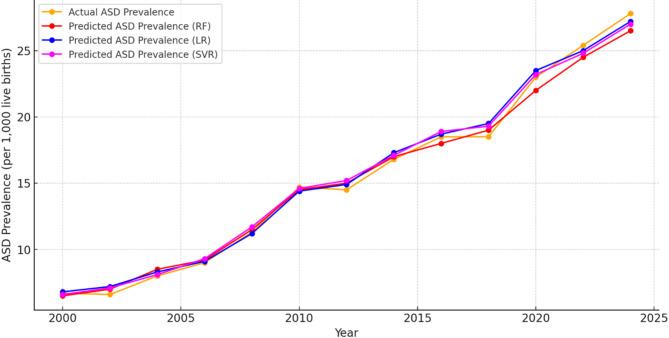
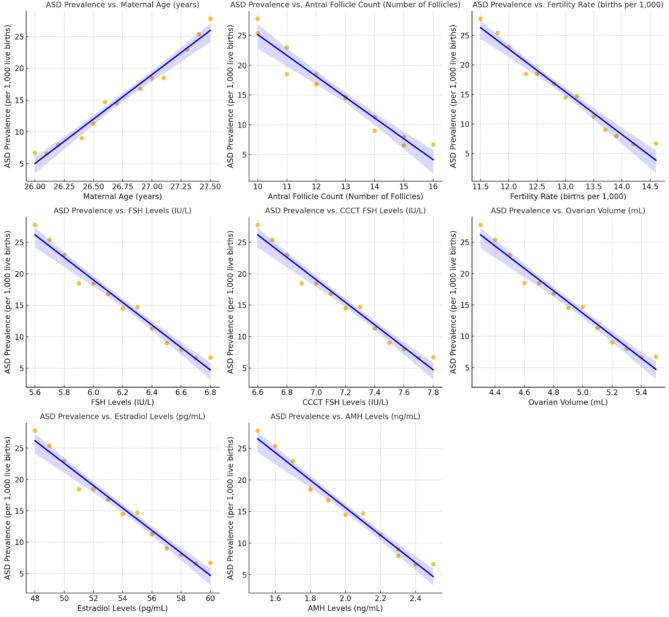
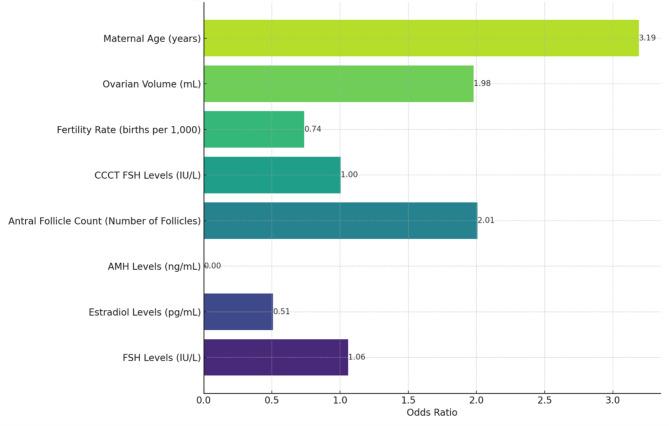
This study investigates the correlation between female reproductive health parameters and Autism Spectrum Disorder (ASD) prevalence from 2000 to 2024. The analysis used advanced statistical and machine learning models to identify trends in key reproductive indicators and their association with ASD prevalence. Significant positive correlations were observed between ASD prevalence and maternal age, while negative correlations were found with antral follicle count, Anti-Müllerian Hormone (AMH) levels, and fertility rate. The Random Forest model emerged as the most accurate predictive tool, explaining 96.9% of the variance in ASD prevalence. Maternal age was the dominant predictor of the variables analyzed, contributing approximately 75% of the model's predictive power, while estradiol levels and Follicle Stimulating Hormone (FSH) contributed significantly less. These findings highlight potential statistical associations but do not establish causality. Further research is necessary to validate these associations and explore underlying biological mechanisms.
本研究调查了2000年至2024年女性生殖健康参数与自闭症谱系障碍(ASD)患病率之间的相关性。该分析使用了先进的统计和机器学习模型,以确定关键生殖指标的趋势及其与ASD患病率的关联。观察到ASD患病率与母亲年龄之间存在显著正相关,而与窦卵泡计数、抗苗勒管激素(AMH)水平和生育率呈负相关。随机森林模型成为最准确的预测工具,解释了ASD患病率96.9%的方差。母亲年龄是所分析变量的主要预测因素,贡献了模型约75%的预测能力,而雌二醇水平和促卵泡生成素(FSH)的贡献则显著较少。这些发现突出了潜在的统计关联,但并未确立因果关系。需要进一步的研究来验证这些关联并探索潜在的生物学机制。






 Zotero 插件