Li Yuanheng, Ermakov Vsevolod, Wang Yazhou, Wei Lifeng, Ma Mingxue, Chi Haoyu, Sun Chao, Tang Hanye, Zhong Linjun, Li Jida, Wei Kun, Sha Zhuowa, Fan Chao, Jiao Mingli
School of Health Management, Harbin Medical University, 157 BaoJian Road, Nangang District, Harbin, Heilongjiang, 150086, China.
The organization department, the Second Affiliated Hospital of Harbin Medical University, 246 Xuefu Road, Nangang District, Harbin, Heilongjiang, 150081, China.
BMC Public Health. 2025 Mar 12;25(1):978. doi: 10.1186/s12889-025-22078-8.
Maintaining sleep health in the elderly is of great significance for promoting health equity. The elderly usually experience more social losses, which may lead to many health problems. Few studies have revealed the relationship between social losses and sleep disturbance in the elderly. This study aims to investigate the relationship between social losses and sleep disturbance in the elderly in Russia, and further explore whether the buffering effect of social interaction on relationships has sex differences.
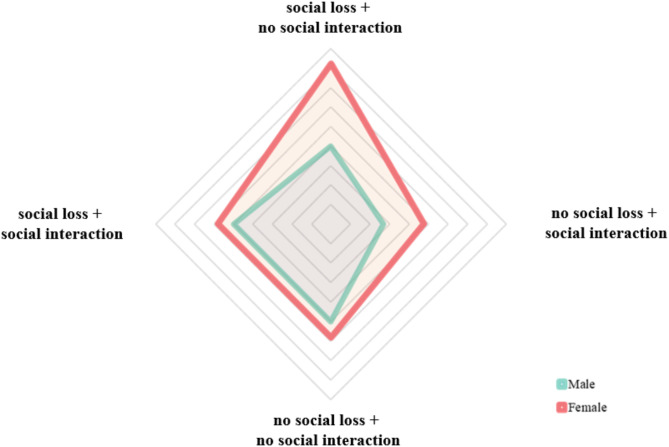
A total of 331 elderly participants from Vladivostok, Russia, were analyzed. Binary logistic regression analysis was performed to explore the factors associated with sleep disturbances. Based on participants' social loss and social interaction, participants were divided into four groups: (i) no social loss + social interaction, (ii) no social loss + no social interaction, (iii) social loss + social interaction, and (iv) social loss + no social interaction. Binary logistic regression was also conducted to examine the interaction between social loss and social interaction on sex-stratified sleep disturbances.
Social loss among older Russian adults was associated with sleep disturbance in both males and females in the sample collected in this study. Female participants who engage in social interaction showed a significant reduction in the risk of sleep disturbances when experiencing social loss. However, no significant association was observed between social interaction and sleep disturbances among male experiencing social loss.
Our findings emphasize that social loss is a risk factor for sleep disturbances, while social interaction serves as a buffering factor for sleep disturbances in elderly females experiencing social loss. This suggests that providing targeted support for elderly individuals of different sexes who have experienced social loss may be an equitable and effective approach to improving sleep health among the elderly in the Russia Far East.
维持老年人的睡眠健康对促进健康公平具有重要意义。老年人通常会经历更多的社会丧失,这可能会导致许多健康问题。很少有研究揭示社会丧失与老年人睡眠障碍之间的关系。本研究旨在调查俄罗斯老年人社会丧失与睡眠障碍之间的关系,并进一步探讨社会互动对这种关系的缓冲作用是否存在性别差异。
对来自俄罗斯符拉迪沃斯托克的331名老年参与者进行了分析。采用二元逻辑回归分析来探讨与睡眠障碍相关的因素。根据参与者的社会丧失和社会互动情况,将参与者分为四组:(i)无社会丧失+社会互动,(ii)无社会丧失+无社会互动,(iii)社会丧失+社会互动,以及(iv)社会丧失+无社会互动。还进行了二元逻辑回归分析,以检验社会丧失和社会互动在按性别分层的睡眠障碍方面的相互作用。
在本研究收集的样本中,俄罗斯老年成年人的社会丧失与男性和女性的睡眠障碍均相关。在经历社会丧失时,参与社会互动的女性参与者睡眠障碍风险显著降低。然而,在经历社会丧失的男性中,未观察到社会互动与睡眠障碍之间存在显著关联。
我们的研究结果强调,社会丧失是睡眠障碍的一个风险因素,而社会互动是经历社会丧失的老年女性睡眠障碍的一个缓冲因素。这表明,为经历社会丧失的不同性别的老年人提供有针对性的支持,可能是改善俄罗斯远东地区老年人睡眠健康的一种公平且有效的方法。