Kim Bomin, Lee Jihoon, Jang Sunjin, Park Jaehyeon, Choi Jinsil, Lee Seungyeol, Jung Joonhoo, Park Jaehyung
Interior & Exterior Materials Development Team, Hyundai Motor Group, Hwaseong-si 18280, Republic of Korea.
Department of Carbon and Fiber Composite Materials, Kyungpook National University, Daegu 41566, Republic of Korea.
Polymers (Basel). 2025 Feb 24;17(5):604. doi: 10.3390/polym17050604.
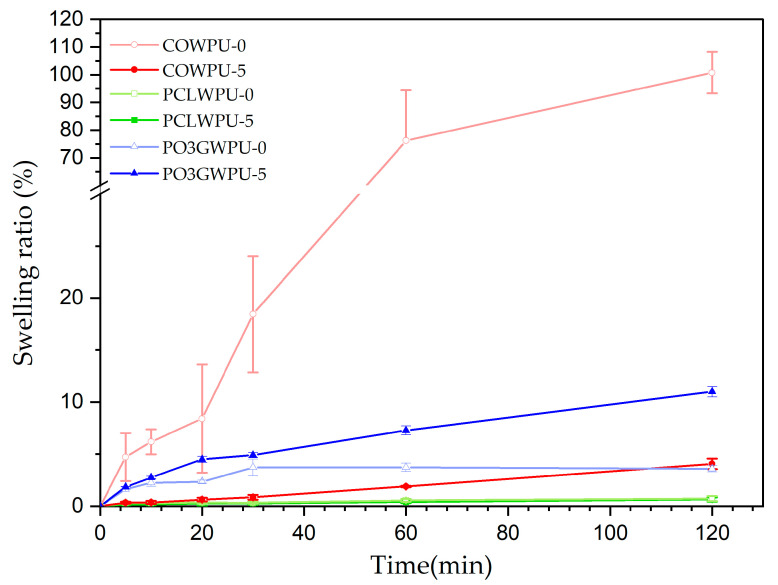
This study developed bio-based waterborne polyurethane (BWPU) dispersions containing lignin as a sustainable filler with castor oil (CO), polycaprolactone diol (PCL), or poly(trimethylene ether) glycol (PO3G). The effects of the polyol structure and the presence of lignin on the mechanical performance, thermal stability, water absorption, ethanol resistance, and UV-blocking capabilities of the resulting BWPU samples were evaluated. The results revealed that lignin affects the molecular packing and interchain interactions of CO-based BWPU, thus improving its tensile strength and thermal stability while reducing its water absorption and ethanol permeability. In the PCL-based BWPU, lignin had a minimal impact on water absorption and ethanol resistance but led to greater UV-blocking ability due to interactions between the semi-crystalline matrix of PCL and the aromatic structure of the lignin. In the PO3G-based BWPU, lignin disrupted the polymer network, increasing its water absorption and reducing its ethanol resistance but significantly improving its elongation and UV-shielding behavior. These results highlight the dual role of lignin as a sustainable reinforcing agent and functional additive in enhancing the properties of BWPU. By tailoring the polyol structure and optimizing lignin use, this study demonstrates a framework for the development of eco-friendly PU composites suitable for use as coatings, barriers, UV-shielding films, and packaging.
本研究开发了以木质素作为可持续填料的生物基水性聚氨酯(BWPU)分散体,其分别与蓖麻油(CO)、聚己内酯二醇(PCL)或聚(三亚甲基醚)二醇(PO3G)混合。评估了多元醇结构和木质素的存在对所得BWPU样品的机械性能、热稳定性、吸水性、耐乙醇性和紫外线阻隔能力的影响。结果表明,木质素会影响基于CO的BWPU的分子堆积和链间相互作用,从而提高其拉伸强度和热稳定性,同时降低其吸水性和乙醇渗透性。在基于PCL的BWPU中,木质素对吸水性和耐乙醇性影响最小,但由于PCL的半结晶基质与木质素的芳香结构之间的相互作用,导致其具有更强的紫外线阻隔能力。在基于PO3G的BWPU中,木质素破坏了聚合物网络,增加了其吸水性并降低了其耐乙醇性,但显著提高了其伸长率和紫外线屏蔽性能。这些结果突出了木质素作为可持续增强剂和功能添加剂在增强BWPU性能方面的双重作用。通过调整多元醇结构和优化木质素的使用,本研究展示了一个开发适用于涂料、阻隔材料、紫外线屏蔽薄膜和包装的环保型聚氨酯复合材料的框架。