Liu Meiling, Kim Da-Sol, Park Sunmin
Department of Chemical Engineering, Shanxi Institute of Science and Technology, Jincheng 048011, China.
Department of Food and Nutrition, Obesity/Diabetes Research Center, Hoseo University, 20 Hoseoro97bun-gil, BaeBang-Yup, Asan 41399, ChungNam-Do, Republic of Korea.
Nutrients. 2025 Mar 6;17(5):916. doi: 10.3390/nu17050916.
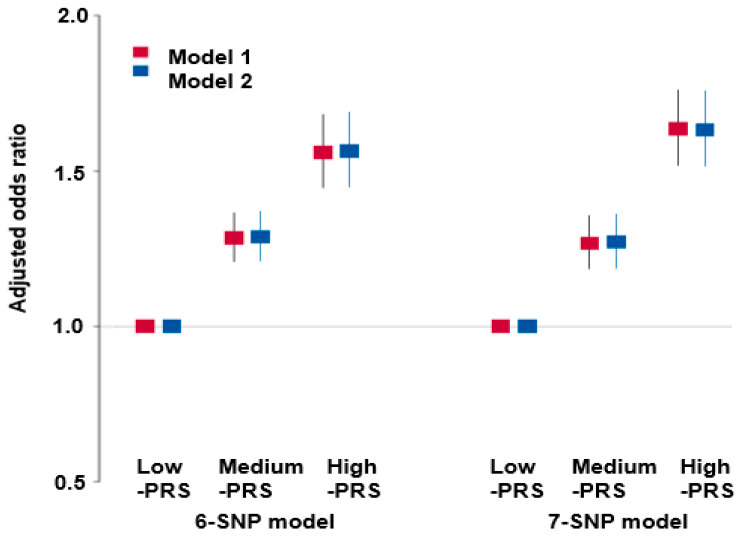
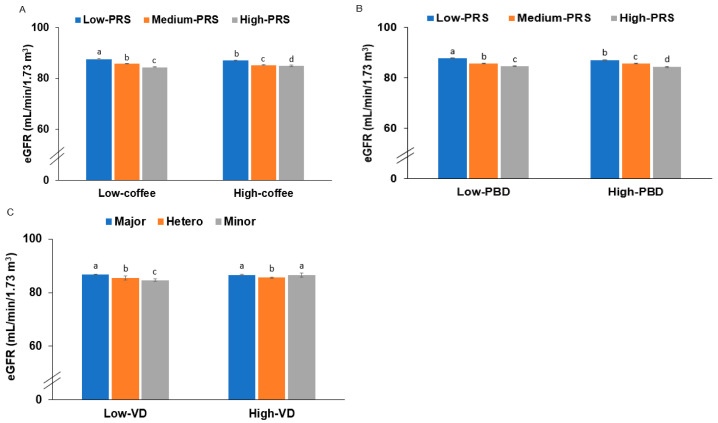
This study aimed to investigate genetic variants associated with the estimated glomerular filtration rate (eGFR) and their interactions with lifestyle factors and bioactive compounds in large hospital-based cohorts, assessing their impact on renal dysfunction risk. Participants were categorized into two groups based on eGFR: High-GFR (control; = 51,084) and Low-GFR (renal dysfunction; = 7617), using an eGFR threshold of 60 mL/min/1.73 m. Genetic variants were identified through a genome-wide association analysis, and their interactions with lifestyle factors were assessed a using generalized multifactor dimensionality reduction (GMDR) analysis. Additionally, interactions between polygenic risk scores (PRS) and nutrient intake were examined. Low eGFR was associated with higher urinary protein levels (4.67-fold) and correlated with a Western-style diet and with saturated fat, arginine, and isoleucine intakes but not sodium intake. The genetic model for low eGFR included variants linked to energy production and amino acid metabolism, such as rs1047891_, rs3770636_, rs5020545_, rs3812036_, and rs4715517_. A high PRS was associated with a 1.78-fold increased risk of low eGFR after adjusting for sociodemographic and lifestyle factors. The PRS from the 6-SNP model interacted with plant-based diets (PBDs) and coffee intake, where individuals with higher PBD and coffee consumption had a lower risk of renal dysfunction. Additionally, rs1047891 interacted with vitamin D intake ( = 0.0436), where the risk allele was linked to lower eGFR with low vitamin D intake but not with high intake. Molecular docking showed that vitamin D3 had a lower binding energy to the CPS1 mutant type (-9.9 kcal/mol) than the wild type (-7.5 kcal/mol), supporting a potential gene-nutrient interaction influencing renal function. Middle-aged and elderly individuals with a high genetic risk for renal dysfunction may benefit from a plant-based diet, moderate coffee consumption, and sufficient vitamin D intake.
本研究旨在调查与估计肾小球滤过率(eGFR)相关的基因变异,以及它们在大型医院队列中与生活方式因素和生物活性化合物的相互作用,评估其对肾功能障碍风险的影响。根据eGFR将参与者分为两组:高肾小球滤过率组(对照组;n = 51,084)和低肾小球滤过率组(肾功能障碍组;n = 7617),采用的eGFR阈值为60 mL/min/1.73 m²。通过全基因组关联分析确定基因变异,并使用广义多因素降维(GMDR)分析评估它们与生活方式因素的相互作用。此外,还研究了多基因风险评分(PRS)与营养摄入之间的相互作用。低eGFR与较高的尿蛋白水平相关(4.67倍),并与西式饮食、饱和脂肪、精氨酸和异亮氨酸摄入量相关,但与钠摄入量无关。低eGFR的遗传模型包括与能量产生和氨基酸代谢相关的变异,如rs1047891_、rs3770636_、rs5020545_、rs3812036_和rs4715517_。在调整社会人口统计学和生活方式因素后,高PRS与低eGFR风险增加1.78倍相关。来自6个单核苷酸多态性(SNP)模型的PRS与植物性饮食(PBD)和咖啡摄入量相互作用,PBD和咖啡摄入量较高的个体肾功能障碍风险较低。此外,rs1047891与维生素D摄入量相互作用(P = 0.0436),风险等位基因与低维生素D摄入量时较低的eGFR相关,但与高摄入量无关。分子对接显示,维生素D3与氨甲酰磷酸合成酶1(CPS1)突变型的结合能(-9.9 kcal/mol)低于野生型(-7.5 kcal/mol),支持潜在的基因-营养素相互作用影响肾功能。肾功能障碍遗传风险高的中年和老年人可能受益于植物性饮食、适量饮用咖啡和充足的维生素D摄入。