Zhang Wenjie, Zhang Chan, Zhao Jinyuan, Cui Jiajing, Bai Jinji, Deng Xuan, Ji Junjun, Li Ting, Wang Yu, Li Kefeng, Qu Yunhui, Li Junfeng
Department of Radiology, Heping Hospital Affiliated to Changzhi Medical College, Changzhi, Shanxi, China.
Changzhi Key Lab of Functional Imaging for Brain Diseases, Heping Hospital Affiliated to Changzhi Medical College, Changzhi, Shanxi, China.
Brain Behav. 2025 Mar;15(3):e70416. doi: 10.1002/brb3.70416.
Structural changes during depressive episodes in adolescents with major depressive disorder (MDD) remains unclear due to participant heterogeneity, illness chronicity, and medication confounders. This study aimed to explore white matter (WM) microstructural changes in first-episode, treatment-naïve adolescents with MDD using an integrated diffusion tensor imaging (DTI) approach.
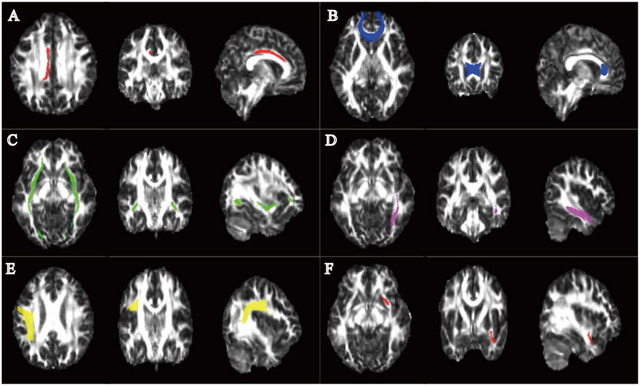
We recruited 66 subjects, including 37 adolescents with MDD and 29 healthy controls. Two main DTI techniques, automated fiber quantification (AFQ) and tract-based spatial statistics (TBSS), were used to analyze fractional anisotropy (FA), axial diffusivity (AD), radial diffusivity (RD), and mean diffusivity (MD) in WM tracts. DTI measures were then correlated with the depressive symptoms evaluated by Hamilton Depression Rating Scale scores (HAMD-17).
In AFQ, MDD patients showed significant segmental differences in WM tracts compared to controls, including a negative correlation between SLF AD values and depression severity. TBSS revealed reduced FA in the cingulum, forceps minor, inferior fronto-occipital fasciculus, inferior longitudinal fasciculus, SLF, and uncinate fasciculus in MDD.
Our integrated DTI analysis in a unique first-episode, medication-naïve cohort revealed microstructural changes in adolescent MDD not previously reported. These findings may provide imaging markers for early detection and enhance our understanding of depression pathology in youth.
由于参与者的异质性、疾病的慢性病程以及药物混杂因素,重度抑郁症(MDD)青少年抑郁发作期间的结构变化仍不清楚。本研究旨在使用综合扩散张量成像(DTI)方法探索首次发作、未接受过治疗的MDD青少年的白质(WM)微观结构变化。
我们招募了66名受试者,包括37名患有MDD的青少年和29名健康对照者。使用两种主要的DTI技术,即自动纤维定量(AFQ)和基于束的空间统计学(TBSS),来分析WM束中的各向异性分数(FA)、轴向扩散率(AD)、径向扩散率(RD)和平均扩散率(MD)。然后将DTI测量结果与通过汉密尔顿抑郁量表评分(HAMD-17)评估的抑郁症状进行相关性分析。
在AFQ中,与对照组相比,MDD患者在WM束中表现出显著的节段差异,包括上纵束AD值与抑郁严重程度之间呈负相关。TBSS显示,MDD患者的扣带束、小钳、额枕下束、下纵束、上纵束和钩束的FA降低。
我们在一个独特的首次发作、未用药队列中进行的综合DTI分析揭示了青少年MDD中以前未报道的微观结构变化。这些发现可能为早期检测提供影像学标志物,并增进我们对青少年抑郁症病理学的理解。