Al-Haj Husain Adib, Mergen Victor, Valdec Silvio, Al-Haj Husain Nadin, Stadlinger Bernd, Essig Harald, Frauenfelder Thomas, Kessler Peter, Lie Suen An Nynke, Alkadhi Hatem, Winklhofer Sebastian
Clinic of Cranio-Maxillofacial and Oral Surgery, Center of Dental Medicine, University of Zurich, Plattenstrasse 11, Zurich, 8032, Switzerland.
Department of Cranio-Maxillofacial and Oral Surgery, University Hospital Zurich, University of Zurich, Zurich, Switzerland.
Int J Implant Dent. 2025 Mar 13;11(1):21. doi: 10.1186/s40729-025-00611-z.
To compare cone-beam computed tomography (CBCT) with photon-counting detector computed tomography (PCD-CT) at equivalent radiation doses, focusing on qualitative and quantitative parameters relevant to dental implant surgery.
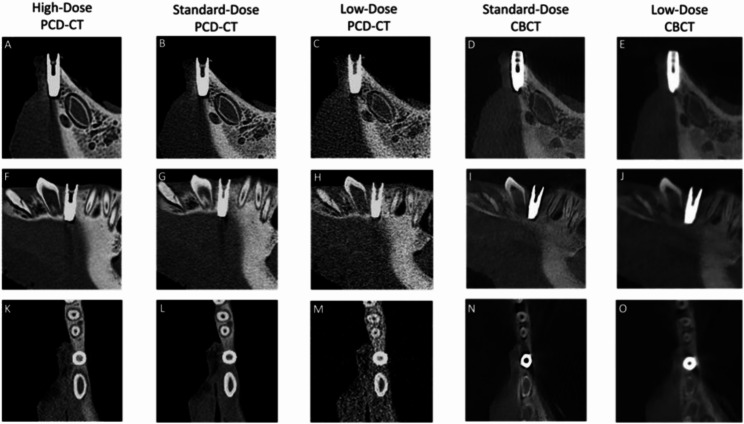
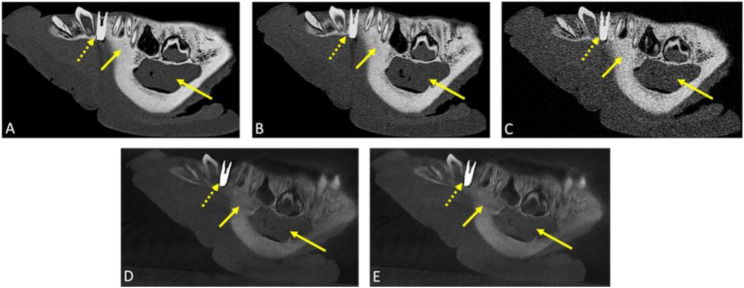
This ex vivo comparative study of porcine specimens assessed five imaging protocols with both CBCT and PCD-CT at three effective radiation dose levels (high: 360µSv, standard: 145µSv, low: 20µSv) to evaluate image quality, artifact burden, metal artifact susceptibility, and quantitative bone measurements in the mandibular region. Three blinded readers analyzed the data using a 5-point Likert scale (5 = highest to 1 = lowest rating) and performed linear bone measurements at implant planning sites. Statistical analysis included descriptive statistics and inter-reader reliability assessment using intraclass correlation coefficients (ICC).
Each reader evaluated 30 data sets (12 CBCT, 18 PCD-CT), with 24 implant planning sites per imaging protocol. High-dose PCD-CT demonstrated the best image quality and diagnostic interpretability (4.89 ± 0.27), followed by standard-dose PCD-CT and CBCT (4.50 ± 0.73; 4.33 ± 0.61), with low-dose protocols showing intermediate quality with higher artifact burden. In comparison to CBCT, PCD-CT demonstrated superior performance in reducing implant-induced artifacts across all protocols. Quantitative bone measurements showed minimal variability, meeting clinical precision requirements for computer-assisted implant surgery. Both qualitative (ICCs:0.70-0.89; p < 0.001) and quantitative (ICCs:0.79-1; p < 0.001) analyses demonstrated high reliability, regardless of the reader's experience.
PCD-CT demonstrated superior image quality and reduced artifacts compared with CBCT at all radiation dose levels. These findings highlight PCD-CT's potential to enhance implant planning and improve clinical outcomes with reduced radiation exposure while maintaining diagnostic accuracy.
在等效辐射剂量下,比较锥形束计算机断层扫描(CBCT)与光子计数探测器计算机断层扫描(PCD-CT),重点关注与牙种植手术相关的定性和定量参数。
这项对猪标本的离体比较研究,在三个有效辐射剂量水平(高:360µSv,标准:145µSv,低:20µSv)下,用CBCT和PCD-CT评估了五种成像方案,以评估下颌区域的图像质量、伪影负担、金属伪影敏感性和骨定量测量。三位盲法读者使用5点李克特量表(5 = 最高至1 = 最低评分)分析数据,并在种植体规划部位进行线性骨测量。统计分析包括描述性统计和使用组内相关系数(ICC)进行读者间可靠性评估。
每位读者评估30个数据集(12个CBCT,18个PCD-CT),每个成像方案有24个种植体规划部位。高剂量PCD-CT显示出最佳图像质量和诊断可解释性(4.89 ± 0.27),其次是标准剂量PCD-CT和CBCT(4.50 ± 0.73;4.33 ± 0.61),低剂量方案显示出中等质量但伪影负担更高。与CBCT相比,PCD-CT在所有方案中减少种植体诱导伪影方面表现更优。骨定量测量显示变异性最小,满足计算机辅助种植手术的临床精度要求。定性(ICC:0.70 - 0.89;p < 0.001)和定量(ICC:0.79 - 1;p < 0.001)分析均显示出高可靠性,与读者经验无关。
在所有辐射剂量水平下,PCD-CT与CBCT相比显示出更好的图像质量并减少了伪影。这些发现突出了PCD-CT在增强种植体规划和改善临床结果方面的潜力,同时减少辐射暴露并保持诊断准确性。