Department of Neuroradiology, Heidelberg University Hospital, Im Neuenheimer Feld 400, 69120, Heidelberg, Germany.
Department of Diagnostic and Interventional Radiology, Heidelberg University Hospital, Im Neuenheimer Feld 420, 69120, Heidelberg, Germany.
Eur Radiol. 2023 Feb;33(2):803-811. doi: 10.1007/s00330-022-09073-y. Epub 2022 Aug 20.
Photon-counting detector computed tomography (PCD-CT) is a promising new technique for CT imaging. The aim of the present study was the in vitro comparison of coil-related artifacts in PCD-CT and conventional energy-integrating detector CT (EID-CT) using a comparable standard brain imaging protocol before and after metal artifact reduction (MAR).
A nidus-shaped rubber latex, resembling an aneurysm of the cerebral arteries, was filled with neurovascular platinum coils and inserted into a brain imaging phantom. Image acquisition and reconstruction were repeatedly performed for PCD-CT and EID-CT (n = 10, respectively) using a standard brain imaging protocol. Moreover, linear interpolation MAR was performed for PCD-CT and EID-CT images. The degree of artifacts was analyzed quantitatively (standard deviation in a donut-shaped region of interest) and qualitatively (5-point scale analysis).
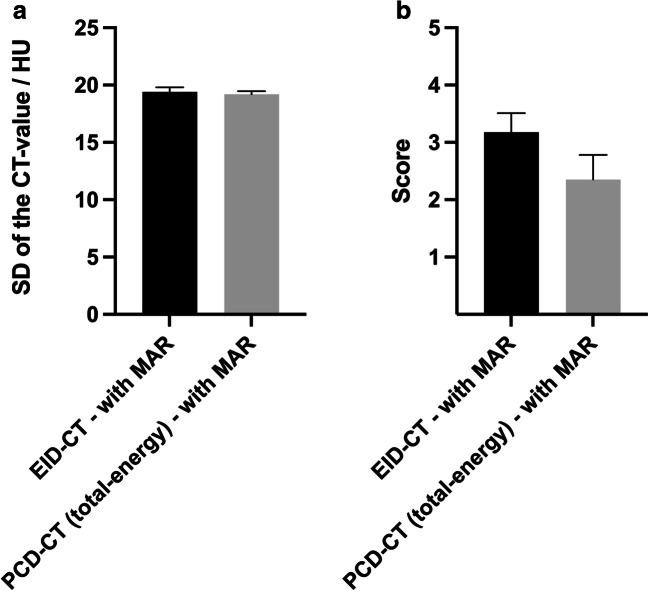
Quantitative and qualitative analysis demonstrated a lower degree of metal artifacts in the EID-CT images compared to the total-energy PCD-CT images (e.g., 82.99 ± 7.89 Hounsfield units (HU) versus 90.35 ± 6.28 HU; p < 0.001) with no qualitative difference between the high-energy bin PCD-CT images and the EID-CT images (4.18 ± 0.37 and 3.70 ± 0.64; p = 0.575). After MAR, artifacts were more profoundly reduced in the PCD-CT images compared to the EID-CT images in both analyses (e.g., 2.35 ± 0.43 and 3.18 ± 0.34; p < 0.001).
PCD-CT in combination with MAR have the potential to provide an improved option for reduction of coil-related artifacts in cerebral imaging in this in vitro study.
• Photon-counting detector CT produces more artifacts compared to energy-integrating detector CT without metal artifact reduction in cerebral in vitro imaging after neurovascular coil-embolization. • Spectral information of PCD-CT provides the potential for new post-processing techniques, since the coil-related artifacts were lower in PCD-CT images compared to EID-CT images after linear interpolation metal artifact reduction in this in vitro study.
光子计数探测器 CT(PCD-CT)是 CT 成像的一种很有前途的新技术。本研究的目的是使用可比的标准脑成像协议,在金属伪影减少(MAR)前后,对 PCD-CT 和传统能量积分探测器 CT(EID-CT)的线圈相关伪影进行体外比较。
将类似于脑动脉动脉瘤的橡胶乳胶结节填充有神经血管铂线圈,并插入脑成像体模中。使用标准脑成像协议,分别对 PCD-CT 和 EID-CT 进行了重复的图像采集和重建(分别为 10 次)。此外,对 PCD-CT 和 EID-CT 图像进行了线性插值 MAR。使用定量(圆环感兴趣区域的标准差)和定性(5 分制分析)方法分析了伪影的程度。
定量和定性分析表明,EID-CT 图像的金属伪影程度低于总能量 PCD-CT 图像(例如,82.99±7.89HU 与 90.35±6.28HU;p<0.001),高能 bin PCD-CT 图像与 EID-CT 图像之间无定性差异(4.18±0.37 和 3.70±0.64;p=0.575)。MAR 后,在两种分析中,PCD-CT 图像中的伪影比 EID-CT 图像中的伪影减少得更为明显(例如,2.35±0.43 和 3.18±0.34;p<0.001)。
在这项体外研究中,PCD-CT 结合 MAR 有可能为减少脑成像中的线圈相关伪影提供一种改进的选择。
在神经血管线圈栓塞后的体外脑成像中,PCD-CT 产生的伪影比 EID-CT 多,且未进行金属伪影减少处理。
在这项体外研究中,经过线性插值金属伪影减少处理后,PCD-CT 图像中的线圈相关伪影低于 EID-CT 图像,这表明 PCD-CT 的光谱信息为新的后处理技术提供了潜力。