Vonbrunn Eva, Ebert Nadja, Cordasic Nada, Amann Kerstin, Büttner Anke, Büttner-Herold Maike, Scherberich Jürgen E, Daniel Christoph
Department of Nephropathology, Institute of Pathology, Friedrich-Alexander-Universität Erlangen-Nürnberg, Universitätsklinikum Erlangen, Krankenhausstr. 8-10, 91054, Erlangen, Germany.
School of Psychology, College of Life and Environmental Sciences, University of Birmingham, Birmingham, UK.
J Transl Med. 2025 Mar 14;23(1):323. doi: 10.1186/s12967-025-06125-x.
Uromodulin (UMOD) is expressed in kidneys and is mainly excreted in the urine, although a smaller amount is also released into the serum. Here, we investigated UMOD in acute kidney injury (AKI), with particular focus on the utility of serum UMOD as marker for nephron loss.
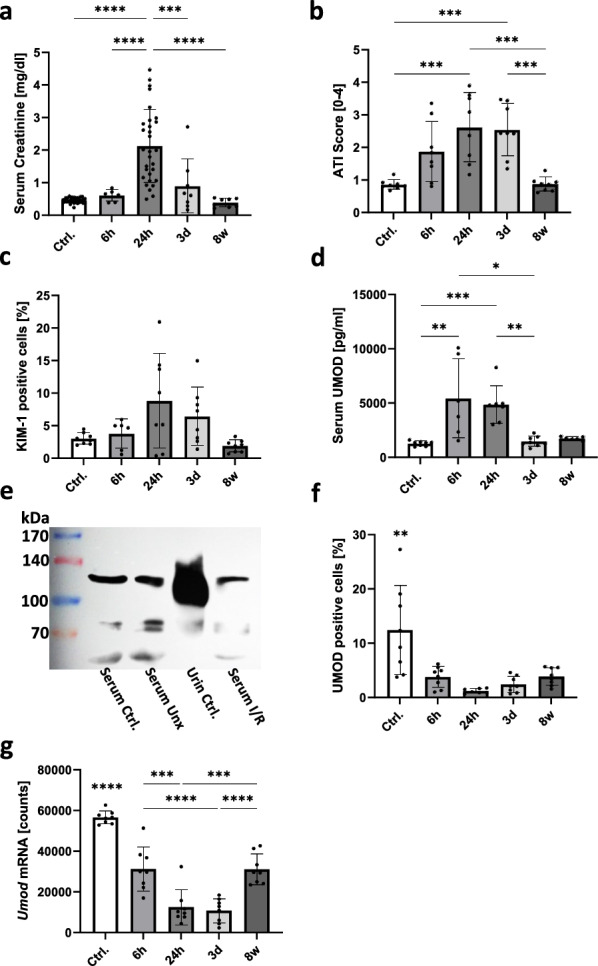
Blood and kidney samples were collected 6 h, 24 h, 3 days and 8 weeks after ischemia/reperfusion (I/R) in a rat model. To investigate the impact of nephron number on UMOD levels, sera and tissue from healthy, uninephrectomized (Unx) and 5/6-nephrectomized (Snx) rats were analyzed. Histological changes, kidney function and cell damage were evaluated and serum UMOD, Umod mRNA expression and distribution of UMOD protein in the kidney were examined.
In AKI, kidney function was markedly impaired 24 h after I/R, while kidney injury and serum UMOD was increased transiently. Simultaneously, the amount of UMOD-positive kidney cells rapidly decreased 24 h after I/R compared to healthy kidneys, and mRNA expression of Umod was lowest on days 1-3 after I/R. Serum UMOD correlated with nephron number showing the highest levels in healthy rats, which were reduced after Unx and further reduced after Snx.
In an AKI model with severe tubular damage, a transient increase in UMOD serum levels in parallel with loss of UMOD-positive cells suggests temporary release of UMOD from destroyed tubular cells into the blood. Serum UMOD appears to be not only a marker of chronic renal failure but also of acute loss of functional and cellular integrity of kidney epithelia in AKI.
尿调节素(UMOD)在肾脏中表达,主要经尿液排泄,不过也有少量释放入血清。在此,我们研究了急性肾损伤(AKI)中的尿调节素,特别关注血清尿调节素作为肾单位丢失标志物的效用。
在大鼠缺血/再灌注(I/R)模型中,于6小时、24小时、3天和8周后采集血液和肾脏样本。为研究肾单位数量对尿调节素水平的影响,分析了来自健康、单侧肾切除(Unx)和5/6肾切除(Snx)大鼠的血清和组织。评估了组织学变化、肾功能和细胞损伤,并检测了血清尿调节素、Umod mRNA表达以及尿调节素蛋白在肾脏中的分布。
在急性肾损伤中,缺血/再灌注24小时后肾功能明显受损,而肾损伤和血清尿调节素短暂升高。同时,与健康肾脏相比,缺血/再灌注24小时后尿调节素阳性肾细胞数量迅速减少,且Umod mRNA表达在缺血/再灌注后第1 - 3天最低。血清尿调节素与肾单位数量相关,在健康大鼠中水平最高,单侧肾切除后降低,5/6肾切除后进一步降低。
在严重肾小管损伤的急性肾损伤模型中,尿调节素血清水平短暂升高并伴有尿调节素阳性细胞丢失,提示尿调节素从受损肾小管细胞暂时释放入血。血清尿调节素似乎不仅是慢性肾衰竭的标志物,也是急性肾损伤中肾上皮细胞功能和细胞完整性急性丧失的标志物。