Jarabicová Izabela, Horváth Csaba, Hrdlička Jaroslav, Boroš Almos, Olejníčková Veronika, Zábrodská Eva, Hubáčková Soňa Štemberková, Šutovská Hana Mauer, Molčan Ľuboš, Kopkan Libor, Chudý Martin, Kura Branislav, Kaločayová Barbora, Goncalvesová Eva, Neckář Jan, Zeman Michal, Kolář František, Adameová Adriana
Faculty of Pharmacy, Department of Pharmacology and Toxicology, Comenius University, Odbojárov 10, 832 32, Bratislava, Slovak Republic.
Institute of Physiology, Czech Academy of Sciences, Prague, Czech Republic.
Basic Res Cardiol. 2025 Apr;120(2):373-392. doi: 10.1007/s00395-025-01101-4. Epub 2025 Mar 15.
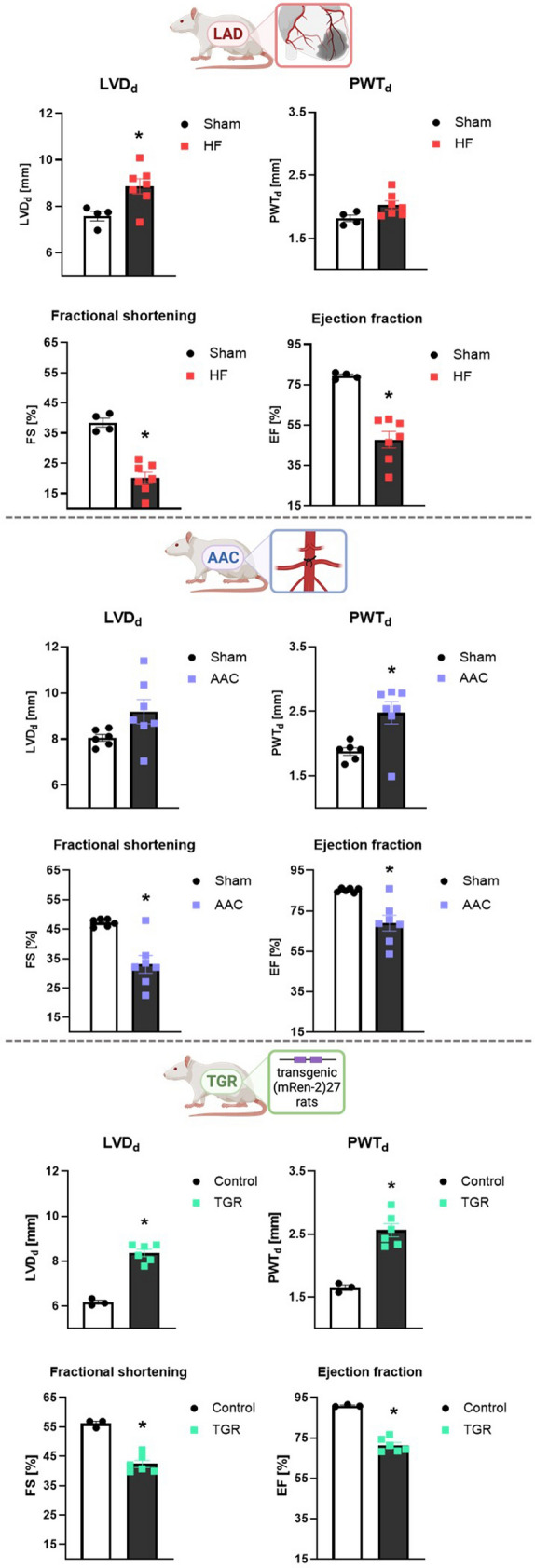
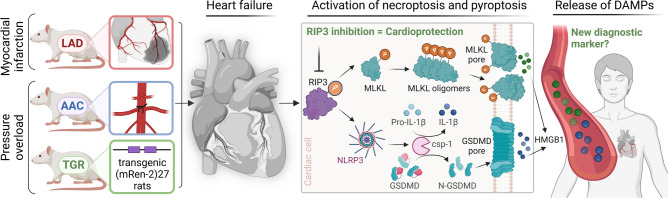
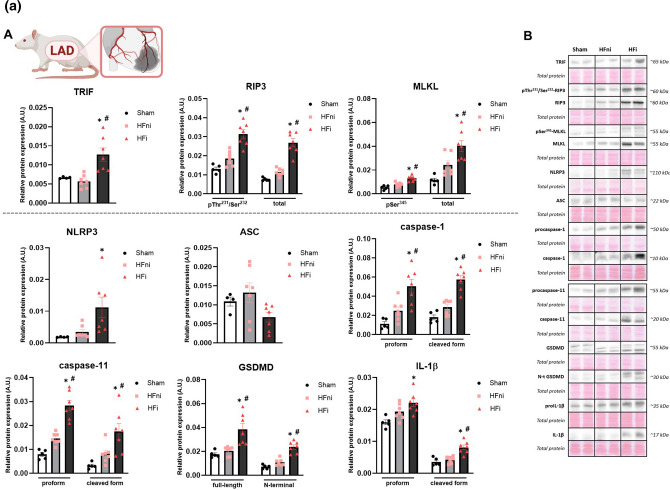
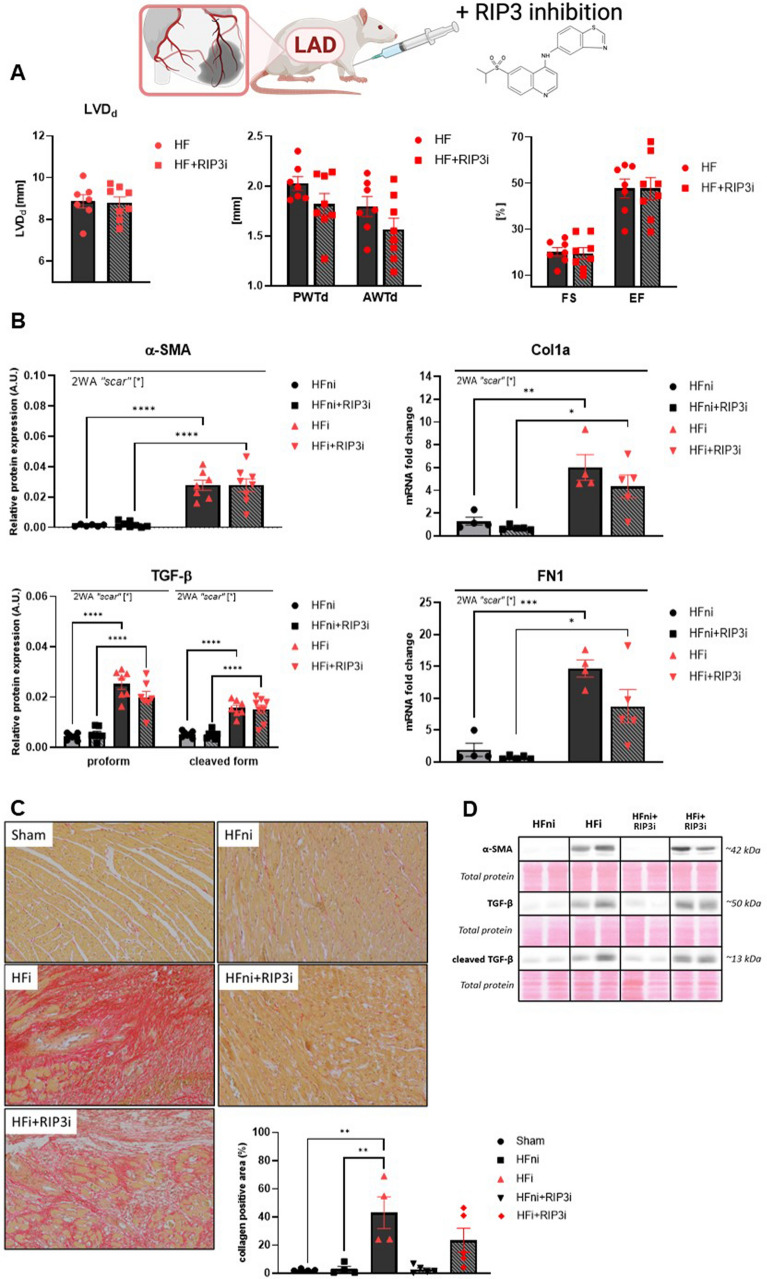
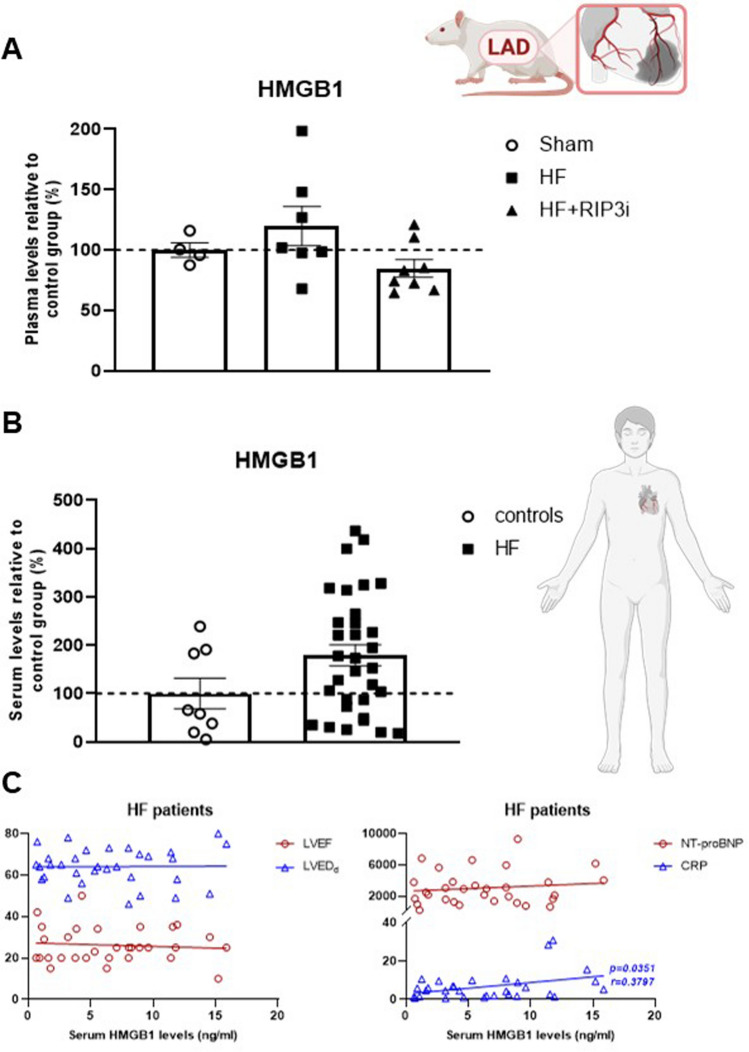
Since cell dying in heart failure (HF) may vary based on the aetiology, we examined the main forms of regulated necrosis, such as necroptosis and pyroptosis, in the hearts damaged due to myocardial infarction (MI) or pressure overload. We also investigated the effects of a drug inhibiting RIP3, a proposed convergent point for both these necrosis-like cell death modes. In rat hearts, left ventricular function, remodelling, pro-cell death, and pro-inflammatory events were investigated, and the pharmacodynamic action of RIP3 inhibitor (GSK'872) was assessed. Regardless of the HF aetiology, the heart cells were dying due to necroptosis, albeit the upstream signals may be different. Pyroptosis was observed only in post-MI HF. The dysregulated miRNAs in post-MI hearts were accompanied by higher levels of a predicted target, HMGB1, its receptors (TLRs), as well as the exacerbation of inflammation likely originating from macrophages. The RIP3 inhibitor suppressed necroptosis, unlike pyroptosis, normalised the dysregulated miRNAs and tended to decrease collagen content and affect macrophage infiltration without affecting cardiac function or structure. The drug also mitigated the local heart inflammation and normalised the higher circulating HMGB1 in rats with post-MI HF. Elevated serum levels of HMGB1 were also detected in HF patients and positively correlated with C-reactive protein, highlighting pro-inflammatory axis. In conclusion, in MI-, but not pressure overload-induced HF, both necroptosis and pyroptosis operate and might underlie HF pathogenesis. The RIP3-targeting pharmacological intervention might protect the heart by preventing pro-death and pro-inflammatory mechanisms, however, additional strategies targeting multiple pro-death pathways may exhibit greater cardioprotection.
由于心力衰竭(HF)中细胞死亡可能因病因不同而有所差异,我们研究了在因心肌梗死(MI)或压力超负荷而受损的心脏中,诸如坏死性凋亡和炎性小体介导的细胞死亡等主要形式的程序性坏死。我们还研究了一种抑制RIP3的药物的作用,RIP3是这两种类坏死性细胞死亡模式的一个假定汇聚点。在大鼠心脏中,我们研究了左心室功能、重塑、促细胞死亡和促炎事件,并评估了RIP3抑制剂(GSK'872)的药效学作用。无论HF的病因如何,心脏细胞都因坏死性凋亡而死亡,尽管上游信号可能不同。炎性小体介导的细胞死亡仅在心肌梗死后的HF中观察到。心肌梗死后心脏中失调的微小RNA伴随着预测靶点HMGB1、其受体(Toll样受体)水平的升高,以及可能源自巨噬细胞的炎症加剧。与炎性小体介导的细胞死亡不同,RIP3抑制剂抑制坏死性凋亡,使失调的微小RNA正常化,并倾向于减少胶原蛋白含量和影响巨噬细胞浸润,而不影响心脏功能或结构。该药物还减轻了局部心脏炎症,并使心肌梗死后HF大鼠中循环HMGB1水平升高的情况正常化。在HF患者中也检测到血清HMGB1水平升高,且与C反应蛋白呈正相关,突出了促炎轴。总之,在心肌梗死而非压力超负荷诱导的HF中,坏死性凋亡和炎性小体介导的细胞死亡均起作用,可能是HF发病机制的基础。靶向RIP3的药理干预可能通过预防促死亡和促炎机制来保护心脏,然而,针对多种促死亡途径的额外策略可能具有更大的心脏保护作用。