Stranix-Chibanda Lynda, Hamilton Erica L, Ngo Julie, Jiao Yuqing, Hanscom Brett, Choudhury Rahul Paul, Agyei Yaw, Piwowar-Manning Estelle, Marzinke Mark, Delany-Moretlwe Sinead, Mgodi Nyaradzo, Siziba Bekezela, Naidoo Ishana, Gati Mirembe Brenda, Kamira Betty, McCoig Cynthia, Adeyeye Adeola, Spiegel Hans M L, Hosek Sybil
University of Zimbabwe Clinical Trials Research Centre, Harare, Zimbabwe; Faculty of Medicine and Health Sciences, University of Zimbabwe, Harare, Zimbabwe.
Network and Collaborative Research Division, FHI 360, Durham, NC, USA.
Lancet HIV. 2025 Apr;12(4):e252-e260. doi: 10.1016/S2352-3018(24)00310-2. Epub 2025 Mar 12.
Long-acting formulations of HIV pre-exposure prophylaxis (PrEP) appear particularly well suited to adolescents. We aimed to establish the safety, tolerability, and acceptability of long-acting injectable cabotegravir as PrEP in cisgender adolescent girls.
HPTN 084-01 is a single-arm, open-label, phase 2b trial conducted at three clinical research sites in South Africa, Uganda, and Zimbabwe. Girls were recruited via community study-outreach teams, reproductive health clinics, and peer referral. Sexually active adolescent girls (younger than 18 years) willing to use long-acting contraception, weighing at least 35 kg, and able to participate with parental or guardian consent (unless an emancipated minor) were eligible. After an oral lead-in, if no adverse events occurred, participants received a 3 mL intramuscular gluteal injection (long-acting injectable cabotegravir 600 mg) at weeks 5, 9, 17, 25, and 33. The product was discontinued for grade 3 or higher toxic effects or pregnancy. The primary outcomes were safety, tolerability, and acceptability. Safety (ie, proportions of grade 2 or higher clinical and laboratory events) was assessed at weeks 6, 10, 18, 26, and 34 in all enrolled participants. Injection tolerability (ie, proportions of premature discontinuation due to intolerability, frequency of injections, or burden of study procedures) and product acceptability (ie, proportions of scheduled injections completed and participants preferring long-acting injectable cabotegravir for future use) were assessed in all participants who received at least one injection at study end. The trial was registered with ClinicalTrials.gov (NCT04824131) and is completed.
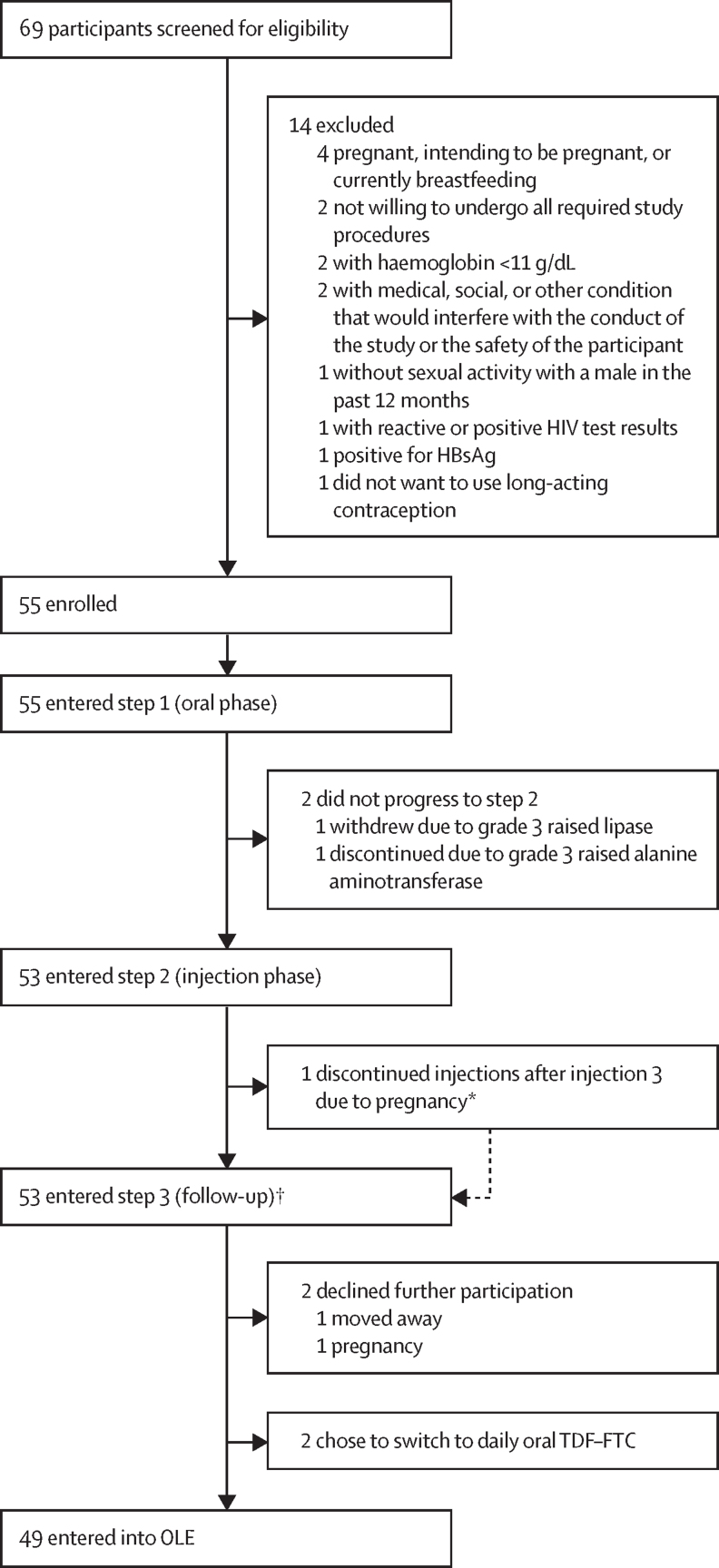
Between Nov 1, 2020, and Aug 31, 2021, 69 participants were assessed for eligibility and 55 met inclusion criteria. The mean age was 16·0 years (SD 1·1), 39 (71%) had a recent primary sexual partner, 12 (22%) reported transactional sex, and 22 (40%) had sexually transmitted infections at baseline. Two participants dropped out and did not initiate long-acting injectable cabotegravir due to adverse events unrelated to the study drug during the oral lead-in. One participant stopped long-acting injectable cabotegravir after three injections due to pregnancy. 51 (93%) participants reported at least one adverse event of grade 2 or higher, mostly unrelated, transient laboratory abnormalities. There were no long-acting injectable cabotegravir discontinuations due to intolerability. Of the 52 participants who completed step 2, all scheduled injections were completed and 32 (62%) participants reported they would consider using long-acting injectable cabotegravir for HIV prevention in the future.
Long-acting injectable cabotegravir is a safe, tolerable, and acceptable option for the prevention of HIV in adolescent girls. Our study findings expand the HIV prevention options available to adolescent girls.
National Institute of Allergy and Infectious Diseases, National Institute of Mental Health, National Institute on Drug Abuse, the Eunice Kennedy Shriver National Institute of Child Health and Human Development, ViiV Healthcare, and The Bill & Melinda Gates Foundation.
长效的艾滋病病毒暴露前预防(PrEP)制剂似乎特别适合青少年。我们旨在确定长效注射用卡博特韦作为PrEP在顺性别青春期女孩中的安全性、耐受性和可接受性。
HPTN 084-01是一项在南非、乌干达和津巴布韦的三个临床研究地点进行的单臂、开放标签的2b期试验。通过社区研究外展团队、生殖健康诊所和同伴推荐招募女孩。性活跃的青春期女孩(年龄小于18岁),愿意使用长效避孕措施,体重至少35公斤,并且能够在获得父母或监护人同意的情况下参与(除非是已独立的未成年人)均符合条件。在口服导入期后,如果没有发生不良事件,参与者在第5、9、17、25和33周接受3毫升臀肌肌内注射(长效注射用卡博特韦600毫克)。因3级或更高毒性效应或怀孕而停用该产品。主要结局是安全性、耐受性和可接受性。在所有登记的参与者中,于第6、10、18、26和34周评估安全性(即2级或更高临床和实验室事件的比例)。在研究结束时接受至少一次注射的所有参与者中评估注射耐受性(即因不耐受、注射频率或研究程序负担而提前停药的比例)和产品可接受性(即完成预定注射的比例以及参与者未来更倾向于使用长效注射用卡博特韦的比例)。该试验已在ClinicalTrials.gov注册(NCT04824131)且已完成。
在2020年11月1日至2021年8月31日期间,评估了69名参与者的资格,55名符合纳入标准。平均年龄为16.0岁(标准差1.1),39名(71%)有近期主要性伴侣,12名(22%)报告有交易性行为,22名(40%)在基线时有性传播感染。两名参与者在口服导入期因与研究药物无关的不良事件而退出且未开始使用长效注射用卡博特韦。一名参与者因怀孕在三次注射后停止使用长效注射用卡博特韦。51名(93%)参与者报告至少有一次2级或更高的不良事件,大多是无关的、短暂的实验室异常。没有因不耐受而停用长效注射用卡博特韦的情况。在完成第2步的52名参与者中,所有预定注射均已完成,32名(62%)参与者报告他们未来会考虑使用长效注射用卡博特韦来预防艾滋病病毒。
长效注射用卡博特韦是预防青春期女孩感染艾滋病病毒的一种安全、可耐受且可接受的选择。我们的研究结果扩展了可供青春期女孩选择的艾滋病病毒预防方案。
美国国立过敏与传染病研究所、美国国立精神卫生研究所、美国国立药物滥用研究所、尤妮斯·肯尼迪·施莱佛国家儿童健康与人类发展研究所、ViiV医疗保健公司以及比尔及梅琳达·盖茨基金会。