Taylor-Abdulai Hannah Benedicta, Dzantor Edem Kojo, Mensah Nathan Kumasenu, Asumah Mubarick Nungbaso, Ocansey Stephen, Arhin Samuel Kofi, Barnes Precious, Opoku Victor Obiri, Mankir Zakariah Jirimah, Famieh Sylvester Ackah, Botchey Collins Paa Kwesi
Department of Physician Assistant Studies, School of Allied Health Sciences, University of Cape Coast, Cape Coast, Ghana.
Department of Epidemiology and Biostatistics, Fred N. Binka School of Public Health, University of Health and Allied Sciences, Hohoe Campus, Hohoe, Ghana.
PLoS One. 2025 Mar 18;20(3):e0319798. doi: 10.1371/journal.pone.0319798. eCollection 2025.
Coronavirus disease 2019 (COVID-19) vaccine hesitancy is a complex health challenge characterized by a delay in the acceptance or refusal of the vaccination with context-specific determinants. Our study, therefore, assessed the COVID-19 vaccine acceptance among urban dwellers in the Central Region, of Ghana.
A cross sectional study was conducted between September and November, 2022 using a multi-stage cluster sampling procedure among 377 participants. A modified World Health Organization pretested paper-based questionnaire was administered to study participants. The data was analyzed using Statistical Package for Social Sciences (SPSS) version 26. Descriptive and inferential statistics were carried out and results were summarized into frequencies, percentages, tables, and charts for clarity. A conventional p-value < 0.05 was considered statistically significant.
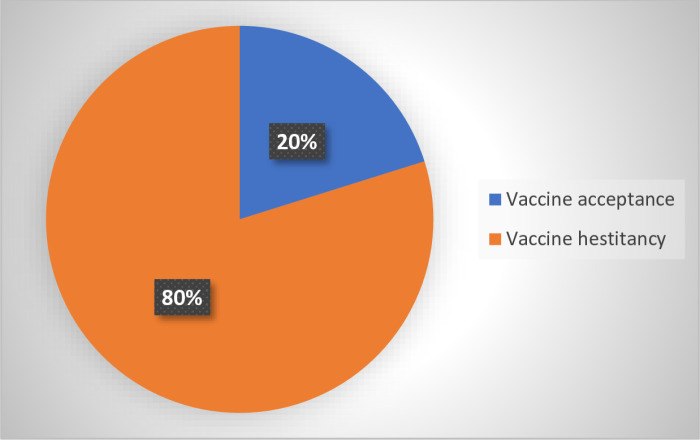
The study revealed that COVID-19 vaccine acceptance was 20.0% (76/377) and vaccine hesitancy was 80.0% (301/377). Out of the 377 participants, their socio-demographic characteristics showed that the majority were below 25 years 53.8% (203/377), [vaccine acceptance; 36.84% (28/76) vs vaccine hesitancy; 58.14% (175/301)], and females 50.1% (189/377), [vaccine acceptance; 56.58% (43/76) vs vaccine hesitancy; 48.50% (146/301)]. Common reasons for COVID-19 vaccine hesitancy included mistrust of the source of the vaccine, personal belief and experience, mistrust of the drug development process, mistrust in the health system, and mistrust of the pharmaceutical company. Age above 25 years, female, educational levels, senior high school and above, being employed, and hearing of new vaccine had a significance influence on COVID-19 vaccine acceptance.
COVID-19 vaccine acceptance was low with high vaccine hesitancy among participants. The study's findings highlights the importance of addressing vaccine hesitancy through building trust in the vaccine development processes, including the provision of accurate information about the vaccine safety and efficacy. Resolving concerns related to the source of the vaccine and the overall healthcare system are important to address vaccine hesitancy. Policy makers could adopt tailored interventions targeting specific demographic groups, such as the younger population and females to increase vaccine acceptance. Ghana's public health authorities could adopt the findings to re-strategize its urban COVID-19 vaccine campaigns to address misconceptions and misinformation to increase vaccine acceptance.
2019年冠状病毒病(COVID-19)疫苗犹豫是一项复杂的健康挑战,其特征是在接受或拒绝接种疫苗方面出现延迟,且存在特定背景下的决定因素。因此,我们的研究评估了加纳中部地区城市居民对COVID-19疫苗的接受情况。
2022年9月至11月期间进行了一项横断面研究,采用多阶段整群抽样程序,共纳入377名参与者。向研究参与者发放了经过世界卫生组织预测试的改良纸质问卷。使用社会科学统计软件包(SPSS)26版对数据进行分析。进行了描述性和推断性统计,并将结果汇总为频率、百分比、表格和图表,以使其更清晰。传统的p值<0.05被认为具有统计学意义。
研究显示,COVID-19疫苗的接受率为20.0%(76/377),疫苗犹豫率为80.0%(301/377)。在377名参与者中,其社会人口学特征显示,大多数年龄在25岁以下,占53.8%(203/377),[疫苗接受率;36.84%(28/76) vs 疫苗犹豫率;58.14%(175/301)],女性占50.1%(189/377),[疫苗接受率;56.58%(43/76) vs 疫苗犹豫率;48.50%(146/301)]。COVID-19疫苗犹豫的常见原因包括对疫苗来源的不信任、个人信念和经历、对药物研发过程的不信任、对卫生系统的不信任以及对制药公司的不信任。25岁以上、女性、教育水平、高中及以上学历、就业以及听说过新疫苗对COVID-19疫苗接受度有显著影响。
参与者中COVID-19疫苗接受率较低,疫苗犹豫率较高。该研究结果凸显了通过建立对疫苗研发过程的信任来解决疫苗犹豫问题的重要性,包括提供有关疫苗安全性和有效性的准确信息。解决与疫苗来源和整个医疗系统相关的担忧对于解决疫苗犹豫问题很重要。政策制定者可以针对特定人群,如年轻人和女性,采取量身定制的干预措施,以提高疫苗接受度。加纳公共卫生当局可以采用这些研究结果,重新制定其城市COVID-19疫苗接种运动策略,以消除误解和错误信息,提高疫苗接受度。