Pires Carla
Escola de Ciências e Tecnologias da Saúde, CBIOS-Universidade Lusófona's Research Center for Biosciences and Health Technologies, Campo Grande, 376, 1749-024 Lisbon, Portugal.
Vaccines (Basel). 2022 Aug 18;10(8):1349. doi: 10.3390/vaccines10081349.
vaccine hesitancy is defined as a delay in the acceptance or refusal of vaccination, even though immunisation is a determinant in reducing the mortality and morbidity associated with Coronavirus Disease 2019 (COVID-19).
to identify and analyse the predictors of COVID-19 vaccine acceptance and/or hesitancy.
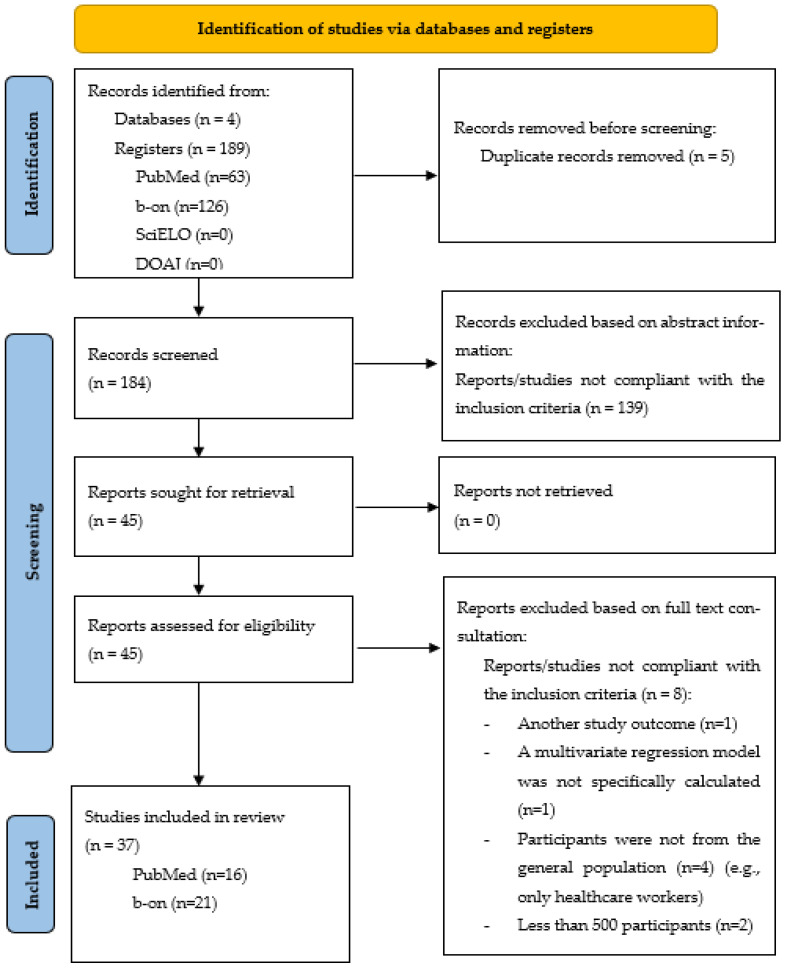
a systematic review according to the Preferred Reporting Items for Systematic Reviews and Meta-Analyses (PRISMA) criteria.
vaccine and (COVID or SARS) and (acceptance or acceptability or willingness or hesitancy or refusal) and (multivariate or regression) and (questionnaire or survey) and national. Databases/resources: PubMed, DOAJ, SciELO and b-on. Timeframe: March 2020-2022.
general population, questionnaire-based, calculation of a multivariate regression model and national studies.
application of the National Heart, Lung, and Blood institute (NHLBI) tool.
a total of 37 studies were selected, whose overall rate was fair. The most predominant predictors of vaccine hesitancy were a lower perceived risk of getting infected, a lower level of institutional trust, not being vaccinated against influenza, lower levels of perceived severity of COVID-19, or stronger beliefs that the vaccination would cause side effects or be unsafe.
the identified predictors can be used to design tailored health policies and/or public health interventions, or to evaluate subjects' vaccine hesitancy.
疫苗犹豫被定义为即使免疫接种是降低2019冠状病毒病(COVID-19)相关死亡率和发病率的决定因素,但仍延迟接受或拒绝接种疫苗。
确定并分析COVID-19疫苗接受度和/或犹豫程度的预测因素。
根据系统评价和Meta分析的首选报告项目(PRISMA)标准进行系统评价。
疫苗与(COVID或SARS)与(接受度或可接受性或意愿或犹豫或拒绝)与(多变量或回归)与(问卷或调查)与全国性。数据库/资源:PubMed、DOAJ、SciELO和b-on。时间范围:2020年3月至2022年。
一般人群、基于问卷、多变量回归模型计算和全国性研究。
应用美国国立心肺血液研究所(NHLBI)工具。
共筛选出37项研究,总体质量一般。疫苗犹豫最主要的预测因素是感染风险感知较低、机构信任度较低、未接种流感疫苗、对COVID-19严重程度的感知较低,或更强烈地认为接种疫苗会产生副作用或不安全。
确定的预测因素可用于制定针对性的卫生政策和/或公共卫生干预措施,或评估受试者的疫苗犹豫程度。