Chen Yongbin, Johnson Scott M, Burr Stephanie D, Povero Davide, Anderson Aaron M, McMahon Cailin E, Liu Jun
Department of Biochemistry and Molecular Biology, Mayo Clinic College of Medicine and Science, Rochester, Minnesota, USA.
Department of Cell Biology, University of Texas Southwestern Medical Center, Dallas, Texas, USA.
J Clin Invest. 2025 Mar 18;135(10). doi: 10.1172/JCI181754. eCollection 2025 May 15.
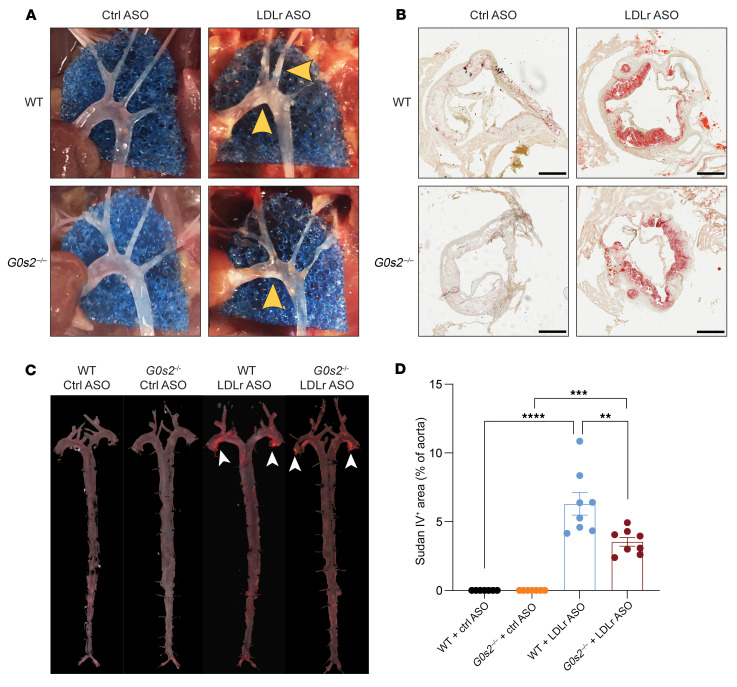
The interplay between intracellular and intravascular lipolysis is crucial for maintaining circulating lipid levels and systemic energy homeostasis. Adipose triglyceride lipase (ATGL) and lipoprotein lipase (LPL), the primary triglyceride (TG) lipases responsible for these two spatially separate processes, are highly expressed in adipose tissue. Yet the mechanisms underlying their coordinated regulation remain undetermined. Here, we demonstrate that genetic ablation of G0S2, a specific inhibitory protein of ATGL, completely abolished diet-induced hypertriglyceridemia and significantly attenuated atherogenesis in mice. These effects were attributable to enhanced whole-body TG clearance, not altered hepatic TG secretion. Specifically, G0S2 deletion increased circulating LPL concentration and activity, predominantly through LPL production from white adipose tissue (WAT). Strikingly, transplantation of G0S2-deficient WAT normalized plasma TG levels in mice with hypertriglyceridemia. In conjunction with improved insulin sensitivity and decreased ANGPTL4 expression, the absence of G0S2 enhanced the stability of LPL protein in adipocytes, a phenomenon that could be reversed upon ATGL inhibition. Collectively, these findings highlight the pivotal role of adipocyte G0S2 in regulating both intracellular and intravascular lipolysis, and the possibility of targeting G0S2 as a viable pharmacological approach to reducing levels of circulating TGs.
细胞内和血管内脂解之间的相互作用对于维持循环脂质水平和全身能量稳态至关重要。脂肪甘油三酯脂肪酶(ATGL)和脂蛋白脂肪酶(LPL)是负责这两个空间上分开的过程的主要甘油三酯(TG)脂肪酶,在脂肪组织中高度表达。然而,它们协同调节的潜在机制仍未确定。在这里,我们证明,G0S2(一种ATGL的特异性抑制蛋白)的基因敲除完全消除了饮食诱导的高甘油三酯血症,并显著减轻了小鼠的动脉粥样硬化。这些作用归因于全身TG清除率的提高,而非肝脏TG分泌的改变。具体而言,G0S2缺失增加了循环LPL浓度和活性,主要是通过白色脂肪组织(WAT)产生LPL。引人注目的是,移植G0S2缺陷的WAT可使高甘油三酯血症小鼠的血浆TG水平恢复正常。与胰岛素敏感性改善和ANGPTL4表达降低相结合,G0S2的缺失增强了脂肪细胞中LPL蛋白的稳定性,这一现象在ATGL抑制后可逆转。总的来说,这些发现突出了脂肪细胞G0S2在调节细胞内和血管内脂解中的关键作用,以及将G0S2作为降低循环TG水平的可行药理学方法的可能性。