Teng Sheng, Yang Yi, Lin Leshi, Li Wenjuan, Li Li, Peng Fang, Gao Xiao, Peng Dongmei
Key Laboratory of Molecular Epidemiology of Hunan Province, Hunan Normal University School of Public Health, Changsha, 410081, China.
Changsha Hospital for Maternal & Child Health Care Affiliated to Hunan Normal University, Changsha, 410081, China.
BMC Public Health. 2025 Mar 18;25(1):1049. doi: 10.1186/s12889-025-22157-w.
Take-out food consumption has adverse effects on public health, and previous studies have reported that frequent consumption of take-out food increases the risk of hypertension and heart disease. However, the status of take-out food consumption among pregnant women remains unclear. This study aimed to provide a comprehensive description of the present state of take-out food consumption among first-trimester pregnant women in Changsha and to investigate the factors influencing this behaviour.
We included 888 pregnant women in early pregnancy from a cross-sectional study (March-August 2022) conducted at Changsha Hospital for Maternal and Child Health Care, Hunan Province, China. Electronic questionnaires were administered during early antenatal check-ups. The questionnaire included demographic information, health and lifestyle behaviours, pregnancy-related information, take-out food consumption, and anxiety and depression scales. Statistical analyses were conducted using SPSS 18.0, including nonparametric Kruskal-Wallis H tests and multivariate ordinal logistic regression, to explore the factors influencing take-out food consumption by first-trimester pregnant women.
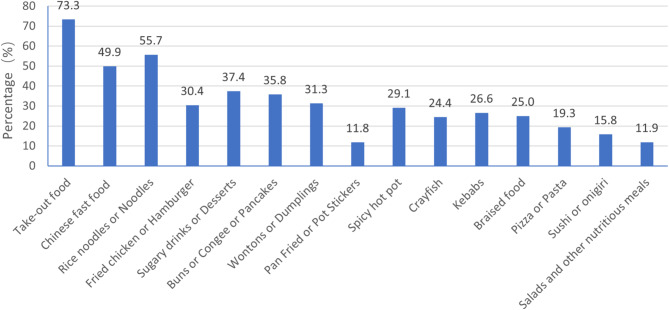
In Changsha, 73.3% of pregnant women consumed take-out food during early pregnancy. The top three types of take-out foods commonly consumed were rice noodles or noodles (55.7%), Chinese fast foods (49.9%), and sugary drinks or desserts (37.4%). The results of multivariate ordinal logistic regression analysis revealed that pregnant women with depression symptoms (odds ratio [OR] = 1.65, 95% confidence interval [CI]:1.18-2.32), higher education level (OR = 1.88, 95%CI:1.23-2.88), and higher online time (OR = 1.50, 95%CI:1.11-2.03) consumed take-out food more frequently in early pregnancy than those without depression symptoms, lower education level, and lower online time.
Our study suggests that take-out food consumption is common among first-trimester pregnant women in Changsha. Education level, depression symptoms, and online time are risk factors that may potentially influence the consumption of take-out food during early pregnancy.
外卖食品消费对公众健康有不良影响,以往研究报告称,经常食用外卖食品会增加患高血压和心脏病的风险。然而,孕妇外卖食品消费状况仍不明确。本研究旨在全面描述长沙早孕孕妇外卖食品消费现状,并调查影响该行为的因素。
我们纳入了来自中国湖南省长沙市妇幼保健院进行的一项横断面研究(2022年3月至8月)中的888名早孕孕妇。在早孕产前检查期间进行电子问卷调查。问卷包括人口统计学信息、健康和生活方式行为、妊娠相关信息、外卖食品消费情况以及焦虑和抑郁量表。使用SPSS 18.0进行统计分析,包括非参数Kruskal-Wallis H检验和多变量有序逻辑回归,以探讨影响早孕孕妇外卖食品消费的因素。
在长沙,73.3%的孕妇在早孕期间食用外卖食品。最常食用的三类外卖食品是米粉或面条(55.7%)、中式快餐(49.9%)和含糖饮料或甜点(37.4%)。多变量有序逻辑回归分析结果显示,有抑郁症状的孕妇(优势比[OR]=1.65,95%置信区间[CI]:1.18-2.32)、教育水平较高(OR=1.88,95%CI:1.23-2.88)以及上网时间较长(OR=1.50,95%CI:1.11-2.03)的孕妇在早孕期间比没有抑郁症状、教育水平较低和上网时间较短的孕妇更频繁地食用外卖食品。
我们的研究表明,外卖食品消费在长沙早孕孕妇中很常见。教育水平、抑郁症状和上网时间是可能影响早孕期间外卖食品消费的危险因素。