Shabani Sadr Narjes Khatoun, Bakhtiarzadeh Fatemeh, Shahpasand Koorosh, Mirnajafi-Zadeh Javad, Behmanesh Mehrdad
Department of Genetics, Faculty of Biological Sciences, Tarbiat Modares University, Tehran, Iran, P.O Box 14115-154.
Department of Physiology, Faculty of Medical Sciences, Tarbiat Modares University, Tehran, Iran, P.O. Box, 14115-331.
Behav Brain Funct. 2025 Mar 18;21(1):7. doi: 10.1186/s12993-025-00271-4.
Alzheimer's disease (AD) is characterized by progressive cognitive decline and synaptic dysfunction, largely driven by amyloid plaques and neurofibrillary tangles (NFTs) composed of hyperphosphorylated tau. These pathological hallmarks disrupt glutamate signaling, which is essential for synaptic plasticity and memory consolidation. This study investigates the therapeutic potential of melatonin on memory and synaptic plasticity in an AD-like mouse model, with a focus on its regulatory effects on glutamate homeostasis and metabotropic glutamate receptors (mGluRs).
The study began with an in-silico bioinformatics analysis of RNA-seq datasets from hippocampal tissues of AD patients to identify differentially expressed genes (DEGs) related to glutamate signaling and tau pathology. An AD-like model was induced via intra-hippocampal injection of cis-phospho tau in C57BL/6 mice. Memory function was assessed using behavioral tests. Synaptic plasticity was evaluated using in vitro field potential recording of hippocampal slices. Histological analyses included Nissl staining for neuronal density, Luxol Fast Blue for myelin integrity, and immunofluorescence for tau hyperphosphorylation. Molecular studies employed qPCR and Western blot to assess glutamate-related markers and tau phosphorylation. Melatonin (10 mg/kg) was administered intraperitoneally, starting either two weeks (early intervention) or four weeks (late intervention) post-induction.
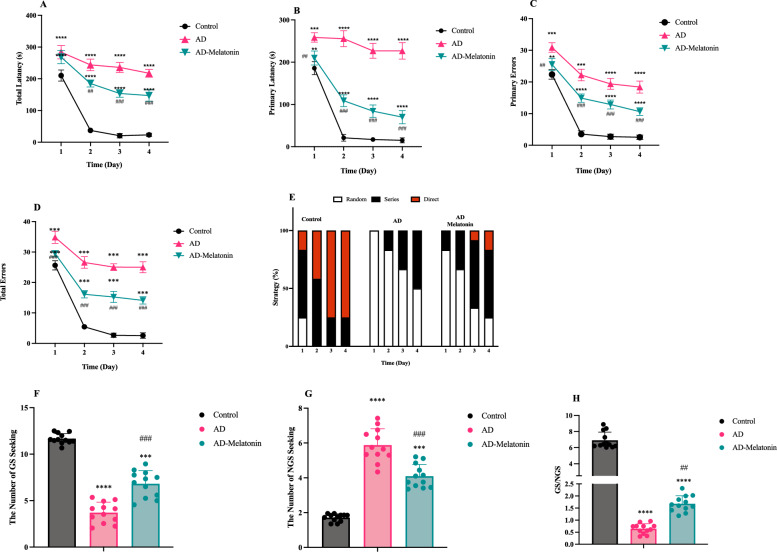
Key molecular targets in glutamate signaling pathways were identified using bioinformatics. AD-like mice displayed memory deficits and synaptic dysfunction. Melatonin improved cognitive function, especially with early intervention, as confirmed by behavioral tests. Histological studies revealed reduced neuronal loss, improved myelin integrity, and decreased tau hyperphosphorylation. Molecular findings showed restored mGluR expression and reduced GSK3 activity. Early intervention yielded superior outcomes, with partial restoration of synaptic plasticity observed in LTP recordings.
These findings underscore the neuroprotective properties of melatonin, mediated by its ability to modulate glutamate signaling and mGluR activity, offering new insights into its potential as a therapeutic agent for AD. Additionally, the results suggest that earlier administration of melatonin may significantly enhance its efficacy, highlighting the importance of timely intervention in neurodegenerative diseases.
阿尔茨海默病(AD)的特征是进行性认知衰退和突触功能障碍,主要由淀粉样斑块和由高度磷酸化tau组成的神经原纤维缠结(NFTs)驱动。这些病理特征破坏了谷氨酸信号传导,而谷氨酸信号传导对于突触可塑性和记忆巩固至关重要。本研究调查了褪黑素在类AD小鼠模型中对记忆和突触可塑性的治疗潜力,重点关注其对谷氨酸稳态和代谢型谷氨酸受体(mGluRs)的调节作用。
该研究首先对AD患者海马组织的RNA测序数据集进行计算机生物信息学分析,以鉴定与谷氨酸信号传导和tau病理相关的差异表达基因(DEGs)。通过向C57BL/6小鼠海马内注射顺式磷酸化tau诱导类AD模型。使用行为测试评估记忆功能。使用海马切片的体外场电位记录评估突触可塑性。组织学分析包括用于神经元密度的尼氏染色、用于髓鞘完整性的Luxol Fast Blue染色以及用于tau高度磷酸化的免疫荧光染色。分子研究采用qPCR和蛋白质印迹法评估谷氨酸相关标志物和tau磷酸化。褪黑素(10mg/kg)腹腔注射,在诱导后两周(早期干预)或四周(晚期干预)开始给药。
使用生物信息学鉴定了谷氨酸信号通路中的关键分子靶点。类AD小鼠表现出记忆缺陷和突触功能障碍。行为测试证实,褪黑素改善了认知功能,尤其是早期干预时。组织学研究显示神经元损失减少、髓鞘完整性改善以及tau高度磷酸化降低。分子研究结果显示mGluR表达恢复且GSK3活性降低。早期干预产生了更好的结果,在长时程增强(LTP)记录中观察到突触可塑性部分恢复。
这些发现强调了褪黑素的神经保护特性,这是由其调节谷氨酸信号传导和mGluR活性的能力介导 的,为其作为AD治疗药物的潜力提供了新的见解。此外,结果表明更早给予褪黑素可能会显著提高其疗效,突出了在神经退行性疾病中及时干预的重要性。