Naser Paul Vincent, Tsitsopoulos Parmenion, Zacharias Friederike, Castaño-Leon Ana M, Buki Andras, Depreitere Bart, Van Essen Thomas, Korhonen Tommi K, Mee Harry, Hossain Iftakher, Posti Jussi, Lippa Laura, Papadopoulos Marios C, Terpolilli Nicole, Marklund Niklas, Petr Ondra, Toth Peter, Luoto Teemu, Krieg Sandro M, Unterberg Andreas W, Younsi Alexander
Heidelberg University Hospital, Department of Neurosurgery, Im Neuenheimer Feld 400, 69120, Heidelberg, Germany.
Heidelberg University, Medical Faculty, Grabengasse 1, 69117, Heidelberg, Germany.
Brain Spine. 2025 Feb 17;5:104214. doi: 10.1016/j.bas.2025.104214. eCollection 2025.
Cranioplasty, a surgical procedure to restore skull integrity and aesthetic contour following decompressive craniectomy, poses challenges in material selection and timing, driven by the lack of guidelines and ongoing regulatory changes.
This study aimed to provide an overview of current cranioplasty practices in Europe, explicitly addressing a potential shift towards alloplastic materials and the management of patients with concomitant hydrocephalus.
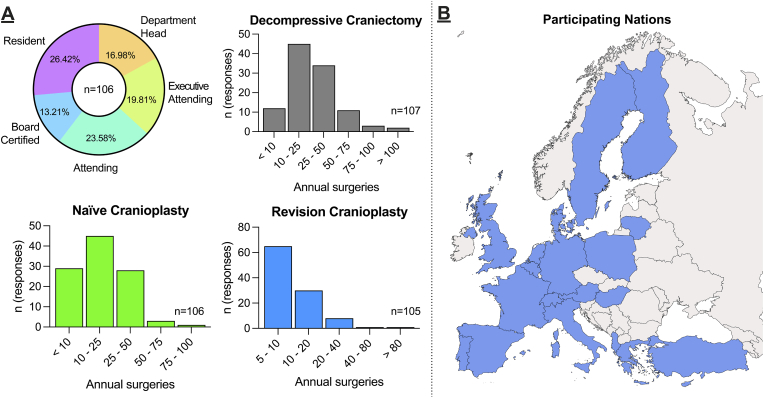
An online survey was conducted among European neurosurgical centers from January to March 2024, collecting data on material preferences, timing of procedures, and management strategies for cranioplasty. Descriptive and statistical analyses were performed on 110 complete responses.
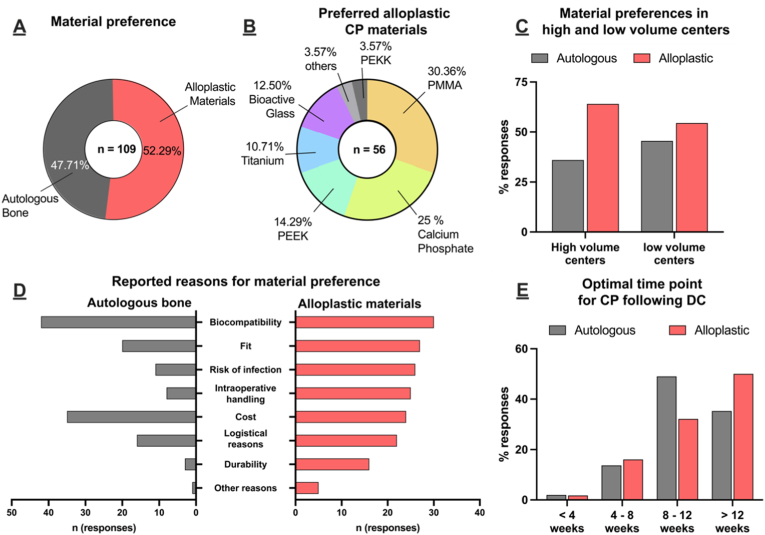
Respondents favored alloplastic materials over autologous bone for cranioplasty, citing regulatory constraints and reduced infection risk as primary reasons. Variability was observed in the timing of procedures and the management of patients with hydrocephalus, with most centers adopting staged approaches.
The shift towards alloplastic materials in cranioplasty reflects regulatory pressures rather than material-specific considerations. Despite variability in practice, our findings underscore the need for standardized guidelines and further research to optimize patient outcomes. This study provides valuable insights into current practices and highlights areas for future investigation in cranioplasty.
颅骨修补术是一种在减压性颅骨切除术后恢复颅骨完整性和美学轮廓的外科手术,由于缺乏指南以及监管不断变化,在材料选择和时机方面面临挑战。
本研究旨在概述欧洲目前的颅骨修补术实践,明确探讨向异体材料的潜在转变以及伴有脑积水患者的管理。
2024年1月至3月对欧洲神经外科中心进行了一项在线调查,收集有关颅骨修补术的材料偏好、手术时机和管理策略的数据。对110份完整回复进行了描述性和统计分析。
受访者在颅骨修补术中更倾向于使用异体材料而非自体骨,主要原因是监管限制和感染风险降低。在手术时机和脑积水患者的管理方面存在差异,大多数中心采用分阶段方法。
颅骨修补术中向异体材料的转变反映了监管压力而非材料特定因素。尽管实践存在差异,但我们的研究结果强调了制定标准化指南和进一步研究以优化患者预后的必要性。本研究为当前实践提供了有价值的见解,并突出了颅骨修补术未来研究的领域。