Ryvlin Jessica, Seneviratne Namal, Bangash Ali Haider, Goodwin C Rory, Weber Michael H, Charest-Morin Raphaële, Shin John H, Versteeg Anne L, Fourman Mitchell S, Murthy Saikiran G, Gelfand Yaroslav, Yassari Reza, De la Garza Ramos Rafael
Spine Tumor Mechanics and Outcomes Research (TUMOR) Lab, Montefiore Medical Center, Albert Einstein College of Medicine, Bronx, NY, USA.
Department of Neurology, Montefiore Medical Center, Albert Einstein College of Medicine, Bronx, NY, USA.
Brain Spine. 2025 Feb 25;5:104223. doi: 10.1016/j.bas.2025.104223. eCollection 2025.
Hypoalbuminemia is associated with poor outcomes in cancer patients, but its role in spinal metastases remains unclear.
This study aimed to identify albumin cutoff values defining hypoalbuminemia and describe the association between serum albumin and outcomes in patients with spinal metastases.
A narrative review of articles up to December 2022 was conducted using PubMed/Medline, EMBASE, and Web of Science databases. Variables extracted included study design, patient characteristics, serum albumin levels, treatments, and levels of evidence. Outcomes included survival/mortality, complications, ambulatory status, readmission, length of stay, discharge disposition, and blood loss.
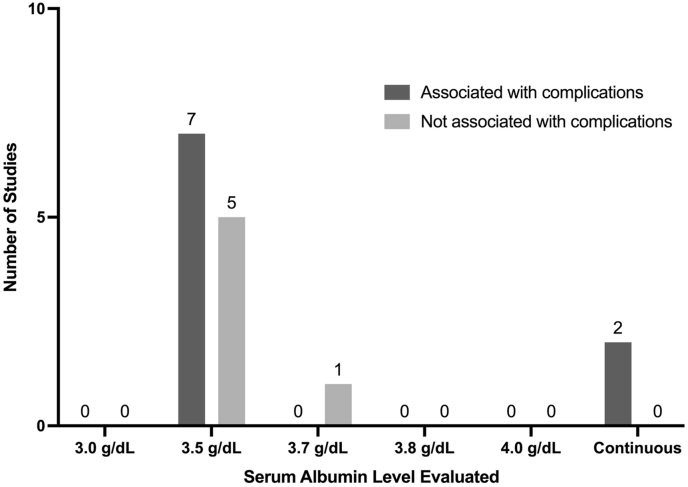
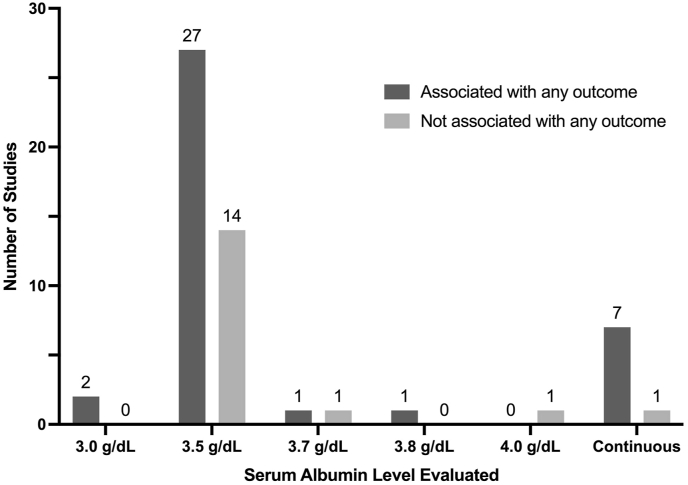
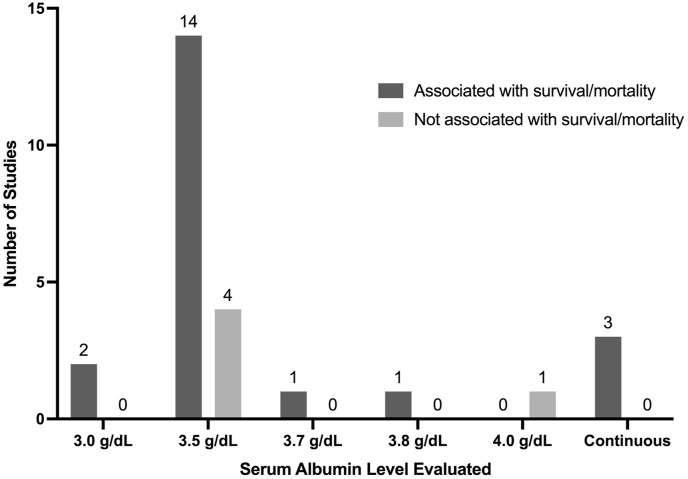
Thirty-eight studies comprising 21,401 patients were analyzed. Most studies (92%) were Level of Evidence III. Albumin was evaluated as a continuous variable in 18% of studies and as a dichotomous variable in 76%, with 3.5 g/dL being the most common threshold for hypoalbuminemia. Primary outcomes evaluated were survival/mortality (71% of studies), complications (34%), and reoperation/readmission (11%). Of studies examining the association between hypoalbuminemia and survival/mortality, 74% found a significant association. An association between albumin levels and complications was found in 54% of relevant studies.
The findings of this study suggest that a threshold of 3.5 g/dL seems most appropriate to define hypoalbuminemia in patients with spinal metastases. However, evidence also supports a level-dependent effect. The most consistent significant association was between low albumin and survival at both fixed and continuous time points. There is less evidence to support an association between hypoalbuminemia and other endpoints such as perioperative complications.
低白蛋白血症与癌症患者的不良预后相关,但其在脊柱转移瘤中的作用尚不清楚。
本研究旨在确定定义低白蛋白血症的白蛋白临界值,并描述血清白蛋白与脊柱转移瘤患者预后之间的关联。
使用PubMed/Medline、EMBASE和Web of Science数据库对截至2022年12月的文章进行叙述性综述。提取的变量包括研究设计、患者特征、血清白蛋白水平、治疗方法和证据水平。结局包括生存/死亡、并发症、活动状态、再次入院、住院时间、出院处置和失血量。
分析了38项研究,共21401例患者。大多数研究(92%)为证据水平III。18%的研究将白蛋白作为连续变量进行评估,76%作为二分变量进行评估,低白蛋白血症最常见的阈值为3.5g/dL。评估的主要结局为生存/死亡(71%的研究)、并发症(34%)和再次手术/再次入院(11%)。在研究低白蛋白血症与生存/死亡之间关联的研究中,74%发现存在显著关联。54%的相关研究发现白蛋白水平与并发症之间存在关联。
本研究结果表明,3.5g/dL的阈值似乎最适合定义脊柱转移瘤患者的低白蛋白血症。然而,证据也支持剂量依赖效应。最一致的显著关联是低白蛋白与固定和连续时间点的生存之间的关联。支持低白蛋白血症与其他终点(如围手术期并发症)之间关联的证据较少。