Hall Johanna L, Yang Shiun-Jr, Limmer David T, Fleming Graham R
Department of Chemistry, University of California, Berkeley, CA 94720.
Molecular Biophysics and Integrated Bioimaging Division, Lawrence Berkeley National Laboratory, Berkeley, CA 94720.
Proc Natl Acad Sci U S A. 2025 Mar 25;122(12):e2426331122. doi: 10.1073/pnas.2426331122. Epub 2025 Mar 19.
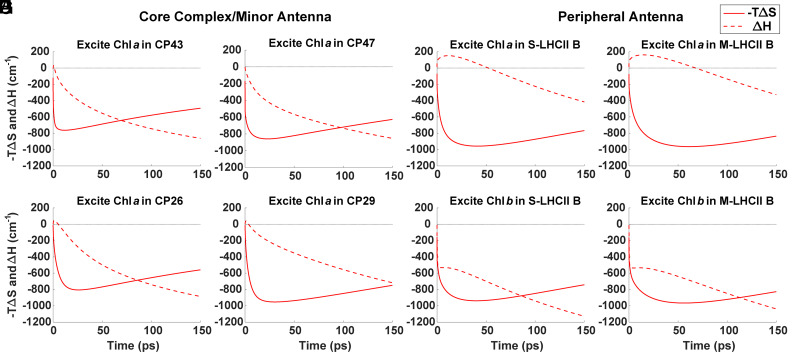
Photosystem II (PSII) can achieve near-unity quantum efficiency of light harvesting in ideal conditions and can dissipate excess light energy as heat to prevent the formation of reactive oxygen species (ROS) under light stress. Understanding how this pigment-protein complex accomplishes these opposing goals is a topic of great interest that has so far been explored primarily through the lens of the system energetics. Despite PSII's known flat energy landscape, a thorough consideration of the entropic effects on energy transfer in PSII is lacking. In this work, we aim to discern the free energetic design principles underlying the PSII energy transfer network. To accomplish this goal, we employ a structure-based rate matrix and compute the free energy terms in time following a specific initial excitation to discern how entropy and enthalpy drive ensemble system dynamics. We find that the interplay between the entropy and enthalpy components differ among each protein subunit, which allows each subunit to fulfill a unique role in the energy transfer network. This individuality ensures that PSII can accomplish efficient energy trapping in the reaction center (RC), effective nonphotochemical quenching (NPQ) in the periphery, and robust energy trapping in the other-monomer RC if the same-monomer RC is closed. We also show that entropy, in particular, is a dynamically tunable feature of the PSII free energy landscape accomplished through regulation of LHCII binding. These findings help rationalize natural photosynthesis and provide design principles for more efficient solar energy harvesting technologies.
在理想条件下,光系统II(PSII)能够实现近乎完美的光捕获量子效率,并且在光胁迫下能够将多余的光能以热的形式耗散,以防止活性氧物种(ROS)的形成。了解这种色素-蛋白复合物如何实现这些相反的目标是一个备受关注的话题,到目前为止,主要是通过系统能量学的视角进行探索的。尽管已知PSII具有平坦的能量格局,但缺乏对熵效应对PSII中能量转移影响的全面考虑。在这项工作中,我们旨在识别PSII能量转移网络背后的自由能设计原则。为了实现这一目标,我们采用基于结构的速率矩阵,并在特定初始激发后及时计算自由能项,以识别熵和焓如何驱动整体系统动力学。我们发现,熵和焓成分之间的相互作用在每个蛋白质亚基中有所不同,这使得每个亚基能够在能量转移网络中发挥独特的作用。这种个体性确保了PSII能够在反应中心(RC)实现高效的能量捕获,在外围实现有效的非光化学猝灭(NPQ),并且如果同一单体RC关闭,则能够在另一单体RC中实现稳健的能量捕获。我们还表明,特别是熵,是PSII自由能格局的一个动态可调特征,是通过对LHCII结合的调节实现的。这些发现有助于解释自然光合作用,并为更高效的太阳能捕获技术提供设计原则。