Lang Junzhe, Dong Zetao, Shi Boyuan, Wang Dongdong, Yuan Jiandong, Chen Lei, Gao Jianqing, Sun Anan, Huang Jiyue, Xue Zhiqiang
Department of Orthopaedics, The First Affiliated Hospital of Wenzhou Medical University, Wenzhou, 325035, Zhejiang Province, China.
Department of Clinical Medicine, Wenzhou Medical University, Wenzhou, 325035, Zhejiang Province, China.
J Orthop Traumatol. 2025 Mar 19;26(1):18. doi: 10.1186/s10195-025-00833-2.
Periprosthetic joint infection (PJI) is a catastrophic complication after joint arthroplasty. This study aimed to analyze the relationship between laboratory tests and PJI and establish a nomogram for predicting risks of PJI after total hip arthroplasty (THA).
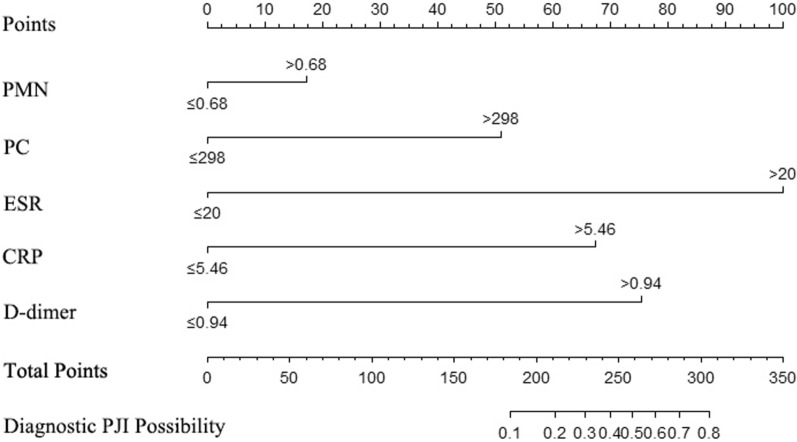
The clinical data of patients who underwent THA from January 2015 to December 2020 were retrospectively analyzed. Demographic and relevant clinical information of patients was collected; independent risk factors associated with PJI were determined by univariate and multivariate logistic regression analysis, and receiver operating characteristics (ROC) were drawn to analyze the specificity and sensitivity of each risk factor. Risk factors are included in the nomogram. Calibration curve and decision curve analysis were used to evaluate the predictive accuracy and discriminability of the model.
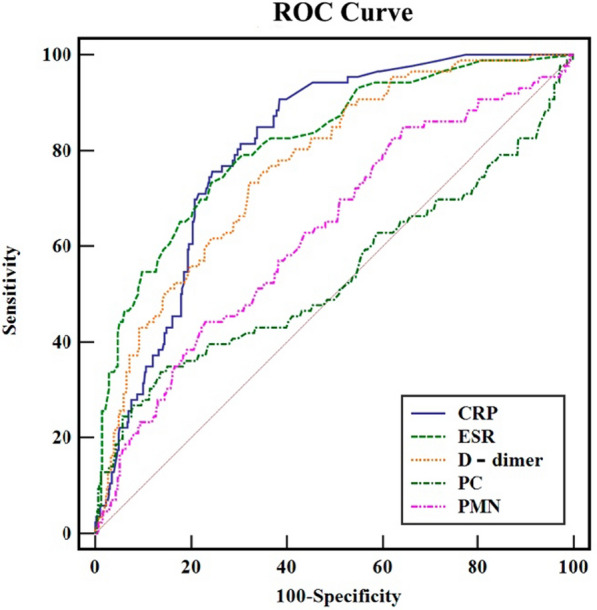
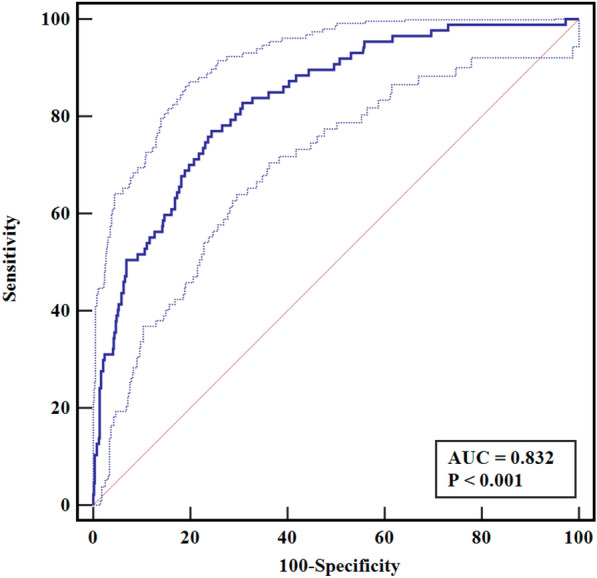
A total of 589 patients were enrolled in the study, of whom 87 were eventually diagnosed with PJI. Multivariate logistic regression analysis showed that serum C-reactive protein, erythrocyte sedimentation rate, polymorphonuclear neutrophils, D-dimer, and platelet count were independent risk factors for PJI after THA. The ROC curve analysis model of multivariate combined diagnosis had good diagnostic value, sensitivity was 77.01%, and specificity was 75.51%. The calibration curve shows good agreement between the prediction of the line graph and the actual observed results. The decision curve shows that the nomogram has a net clinical benefit.
The changes in serum C-reactive protein, erythrocyte sedimentation rate, polymorphonuclear neutrophils, D-dimer, and platelet count are related to the occurrence of PJI after hip arthroplasty. The nomogram prediction model established in this study is promising for the screening of PJI after hip arthroplasty.
Level III evidence. Non-randomized controlled cohort/follow-up study.
人工关节周围感染(PJI)是关节置换术后的一种灾难性并发症。本研究旨在分析实验室检查与PJI之间的关系,并建立一个预测全髋关节置换术(THA)后PJI风险的列线图。
回顾性分析2015年1月至2020年12月接受THA的患者的临床资料。收集患者的人口统计学和相关临床信息;通过单因素和多因素逻辑回归分析确定与PJI相关的独立危险因素,并绘制受试者工作特征(ROC)曲线分析各危险因素的特异性和敏感性。将危险因素纳入列线图。采用校准曲线和决策曲线分析评估模型的预测准确性和判别能力。
本研究共纳入589例患者,其中87例最终被诊断为PJI。多因素逻辑回归分析显示,血清C反应蛋白、红细胞沉降率、多形核中性粒细胞、D-二聚体和血小板计数是THA后PJI的独立危险因素。多因素联合诊断的ROC曲线分析模型具有良好的诊断价值,敏感性为77.01%,特异性为75.51%。校准曲线显示折线图预测与实际观察结果之间具有良好的一致性。决策曲线表明列线图具有净临床效益。
血清C反应蛋白、红细胞沉降率、多形核中性粒细胞、D-二聚体和血小板计数的变化与髋关节置换术后PJI的发生有关。本研究建立的列线图预测模型对髋关节置换术后PJI的筛查具有一定的应用前景。
III级证据。非随机对照队列/随访研究。