Liu Wen, Lee Kyuri, Suh Heather, Li Junxin
College of Nursing, University of Iowa, Iowa City, Iowa, USA.
School of Nursing, Johns Hopkins University, Baltimore, Maryland, USA.
Alzheimers Dement. 2025 Mar;21(3):e14522. doi: 10.1002/alz.14522.
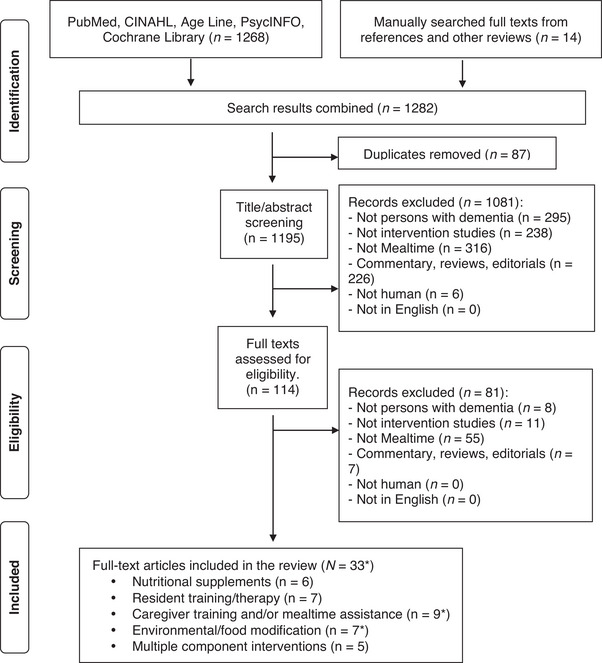
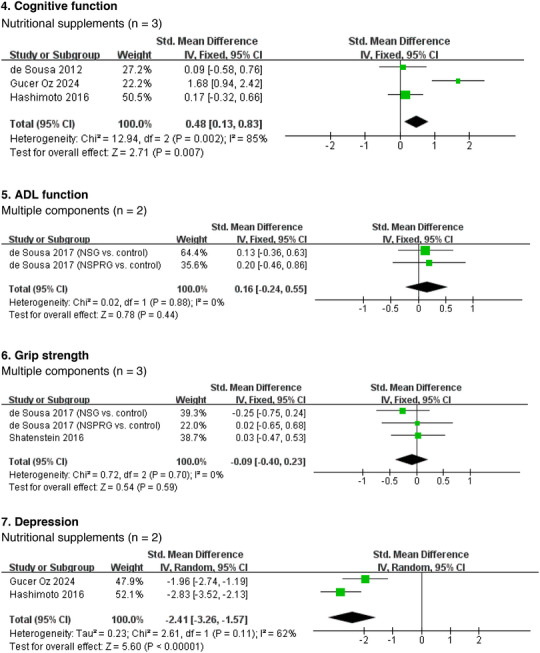
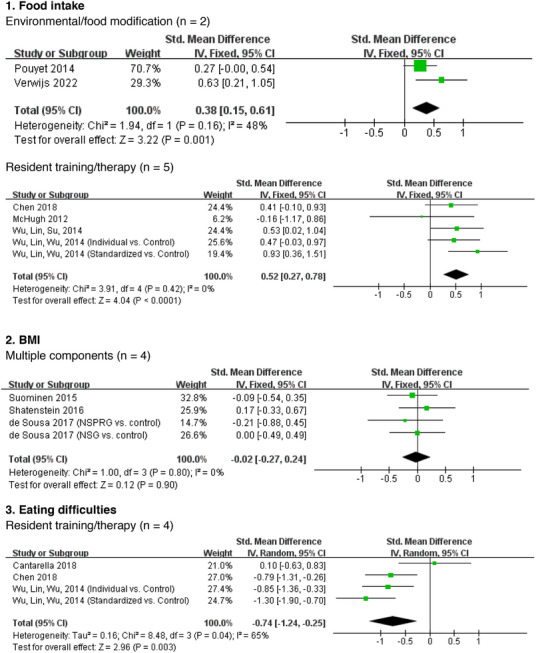
Interventions addressing modifiable personal and environmental factors are critical to optimize dementia mealtime care, caregiving, and outcomes. This review synthesized the characteristics and effects of non-pharmacological interventions on mealtime care and outcomes in people with dementia and their caregivers. Five databases were searched from January 2012 to October 2024. Eligible studies were accessed for study quality and graded for level of evidence. Meta-analyses were performed for studies within the same intervention type that tested the impact on same outcomes. 33 studies were identified and categorized into five intervention types. Five studies were strong, 7 moderate, and 21 weak in quality. The levels of evidence varied from very low to moderate, with most being very low to low. Meta-analyses showed "resident training/therapy" decreased eating difficulties and increased food intake; "Nutritional supplement" improved cognition and depression; "environmental/food modification" increased food intake. Further research using rigorous designs is needed to increase evidence quality and determine effects of multi-component interventions. HIGHLIGHTS: Five intervention types were identified from the 33 included studies: nutritional supplements, resident training/therapy, caregiver training and/or mealtime assistance, environmental/food modification, and multiple component interventions. One-third of the included studies were strong to moderate, and two-thirds were weak in study quality. "Resident training/therapy" showed effects in reducing eating difficulties and increasing food intake. "Environmental/food modification" showed effects in increasing food intake. "Nutritional supplements" showed effects in improving cognitive function and depression.
针对可改变的个人和环境因素的干预措施对于优化痴呆症患者用餐护理、照护及结果至关重要。本综述综合了非药物干预对痴呆症患者及其照护者用餐护理和结果的特征及影响。检索了2012年1月至2024年10月期间的五个数据库。对符合条件的研究进行研究质量评估并对证据水平进行分级。对测试相同结果的同一干预类型的研究进行荟萃分析。共识别出33项研究并分为五种干预类型。5项研究质量高,7项中等,21项质量低。证据水平从极低到中等不等,大多数为极低到低。荟萃分析表明,“患者培训/治疗”可减少进食困难并增加食物摄入量;“营养补充剂”可改善认知和抑郁状况;“环境/食物改良”可增加食物摄入量。需要采用严谨设计进行进一步研究,以提高证据质量并确定多成分干预措施的效果。要点:从纳入的33项研究中识别出五种干预类型:营养补充剂、患者培训/治疗、照护者培训和/或用餐协助、环境/食物改良以及多成分干预措施。三分之一的纳入研究质量高到中等,三分之二研究质量低。“患者培训/治疗”在减少进食困难和增加食物摄入量方面显示出效果。“环境/食物改良”在增加食物摄入量方面显示出效果。“营养补充剂”在改善认知功能和抑郁方面显示出效果。