Castien René, Reezigt Roland R, den Hartog Ruben, Amons Andreas, De Hertogh Willem, Scholten-Peeters Gwendolyne G
Faculty of Behavioural and Movement Sciences, Amsterdam Movement Sciences Program Musculoskeletal Health, Vrije Universiteit Amsterdam, Amsterdam, the Netherlands.
Amsterdam Public Health Research Institute, Department of General Practice, Section Research-Soma & Psyche, Vrije Universiteit Amsterdam, Amsterdam, the Netherlands.
Pain Rep. 2025 Mar 18;10(2):e1258. doi: 10.1097/PR9.0000000000001258. eCollection 2025 Apr.
Manual pressure techniques are commonly employed as a therapeutic approach for individuals experiencing musculoskeletal pain. The painful nature of these techniques suggests that a central mechanism known as conditioned pain modulation (CPM) might play a role.
This study tested whether a painful manual pressure technique (MPT) reduces pain sensitivity partly by eliciting a CPM effect.
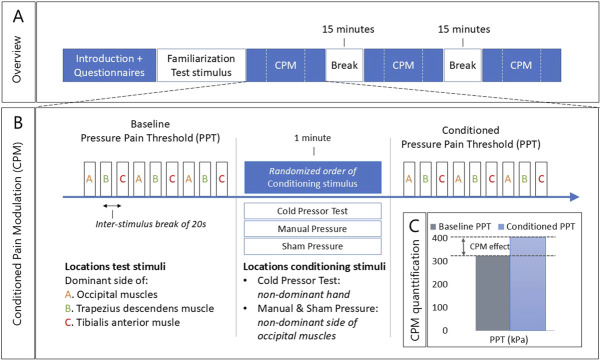
This crossover study examined 3 different conditioning stimuli: (1) a cold pressor test (CPT) with the contralateral hand submerged in a cold water bath, (2) painful MPT, and (3) sham-MPT on suboccipital muscles. We measured their effect on pain sensitivity using pressure pain thresholds at 3 locations: locally (suboccipital muscles), regionally (trapezius muscle), and remotely (tibialis anterior muscle).
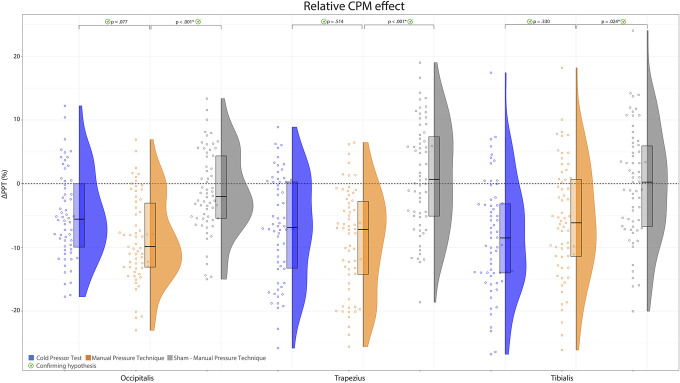
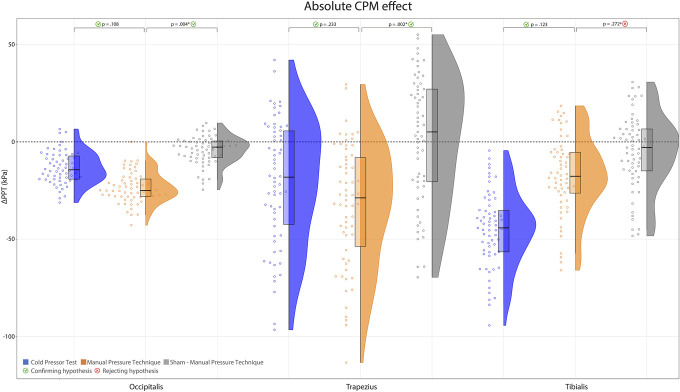
In 63 healthy participants, no significant differences were found between the painful MPT and CPT on the pressure pain thresholds at all test locations: locally, -11 kPa (95% CI: 3 to -25); regionally, -15 kPa (95% CI: 10 to -39); and remotely, -24 kPa (95% CI: 55 to -7). Manual pressure technique compared to sham-MPT showed significant differences in the suboccipital muscles, -20.04 kPa (95% CI: -6.45 to -34.63) and the trapezius muscle, -38.24 (95% CI: -13.97 to -62.5) but no significant difference at the tibialis anterior muscle, -17.5 kPa (95% CI: 13.9 to -48.91).
Painful MPTs applied at the suboccipital muscles reduce pain sensitivity at all sites, similar to the CPT, indicating CPM activation. Central pain inhibition might contribute to the effect of painful MPT in healthy people.
手动按压技术通常被用作治疗肌肉骨骼疼痛患者的一种治疗方法。这些技术的疼痛性质表明,一种称为条件性疼痛调制(CPM)的中枢机制可能发挥作用。
本研究测试了一种疼痛性手动按压技术(MPT)是否部分通过引发CPM效应来降低疼痛敏感性。
这项交叉研究检查了3种不同的条件刺激:(1)对侧手浸入冷水浴中的冷加压试验(CPT),(2)疼痛性MPT,以及(3)枕下肌肉的假MPT。我们使用3个部位的压力疼痛阈值来测量它们对疼痛敏感性的影响:局部(枕下肌肉)、区域(斜方肌)和远处(胫骨前肌)。
在63名健康参与者中,疼痛性MPT和CPT在所有测试部位的压力疼痛阈值上没有显著差异:局部为-11 kPa(95%CI:3至-25);区域为-15 kPa(95%CI:10至-39);远处为-24 kPa(95%CI:55至-7)。与假MPT相比,手动按压技术在枕下肌肉(-20.04 kPa,95%CI:-6.45至-34.63)和斜方肌(-38.24,95%CI:-13.97至-62.5)上显示出显著差异,但在胫骨前肌上没有显著差异(-17.5 kPa,95%CI:13.9至-48.91)。
在枕下肌肉施加疼痛性MPT可降低所有部位的疼痛敏感性,类似于CPT,表明CPM被激活。中枢性疼痛抑制可能有助于疼痛性MPT对健康人的影响。