Saeed Sadia, la Cour Poulsen Lars, Visnovska Tina, Hoffmann Anne, Ghosh Adhideb, Wolfrum Christian, Rønningen Torunn, Dahl Mai Britt, Wang Junbai, Cayir Akin, Mala Tom, Kristinsson Jon A, Svanevik Marius, Hjelmesæth Jøran, Hertel Jens Kristoffer, Blüher Matthias, Valderhaug Tone Gretland, Böttcher Yvonne
Department of Clinical Molecular Biology, EpiGen, Institute of Clinical Medicine, University of Oslo, Oslo, Norway.
EpiGen, Medical Division, Akershus University Hospital, Lørenskog, Norway.
EBioMedicine. 2025 Apr;114:105653. doi: 10.1016/j.ebiom.2025.105653. Epub 2025 Mar 20.
Obesity is a global health challenge and adipose tissue exhibits distinct depot-specific characteristics impacting differentially on the risk of metabolic comorbidities.
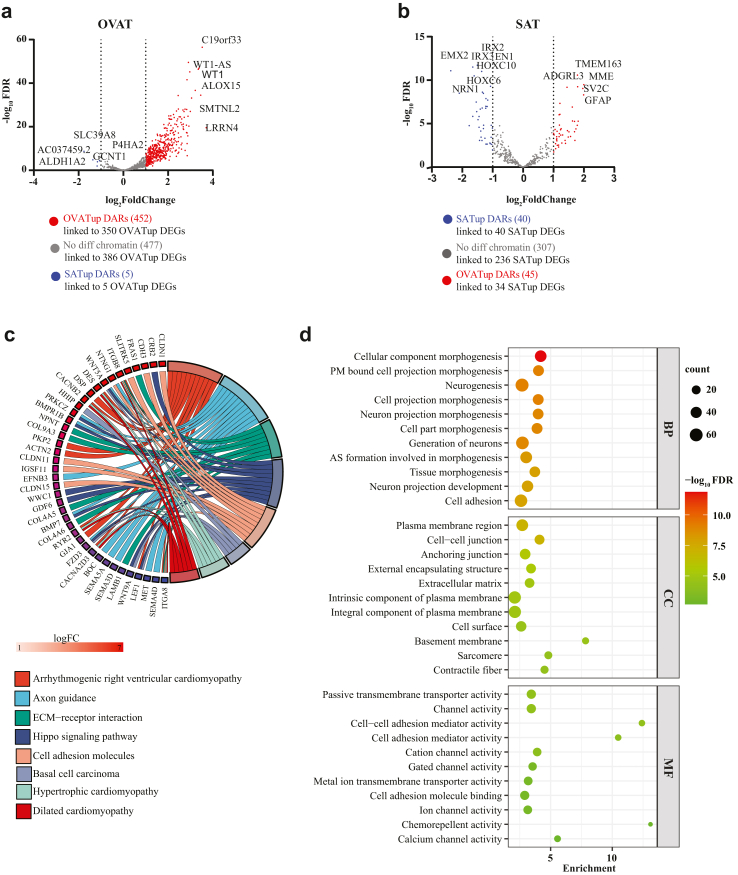
Here, we integrate chromatin accessibility (ATAC-seq) and gene expression (RNA-seq) data from intra-individually paired human subcutaneous (SAT) and omental visceral adipose tissue (OVAT) samples to unveil depot-specific regulatory mechanisms.
We identified twice as many depot-specific differentially accessible regions (DARs) in OVAT compared to SAT. SAT-specific regions showed enrichment for adipose tissue enhancers involving genes controlling extracellular matrix organization and metabolic processes. In contrast, OVAT-specific regions showed enrichment in promoters linked to genes associated with cardiomyopathies. Moreover, OVAT-specific regions were enriched for bivalent transcription start site and repressive chromatin states, suggesting a "lingering" regulatory state. Motif analysis identified CTCF and BACH1 as most significantly enriched motifs in SAT and OVAT-specific DARs, respectively. Distinct gene sets correlated with important clinical variables of obesity, fat distribution measures, as well as insulin, glucose, and lipid metabolism.
We provide an integrated analysis of chromatin accessibility and transcriptional profiles in paired human SAT and OVAT samples, offering new insights into the regulatory landscape of adipose tissue and highlighting depot-specific mechanisms in obesity pathogenesis.
SS received EU-Scientia postdoctoral Fellowship and project funding from the European Union's Horizon 2020 Research and Innovation program under the Marie Skłodowska-Curie Grant, (agreement No. 801133). LlCP and TR were supported by Helse Sør-Øst grants to Y.B (ID 2017079, ID 278908). MB received funding from grants from the DFG (German Research Foundation)-Projekt number 209933838-SFB 1052 (project B1) and by Deutsches Zentrum für Diabetesforschung (DZD, Grant: 82DZD00601).
肥胖是一项全球性的健康挑战,脂肪组织呈现出不同的部位特异性特征,对代谢合并症风险产生不同影响。
在此,我们整合来自个体内配对的人类皮下脂肪组织(SAT)和网膜内脏脂肪组织(OVAT)样本的染色质可及性(ATAC-seq)和基因表达(RNA-seq)数据,以揭示部位特异性调控机制。
我们发现,与SAT相比,OVAT中部位特异性差异可及区域(DAR)的数量是其两倍。SAT特异性区域显示出涉及控制细胞外基质组织和代谢过程的基因的脂肪组织增强子富集。相比之下,OVAT特异性区域在与心肌病相关基因的启动子中显示出富集。此外,OVAT特异性区域在二价转录起始位点和抑制性染色质状态方面富集,表明存在一种“持续的”调控状态。基序分析确定CTCF和BACH1分别是SAT和OVAT特异性DAR中最显著富集的基序。不同的基因集与肥胖的重要临床变量、脂肪分布指标以及胰岛素、葡萄糖和脂质代谢相关。
我们对配对的人类SAT和OVAT样本中的染色质可及性和转录谱进行了综合分析,为脂肪组织的调控格局提供了新见解,并突出了肥胖发病机制中的部位特异性机制。
SS获得了欧盟-科学博士后奖学金以及欧盟“地平线2020”研究与创新计划下玛丽·居里奖学金的项目资金(协议编号801133)。LlCP和TR得到了南奥斯特医疗信托基金授予Y.B的资助(ID 2017079,ID 278908)。MB获得了德国研究基金会(DFG)-项目编号209933838-SFB 1052(项目B1)以及德国糖尿病研究中心(DZD,资助编号:82DZD00601)的资助。