Mengist Belayneh, Lotfaliany Mojtaba, Pasco Julie A, Agustini Bruno, Berk Michael, Forbes Malcolm, Lane Melissa M, Orchard Suzanne G, Ryan Joanne, Owen Alice J, Woods Robyn L, McNeil John J, Mohebbi Mohammadreza
Deakin University, the Institute for Mental and Physical Health and Clinical Translation (IMPACT), School of Medicine, Geelong, VIC, Australia.
College of Medicine and Health Sciences, Debre Markos University, Debre Markos, Ethiopia.
BMC Med. 2025 Mar 24;23(1):172. doi: 10.1186/s12916-025-04002-4.
Longitudinal cohort studies across the lifespan suggest an association between ultra-processed food (UPF) and depression. However, the effect of UPF on depression and mental health in older adults has not been determined. Therefore, this study investigated the effect of UPF on depressive symptoms and mental health in community-dwelling older adults.
A pragmatic target trial was designed and emulated using the ASPirin in Reducing Events in the Elderly longitudinal data. Participants were community-dwelling older adults (≥ 70 years) in Australia. We specified and emulated the protocol of a two-arm randomised pragmatic clinical trial using the level of UPF consumption as the intervention. Greater than or equal to 4 servings of UPF per day was considered the intervention, with less than 4 servings per day the control. Dietary consumption was assessed using a mail-based diet screening questionnaire, and the level of food processing was classified based on the NOVA classification. The study outcomes were depressive symptoms, defined as a score of ≥ 8 on the Center for Epidemiological Studies Depression 10-item scale, and general mental health, defined by the mental component summary score of the Short Form-12. We applied inverse probability treatment weighting to balance confounders. Marginal structural models were employed to estimate the population-level average effect of intervention using generalised estimated equations.
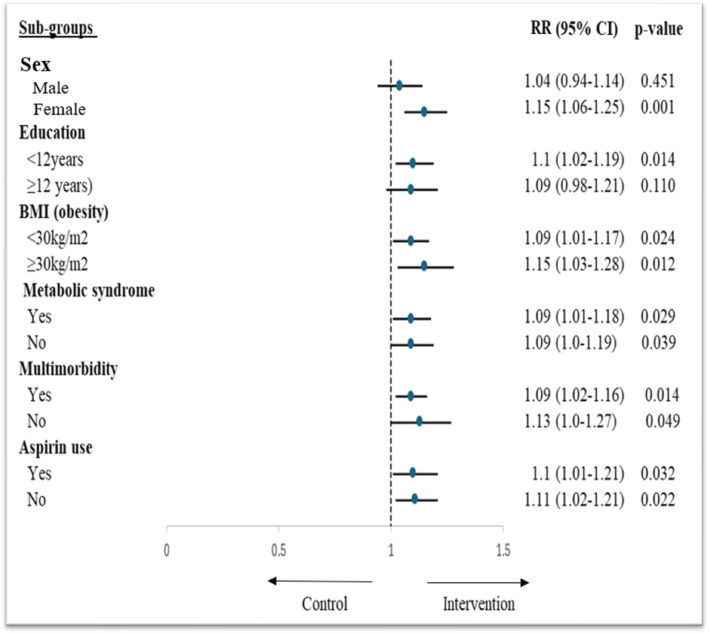
A total of 11,192 participants (3415 intervention and 7777 control) were eligible for the emulation. High UPF consumption at time zero was associated with an increased risk of depressive symptoms at follow-ups (RR: 1.10; CI: 1.04-1.18). The finding was consistent with sensitivity analyses; after excluding participants on antidepressants at time zero, the risk of depressive symptoms in the intervention group was increased by 11% compared to the control (RR: 1.11; 95% CI: (1.04-1.20)). Consumption of UPF adversely affected the mental component quality of life (β: - 0.40; CI: - 0.65 to - 0.15).
A higher level of UPF consumption was associated with a higher risk of depressive symptoms and adversely affected mental health among older adults.
针对整个生命周期的纵向队列研究表明,超加工食品(UPF)与抑郁症之间存在关联。然而,UPF对老年人抑郁症和心理健康的影响尚未确定。因此,本研究调查了UPF对社区居住老年人抑郁症状和心理健康的影响。
使用老年人阿司匹林减少事件纵向数据设计并模拟了一项实用目标试验。参与者为澳大利亚社区居住的老年人(≥70岁)。我们以UPF摄入量作为干预措施,指定并模拟了一项双臂随机实用临床试验方案。每天食用≥4份UPF被视为干预组,每天食用少于4份为对照组。使用基于邮件的饮食筛查问卷评估饮食摄入量,并根据NOVA分类对食品加工水平进行分类。研究结果包括抑郁症状,定义为在流行病学研究中心抑郁10项量表上得分≥8分,以及总体心理健康状况,由简短健康调查问卷-12的心理成分汇总得分定义。我们应用逆概率治疗加权来平衡混杂因素。采用边际结构模型,使用广义估计方程估计干预措施在人群水平上的平均效果。
共有11192名参与者(3415名干预组和7777名对照组)符合模拟条件。基线时高UPF摄入量与随访时抑郁症状风险增加相关(风险比:1.10;可信区间:1.04-1.18)。这一发现与敏感性分析结果一致;在排除基线时服用抗抑郁药的参与者后,干预组抑郁症状的风险比对照组增加了11%(风险比:1.11;95%可信区间:(1.04-1.20))。UPF的摄入对心理成分生活质量有不利影响(β:-0.40;可信区间:-0.65至-0.15)。
较高水平的UPF消费与老年人抑郁症状风险较高相关,并对心理健康产生不利影响。