Fu Chengxia, Wu Yichao, Sørensen Søren J, Zhang Ming, Dai Ke, Gao Chunhui, Qu Chenchen, Huang Qiaoyun, Cai Peng
National Key Laboratory of Agricultural Microbiology, College of Resources and Environment, Huazhong Agricultural University, Wuhan, 430070, China.
Section of Microbiology, Department of Biology, University of Copenhagen, Copenhagen, Denmark.
Microbiome. 2025 Mar 24;13(1):84. doi: 10.1186/s40168-025-02075-0.
Porous environments constitute ubiquitous microbial habitats across natural, engineered, and medical settings, offering extensive internal surfaces for biofilm development. While the physical structure of the porous environment is known to shape the spatial organization of biofilm inhabitants and their interspecific interactions, its influence on biofilm community structure and functional diversity remains largely unknown. This study employed microfluidic chips with varying micropillar diameters to create distinct pore spaces that impose different levels of spatial constraints on biofilm development. The impact of pore spaces on biofilm architecture, community assembly, and metabolic functions was investigated through in situ visualization and multi-omics technologies.
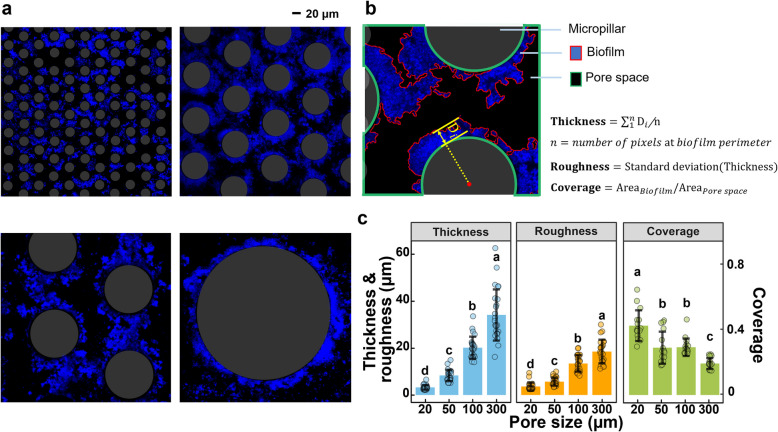
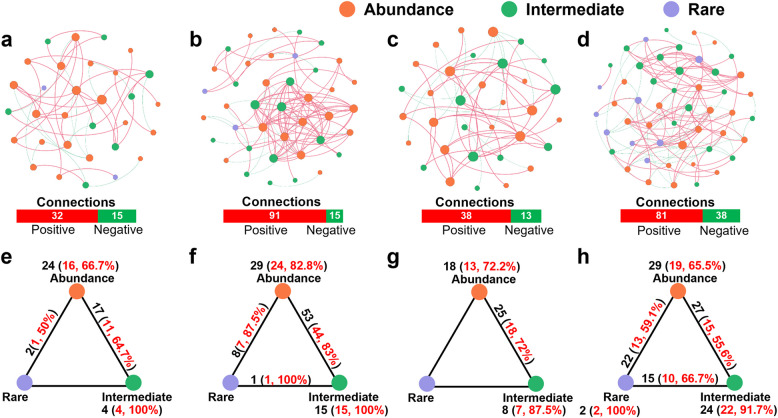
Larger pore sizes were found to increase biofilm thickness and roughness while decreasing biofilm coverage over pore spaces. An increase in pore size resulted in reduced biofilm community evenness and increased phylogenetic diversity. Remarkably, biofilms in 300-μm pore spaces displayed the highest richness and the most complex and interconnected co-occurrence network pattern. The neutral model analysis demonstrated that biofilm assembly within different pore spaces was predominantly governed by stochastic processes, while deterministic processes became more influential as pore space increased. Exometabolomic analyses of effluents from the microfluidic chips further elucidated a significant correlation between the exometabolite profiles and biofilm community structure. The increased community richness in the 300-μm pore space was associated with the significantly higher exometabolome diversity.
Collectively, our results indicate that increased pore space, which alleviated spatial constraints on biofilm development, resulted in the formation of thicker biofilms with enhanced phylogenetic and functional diversity. Video Abstract.
多孔环境构成了自然、工程和医学环境中普遍存在的微生物栖息地,为生物膜的形成提供了广阔的内表面。虽然已知多孔环境的物理结构会影响生物膜群落成员的空间组织及其种间相互作用,但其对生物膜群落结构和功能多样性的影响仍 largely 未知。本研究采用具有不同微柱直径的微流控芯片来创建不同的孔隙空间,这些孔隙空间对生物膜的形成施加了不同程度的空间限制。通过原位可视化和多组学技术研究了孔隙空间对生物膜结构、群落组装和代谢功能的影响。
发现较大的孔径会增加生物膜的厚度和粗糙度,同时降低生物膜在孔隙空间上的覆盖率。孔径的增加导致生物膜群落均匀度降低,系统发育多样性增加。值得注意的是,300μm 孔隙空间中的生物膜显示出最高的丰富度以及最复杂和相互连接的共现网络模式。中性模型分析表明,不同孔隙空间内的生物膜组装主要受随机过程控制,而随着孔隙空间的增加,确定性过程的影响变得更大。对微流控芯片流出物的胞外代谢组学分析进一步阐明了胞外代谢物谱与生物膜群落结构之间的显著相关性。300μm 孔隙空间中群落丰富度的增加与胞外代谢组多样性的显著提高相关。
总体而言,我们的结果表明,孔隙空间的增加缓解了对生物膜形成的空间限制,导致形成了具有更高系统发育和功能多样性的更厚生物膜。视频摘要。