Davenport Andrew
UCL Centre for Kidney and Bladder Health, Royal Free Hospital, University College London, London, UK.
Ther Apher Dial. 2025 Jun;29(3):471-478. doi: 10.1111/1744-9987.70012. Epub 2025 Mar 24.
Peritoneal solute transfer rates (PSTR) are reported to increase with time. Changes in PSTR were reviewed in long-term peritoneal dialysis (PD) patients to determine whether lower glucose degradation products (low GDP) dialysates prevented an increase in PSTR.
PSTR was determined with a 4-h peritoneal equilibrium test with a 2.0 L 22.7 g/L glucose dialysate.
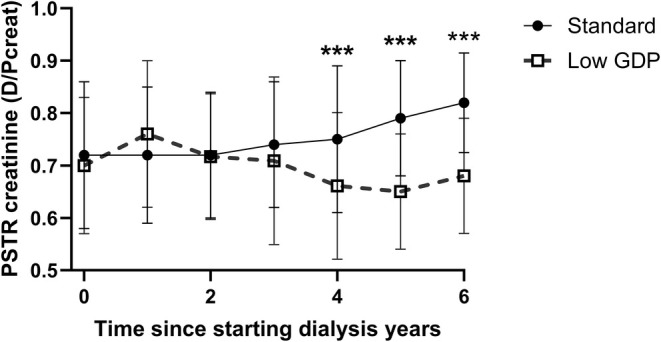
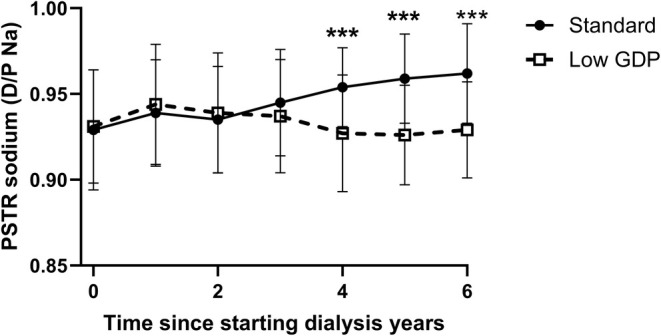
One hundred twenty-three PD patients treated for ≥4 years, 47.2% male, age 61 ± 16 years, 31.7% diabetic. Initially, 15.6% were treated with low GDP dialysates, which rose to 44.7% at 6 years. Creatinine PSTR increased with standard glucose dialysates (0.72 ± 0.1 at Year 3 to 0.79 ± 0.1 Year 5 and 0.82 ± 0.1 Year 6, p < 0.05), whereas PSTR was stable and lower with low GDP dialysates (0.71 ± 0.1, 0.65 ± 0.1, 0.68 ± 0.1); p < 0.001 for Years 5 and 6.
Exposure to standard glucose dialysates resulted in faster peritoneal solute transfer rates over time, whereas peritoneal solute transfer rates appeared more stable with lower glucose degradation products dialysates.
据报道,腹膜溶质转运率(PSTR)会随时间增加。对长期腹膜透析(PD)患者的PSTR变化进行了回顾,以确定低葡萄糖降解产物(低GDP)透析液是否能阻止PSTR升高。
采用2.0升22.7克/升葡萄糖透析液进行4小时腹膜平衡试验来测定PSTR。
123例接受透析≥4年的PD患者,男性占47.2%,年龄61±16岁,糖尿病患者占31.7%。最初,15.6%的患者使用低GDP透析液治疗,6年后这一比例升至44.7%。使用标准葡萄糖透析液时,肌酐PSTR升高(第3年为0.72±0.1,第5年为0.79±0.1,第6年为0.82±0.1,p<0.05),而使用低GDP透析液时PSTR稳定且较低(分别为0.71±0.1、0.65±0.1、0.68±0.1);第5年和第6年p<0.001。
随着时间推移,使用标准葡萄糖透析液会导致腹膜溶质转运率加快,而使用低葡萄糖降解产物透析液时腹膜溶质转运率似乎更稳定。