
软骨细胞中SCRG1的缺失通过抑制神经因子受体来促进颞下颌关节中的自噬活性,从而抑制骨关节炎。
Loss of SCRG1 in chondrocytes inhibits osteoarthritis by promoting autophagy activity in the temporomandibular joint through inhibition of neurokine receptors.
作者信息
Zhang JiaJun, Yuan LePing, Zhang YanYan, Jin HaoYang, Zhao YeKe, Zeng XiaoKe, Zou YanHui, Wang KeYu, Nie Xin
机构信息
Department of Oral and Maxillofacial Surgery, Hospital of Stomatology Wenzhou Medical University, 325027 Wenzhou, Zhejiang, China.
Department of Oral and Maxillofacial Surgery, The Third People's Hospital of Yuhang District, 311115 Hangzhou, Zhejiang, China.
出版信息
J Oral Facial Pain Headache. 2025 Mar;39(1):196-203. doi: 10.22514/jofph.2025.020. Epub 2025 Mar 12.
BACKGROUND
To investigate how scrapie responsive gene 1 (SCRG1) contributes to the development of temporomandibular joint osteoarthritis (TMJOA).
METHODS
Western blotting was used to identify protein expression. Proinflammatory cytokine levels were assessed by means of an enzyme-linked immunosorbent test. In order to find out whether chondrocytes expressed protein light chain 3B (LC3B), immunofluorescence was utilized.
RESULTS
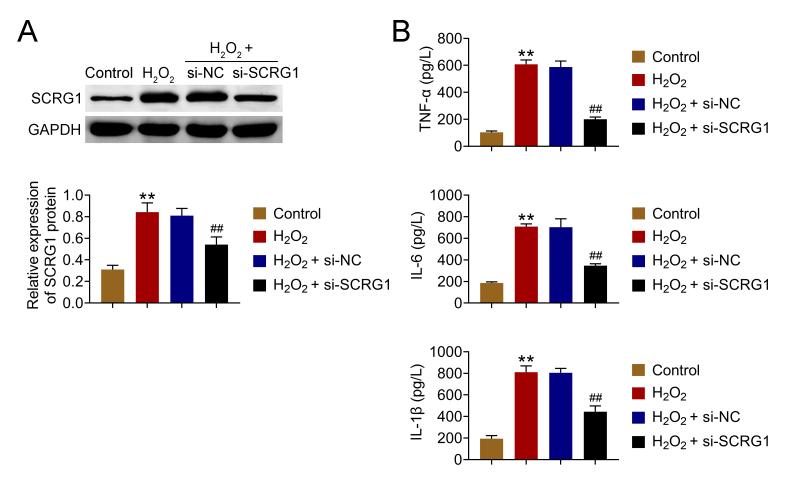
In the TMJOA model, hydrogen peroxide (HO) treatment increased the expression of SCRG1, stimulated chondrocyte catabolism and inflammatory response, and blocked autophagy. In chondrocytes, SCRG1 silencing reduces the inflammatory response, catabolism, and autophagy inhibition brought on by HO. Concurrently, HO induction triggers the nuclear factor (NF)-κB pathway and nerve growth factor receptor (NGFR). When SCRG1 is downregulated, NGFR expression is inhibited and the NF-κB pathway is blocked.
CONCLUSIONS
By inhibiting NGFR and blocking the NF-κB pathway, knocking down SCRG1 can prevent HO-induced inflammatory response, metabolic breakdown and autophagy inhibition in chondrocytes.
背景
研究瘙痒病反应基因1(SCRG1)如何促进颞下颌关节骨关节炎(TMJOA)的发展。
方法
采用蛋白质免疫印迹法鉴定蛋白质表达。通过酶联免疫吸附试验评估促炎细胞因子水平。为了确定软骨细胞是否表达微管相关蛋白1轻链3B(LC3B),采用了免疫荧光法。
结果
在TMJOA模型中,过氧化氢(HO)处理增加了SCRG1的表达,刺激了软骨细胞分解代谢和炎症反应,并阻断了自噬。在软骨细胞中,SCRG1沉默可减轻HO引起的炎症反应、分解代谢和自噬抑制。同时,HO诱导激活核因子(NF)-κB通路和神经生长因子受体(NGFR)。当SCRG1下调时,NGFR表达受到抑制,NF-κB通路被阻断。
结论
敲低SCRG1可通过抑制NGFR和阻断NF-κB通路,防止HO诱导的软骨细胞炎症反应、代谢分解和自噬抑制。




 Zotero 插件