Karakullukcu Omur Fatih, Ayhan Cihan, Kalkan Tugcenur, Okudan Bilal, Talaghir Laurentiu-Gabriel, Iconomescu Teodora Mihaela
Ministry of National Education, Ankara, Türkiye.
Department of Recreation, Sakarya University of Applied Sciences, Sakarya, Türkiye.
Front Psychol. 2025 Mar 10;16:1546405. doi: 10.3389/fpsyg.2025.1546405. eCollection 2025.
This study examined how the level of involvement influences the re-participation intentions of recreational tennis players.
To measure the participants' leisure involvement levels; the leisure involvement scale, developed by Kyle et al. (2007) and adapted to the Turkish language by Gürbüz et al. (2018) was used. The behavioral intentions scale developed by Zeithaml et al. (1996) was used to measure participants' re-participation intentions. The research group consists of a total of 327 volunteer individuals, 172 males (52.6%) and 155 females (47.4%), selected by convenience sampling method among individuals who play tennis for recreational purposes. The normality test of the data obtained was tested by checking the skewness-kurtosis values and it was determined that the data showed normal distribution. In this context, in addition to descriptive statistics, Hierarchical-Non-Hierarchical Clustering Analysis, and Univariate analyses were used in the analysis of the data.
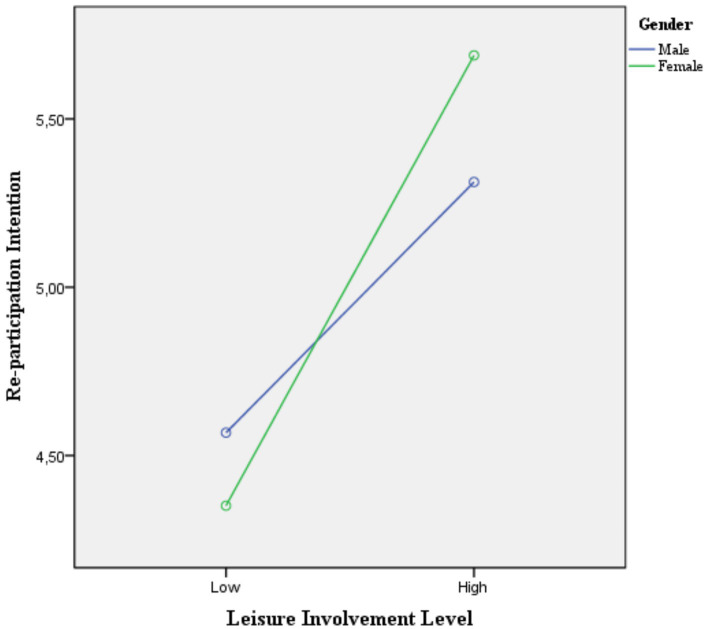
According to the research findings, it was determined that there was a statistically significant difference in the re-participation intentions of the participants who played tennis for recreational purposes according to their involvement levels.
It was observed that participants with high involvement levels had higher re-participation intentions than those with low involvement.
本研究探讨参与程度如何影响休闲网球参与者的再次参与意愿。
为测量参与者的休闲参与水平,使用了由凯尔等人(2007年)开发并经居尔布兹等人(2018年)改编为土耳其语的休闲参与量表。使用由泽伊瑟姆尔等人(1996年)开发的行为意向量表来测量参与者的再次参与意愿。研究组共由327名志愿者个体组成,其中172名男性(52.6%)和155名女性(47.4%),通过便利抽样法从以休闲为目的打网球的个体中选取。通过检查偏度-峰度值对所获数据进行正态性检验,确定数据呈正态分布。在此背景下,除描述性统计外,数据分析中还使用了层次-非层次聚类分析和单变量分析。
根据研究结果,确定以休闲为目的打网球的参与者的再次参与意愿根据其参与程度存在统计学上的显著差异。
观察到参与程度高的参与者比参与程度低的参与者有更高的再次参与意愿。